
Construction has a carbon problem, and sustainable biomaterials are one of the more practical answers on the table. These are building materials made from renewable biological sources, and they’re moving from pilot projects into mainstream design.
The range is wider than most people expect. Engineered wood products now include glulam, cross-laminated timber (CLT), dowel laminated timber, densified wood, structural composite timber, and bamboo. Then there are mycelium-based composites (MBCs), engineering materials made from lignocellulosic by-products bonded together by fungal mycelium. One is a structural workhorse, the other a newer material grown from agricultural waste. Both belong in the same conversation.
Mass timber is the clearest proof that this isn’t theoretical. It’s described as a sustainable, carbon-efficient, durable, and modern building option, and it has already had a profound impact on residential and nonresidential construction in Europe and, more recently, Canada and the United States. CLT alone can be used to build schools, apartments, campus buildings, hotels, airport terminals, and many other large structures. That’s a long way from the small-scale experiments these materials started as.
For architects, engineers, and contractors, the appeal goes beyond a lower footprint. These materials change how buildings get designed, prefabricated, and assembled, and they sit alongside other advances in the field, from composite 3D printing to lightweight alloys. As regulators lean further toward lower-carbon construction, knowing what each biomaterial can do, and where it fits, is quickly becoming a core professional skill.
Revolutionary Bio-Based Building Materials Taking Center Stage
Cross-Laminated Timber (CLT) and Engineered Wood Products
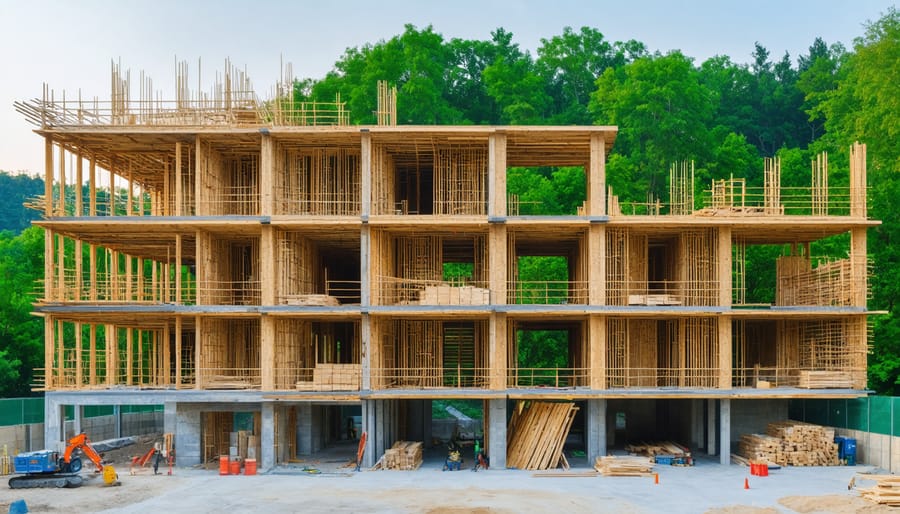
Cross-laminated timber (CLT) is one of the clearest examples of sustainable biomaterials moving from experiment to mainstream building practice. It’s an engineered wood product made from multiple layers of timber boards stacked perpendicular to each other and bonded with structural adhesives. That cross-grain layup gives the panels a strong strength-to-weight ratio and good dimensional stability.
Through advanced manufacturing techniques CLT panels reach serious structural capability while keeping the carbon-storing nature of wood. If you want to see how the panels actually come together, this overview of CLT panel manufacturing is a useful starting point. Mass timber products in general are described as a sustainable, carbon-efficient, durable, and modern building option, which explains why designers keep reaching for them.
The practical advantages are easy to list. Prefabrication shortens on-site work, cuts waste, and improves quality control, since panels are made in a controlled factory setting and then assembled on site. The material also brings a lower carbon profile than conventional structural options and good thermal performance. Fire resistance and long-term durability are the questions project teams ask most, and the answers depend on the specific product, assembly, and local code, so check them against project documentation rather than assuming a blanket result.
Adoption backs up the interest. Mass timber construction has already had a profound impact on residential and nonresidential applications in Europe and, more recently, Canada and the United States. Cross-laminated timber can be used to build schools, apartments, campus buildings, hotels, airport terminals, and many other large structures. That range of building types says a lot about how far the material has come.
CLT also isn’t alone. The family of emerging engineered wood products includes glulam, dowel laminated timber, densified wood, structural composite timber, and bamboo. Each fills a different structural niche, and they often work alongside CLT in the same building, with glulam beams and columns framing the floors and walls that CLT panels provide.
Cross-laminated timber building under construction showing layered wood panels and structural elements
Mycelium-Based Materials
Mycelium-based composites (MBCs) are engineering materials made from lignocellulosic by-products bonded with fungal mycelium. Growers combine agricultural waste with mycelium spores, and the fungus grows through the substrate as a dense network of threads that binds everything into a solid, lightweight form.
The resulting material is valued for thermal insulation and acoustic absorption. Reported densities run from roughly 60 to 300 kg/m³, depending on the cultivation process and the substrate chosen. Fire performance and long-term durability are still open questions. Anyone specifying MBCs for a real building should ask for current test data on both rather than assume the material will behave like conventional insulation.
For now, applications center on non-structural elements such as insulation panels, acoustic tiles, and decorative facades. Dell’s packaging work and the architectural installation at MoMA PS1 in New York are the best-known examples. The process itself is gentle: it needs little energy, and the finished material is biodegradable at end-of-life.
Scalability has been the main hurdle, and producers have worked on it through more automated production and standardized growth conditions. Researchers are also exploring hybrid systems that pair mycelium with traditional materials to raise structural capacity. Costs still run higher than conventional alternatives, though greater production efficiency and market demand should narrow that gap over time. Teams interested in how other novel materials are reaching construction sites can look at how composite 3D printers are revolutionizing construction.
The appeal comes down to carbon sequestration during growth, a low environmental footprint, and the ability to grow the material almost anywhere the right conditions can be set up. Mycelium won’t replace structural frames. It does offer a credible way to cut the footprint of the non-structural layers that wrap around them.
Microscopic view of mycelium growth binding agricultural waste materials
Performance Metrics That Matter
Structural Integrity and Durability
The structural integrity and durability of sustainable biomaterials have advanced significantly, meeting or exceeding the performance standards of traditional modern construction materials in numerous applications. Recent laboratory testing reveals that engineered bamboo composites demonstrate impressive compressive strength ratings of 11,000 psi, comparable to conventional concrete. Similarly, cross-laminated timber (CLT) exhibits exceptional dimensional stability with moisture content variations of less than 2% under controlled conditions.
Performance metrics from industry studies indicate that mycelium-based materials show remarkable durability, with accelerated aging tests demonstrating minimal degradation over simulated 50-year periods when properly treated. These materials maintain structural integrity while providing natural fire resistance properties, achieving Class B fire ratings without additional chemical treatments.
Engineered wood products, particularly those incorporating bio-based adhesives, have demonstrated superior load-bearing capabilities. Testing data shows that these materials can withstand cyclic loading for over 100,000 cycles without significant structural compromise, surpassing many traditional building materials in long-term performance stability.
The incorporation of natural fibers into bio-composite matrices has yielded impressive tensile strength values ranging from 290 to 510 MPa. These results, validated through extensive third-party testing, confirm their suitability for load-bearing applications in commercial construction. Furthermore, impact resistance testing reveals that certain bio-composite formulations exhibit up to 30% higher impact absorption capacity compared to conventional materials, enhancing their longevity in high-stress environments.
Environmental Impact Assessment
The environmental impact of sustainable biomaterials extends far beyond their immediate applications in construction. Lifecycle analysis (LCA) studies demonstrate that most bio-based materials exhibit significantly lower carbon footprints compared to traditional construction materials. For instance, hemp-based insulation materials typically generate 40% less CO2 emissions during production than mineral wool alternatives.
Biodegradability presents a crucial advantage in reducing end-of-life environmental impact. Many sustainable biomaterials naturally decompose within 6-24 months under proper conditions, leaving minimal ecological footprint. This characteristic particularly benefits temporary construction applications and reduces landfill burden.
Carbon sequestration capabilities further enhance the environmental profile of biomaterials. During growth, plants used for biomaterial production actively capture atmospheric CO2. Research indicates that hemp-based construction materials can sequester approximately 325kg of CO2 per cubic meter throughout their lifecycle.
Environmental assessments must consider resource consumption during production. Most biomaterials require significantly less water and energy input compared to conventional materials. For example, manufacturing mycelium-based insulation consumes 90% less energy than producing traditional foam insulation boards.
Transportation impacts also factor into environmental calculations. Local sourcing of biomaterials can substantially reduce transportation-related emissions. Studies show that utilizing regional agricultural waste for construction materials can decrease transportation emissions by up to 70% compared to traditional material supply chains.
However, comprehensive environmental assessment must account for potential drawbacks, including land use competition with food crops and the environmental impact of agricultural practices. Sustainable certification systems and responsible sourcing protocols help mitigate these concerns while ensuring optimal environmental performance throughout the material lifecycle.
Real-World Implementation Success Stories
Commercial Building Applications
Commercial buildings are increasingly incorporating sustainable biomaterials to achieve both environmental goals and enhanced occupant well-being. Leading architectural firms are utilizing mycelium-based insulation panels, which offer superior thermal properties while sequestering carbon. These innovative solutions, combined with recent structural performance innovations, are revolutionizing modern office construction.
Notable examples include the Edge Building in Amsterdam, which features bamboo-composite flooring systems and hemp-based wall panels throughout its 40,000-square-meter office space. The material selection has contributed to a 70% reduction in embodied carbon compared to traditional construction materials while maintaining superior acoustic properties and fire resistance ratings.
Retail spaces are adopting cross-laminated timber (CLT) for both structural and aesthetic purposes, with major retailers like Whole Foods implementing exposed CLT ceiling systems in their new locations. These applications demonstrate the versatility of biomaterials in meeting stringent commercial building codes while delivering sustainable performance metrics.
Recent innovations in bio-based finishing materials, such as algae-derived coatings and agricultural waste composites, are providing architects with expanded options for interior applications. These materials offer enhanced durability, low VOC emissions, and natural antimicrobial properties, making them particularly suitable for high-traffic commercial environments.
Residential Construction Innovations
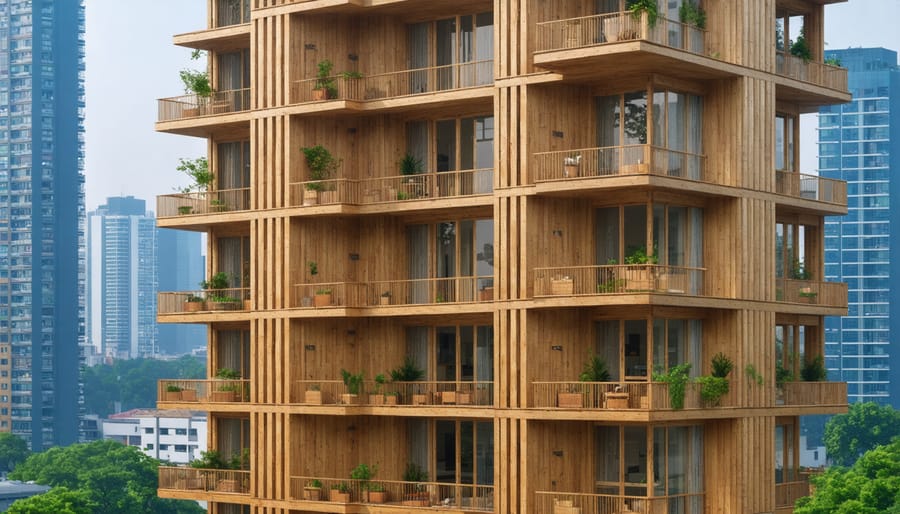
Recent residential construction projects have demonstrated remarkable innovation in biomaterial applications, offering sustainable alternatives to traditional building materials. Cross-laminated timber (CLT) structures have gained significant traction, with notable projects like the 25-story Ascent Tower in Milwaukee showcasing the material’s structural capabilities and fire resistance properties.
Mycelium-based insulation has emerged as a groundbreaking solution, providing excellent thermal performance while being completely biodegradable. In Sweden, several pilot homes have successfully implemented mycelium panels, reporting a 40% reduction in heating costs compared to conventional insulation materials.
Hemp-lime composites (hempcrete) continue to prove their worth in residential construction, particularly in load-bearing walls and interior partitions. These materials offer superior moisture regulation and carbon sequestration properties, with recent studies indicating they can absorb up to 370 kg of CO2 per cubic meter during their lifetime.
Bamboo-engineered products have revolutionized flooring and decorative applications, while advanced bio-based adhesives derived from soy and lignin have replaced traditional petroleum-based options. These innovations extend to exterior applications, where bio-composite cladding materials demonstrate exceptional weathering resistance and durability.
Modern residential projects increasingly incorporate agricultural waste products, such as rice husk ash and bagasse fiber, into concrete mixtures and particle boards, creating circular economy solutions while maintaining structural integrity and performance standards.
Who Should Choose Which
The right material depends less on which one sounds greenest and more on what you’re actually building. Here’s how the choices break down for sustainable biomaterials in residential work.
Choose cross-laminated timber if you’re building big or building up
CLT is the pick for multi-story housing, apartment blocks, and anything where structural load matters. Mass timber has already shaped residential and nonresidential building across Europe and, more recently, Canada and the United States, and CLT is used for schools, apartments, campus buildings, hotels, and airport terminals. If you’re a developer or an architect working at scale, this is the proven path. Glulam makes sense when you need long spans or exposed beams rather than full wall and floor panels.
Choose mycelium composites if insulation is the priority
Mycelium-based composites are made from lignocellulosic by-products bonded with fungal mycelium. They suit homeowners and builders focused on thermal performance and low-impact interiors, particularly in retrofits and non-structural applications. Don’t expect them to carry a roof.
Choose hempcrete or bamboo for specific jobs
- Hempcrete: best for self-builders and small projects that want breathable, carbon-absorbing walls on top of a separate structural frame.
- Bamboo: a good fit for flooring, panels, and finishes where you want a fast-renewing, modern-looking product.
Fire performance and long-term durability vary by product and assembly, so confirm both with your local code officials and the manufacturer before committing to any of these.
Future-Proofing Construction with Biomaterials
The construction industry stands at the cusp of a biomaterial revolution, with emerging technologies and research pointing towards a future where sustainable materials become the norm rather than the exception. As innovative construction technologies continue to evolve, biomaterials are playing an increasingly crucial role in shaping tomorrow’s building practices.
Recent developments in mycelium-based materials show particular promise, with researchers successfully creating structural elements that match traditional building materials in strength while offering superior insulation properties. These living materials can be grown in predetermined shapes and sizes, potentially revolutionizing prefabrication processes.
Advanced biocomposites, combining natural fibers with bio-based resins, are emerging as viable alternatives to traditional petroleum-based materials. Industry experts project that by 2030, these materials could replace up to 30% of conventional construction materials in specific applications, particularly in non-load-bearing elements and interior finishes.
Biomimetic design principles are driving innovation in structural systems, with materials that can self-heal and adapt to environmental conditions. For instance, self-repairing concrete incorporating bacterial spores has moved from laboratory testing to real-world applications, demonstrating the potential for reducing maintenance costs and extending building lifespans.
The integration of smart biosensors within biomaterials represents another frontier, enabling real-time monitoring of structural health and environmental conditions. These developments are particularly relevant for ensuring long-term durability and performance of bio-based building components.
To ensure successful implementation, the industry is developing new standards and certification processes specifically for biomaterials. These frameworks will address concerns about durability, fire resistance, and long-term performance, making it easier for architects and engineers to specify these materials with confidence.
Investment in research and development continues to grow, with major construction companies establishing dedicated biomaterial innovation centers. This commitment to advancement suggests that biomaterials will become increasingly cost-competitive and technically sophisticated, ready to meet the demands of future construction projects.
The integration of sustainable biomaterials in construction represents a critical shift toward environmentally responsible building practices while maintaining high performance standards. Throughout this exploration, we’ve seen how materials like cross-laminated timber, mycelium-based composites, and agricultural waste products offer viable alternatives to traditional construction materials.
For construction professionals looking to implement these solutions, several key considerations emerge. First, carefully evaluate the specific performance requirements of your project against the capabilities of available biomaterials. Consider factors such as load-bearing capacity, durability, and local climate conditions. Second, ensure compliance with local building codes and regulations, as standards for biomaterials continue to evolve.
Cost considerations should account for the full lifecycle of the material, including maintenance requirements and end-of-life disposal or recycling options. While initial costs may sometimes be higher, the long-term benefits often justify the investment through reduced environmental impact and potential energy savings.
Moving forward, stay informed about emerging technologies and new biomaterial developments. Establish relationships with reliable suppliers and manufacturers who can provide consistent quality and necessary documentation. Consider starting with smaller-scale applications to gain experience and build confidence in these materials.
The future of sustainable construction lies in the balanced integration of biomaterials with traditional building methods. By making informed decisions today, construction professionals can lead the industry toward a more sustainable future while meeting the demanding requirements of modern construction projects.
At-a-Glance Comparison
Choosing among sustainable biomaterials usually comes down to a few questions: what is the material made of, where does it fit in a building, and how mature is its track record? This quick comparison covers the three groups most professionals ask about in 2026.
| Material group | What it is | Typical use | Maturity |
|---|---|---|---|
| Mass timber (CLT, glulam, dowel laminated timber) | Engineered wood products built from layered or bonded timber | Schools, apartments, campus buildings, hotels, airport terminals | Established in Europe, growing in Canada and the United States |
| Other engineered biomaterials (densified wood, structural composite timber, bamboo) | Emerging wood and fiber products for structural roles | Structural and building components | Emerging |
| Mycelium-based composites | Lignocellulosic by-products bonded with fungal mycelium | Innovative engineering materials, best suited to small-scale pilots | Early stage |
The short version: mass timber is the safest starting point for large structures, since it’s already shaping residential and nonresidential projects across several regions. Mycelium composites are exciting but belong in pilot applications for now.
One caution. Durability and fire resistance vary by product and project, so confirm both with manufacturers and your local code authority before you specify anything.
What each option is
Two of the materials getting the most attention in sustainable biomaterials are mass timber and mycelium-based composites. They share a bio-based origin, but they’re different products with different jobs, so it helps to define each one before comparing them.
Mass timber
Mass timber is a family of engineered wood products built for structural work. It includes glulam and cross-laminated timber (CLT), along with newer entries such as dowel laminated timber, densified wood, structural composite timber, and bamboo. Builders choose it as a carbon-efficient, durable, and modern alternative to steel and concrete framing. CLT in particular has been used for schools, apartments, campus buildings, hotels, and airport terminals. Mass timber construction has already shaped residential and nonresidential projects in Europe and, more recently, Canada and the United States.
Mycelium-based composites
Mycelium-based composites (MBCs) work on a completely different principle. They’re engineered materials made from lignocellulosic by-products, such as agricultural residues, bonded together by fungal mycelium. The fungus acts as the natural binder, so the material is grown rather than milled or pressed. That makes MBCs a waste-stream material at heart, and it’s why they’re discussed alongside other emerging biocomposites rather than load-bearing timber.
The short version: mass timber is a proven structural system, while mycelium composites are a grown, binder-free material still finding their place in buildings. Fire resistance and long-term durability details vary by product, so check manufacturer data for any specific application.
Dimension-by-dimension comparison
Choosing between sustainable biomaterials rarely comes down to one number. A material that looks great on carbon can fall short on scale, and a promising lab result doesn’t always translate to a building site. Comparing them across a few dimensions at a time gives a clearer picture of where each one fits.
| Dimension | Engineered wood (glulam, CLT, mass timber) | Mycelium-based composites |
|---|---|---|
| Raw inputs | Timber laminated or bonded into structural products, with bamboo and densified wood also in the emerging mix | Lignocellulosic by-products bonded with fungal mycelium |
| Environmental profile | Described as carbon-efficient and sustainable | Built from by-products that would otherwise be waste |
| Building scale | Schools, apartments, campus buildings, hotels, airport terminals and other large structures | Innovative engineering material, still earlier in its adoption |
| Track record | Established in residential and nonresidential projects in Europe, and more recently Canada and the United States | Newer, with less field history to draw on |
How to read the table
Maturity is the biggest separator. Engineered wood already carries real project history, which matters when you’re dealing with approvals, insurers and clients who want precedent. Mycelium composites are interesting precisely because they turn agricultural and forestry residues into usable material, but they’re a newer proposition.
Application range also differs. Cross-laminated timber is proven in large structures, so it suits primary structure. Mycelium composites make more sense as a candidate for specific, lower-risk uses while the evidence base grows.
One gap to flag: durability and fire resistance vary by product and system, and they need to be confirmed with manufacturer data and local code requirements for your project. Don’t assume equivalence across materials.
If you’re building a sustainable biomaterials comparison for a real project, score each candidate against your own priorities, such as structural demand, code path and supply, then pilot the winner on a small scale first.
