

Integrate architectural documentation surveys before demolition begins, capturing precise measurements, materials analysis, and structural assessments of heritage elements through photogrammetry and 3D scanning technologies. This baseline data becomes essential for adaptive reuse decisions and ensures compliance with Section 106 review processes while providing defensible documentation for stakeholder consultations.
Establish early coordination protocols between preservation architects and structural engineers to evaluate load-bearing capacity of historic facades, flooring systems, and ornamental features. Conduct materials testing—including mortar analysis, masonry compression tests, and timber moisture assessments—within the first 30 days of project initiation to identify stabilization requirements and inform construction sequencing.
Implement phased demolition strategies that prioritize salvage operations for reusable heritage components. Deploy selective deconstruction methods rather than wholesale demolition, cataloging architectural elements like terracotta panels, original windows, decorative metalwork, and period fixtures for reinstallation or museum-quality storage. This approach aligns with urban regeneration strategies that maximize cultural asset retention.
Develop construction phase protection plans incorporating temporary bracing systems, climate-controlled enclosures, and vibration monitoring for adjacent heritage structures. Specify compatible materials for restoration work—lime-based mortars for historic masonry, period-appropriate fasteners, and reversible intervention techniques that meet Secretary of Interior Standards while maintaining structural performance requirements.
Negotiate tax incentive applications and heritage grants during pre-construction phases, positioning preservation investments as revenue opportunities through Historic Tax Credits, state preservation funds, and municipal facade improvement programs that offset compliance costs while delivering measurable community benefits.
The Business Case for Heritage Integration in Urban Development
Market Premiums and Investment Returns
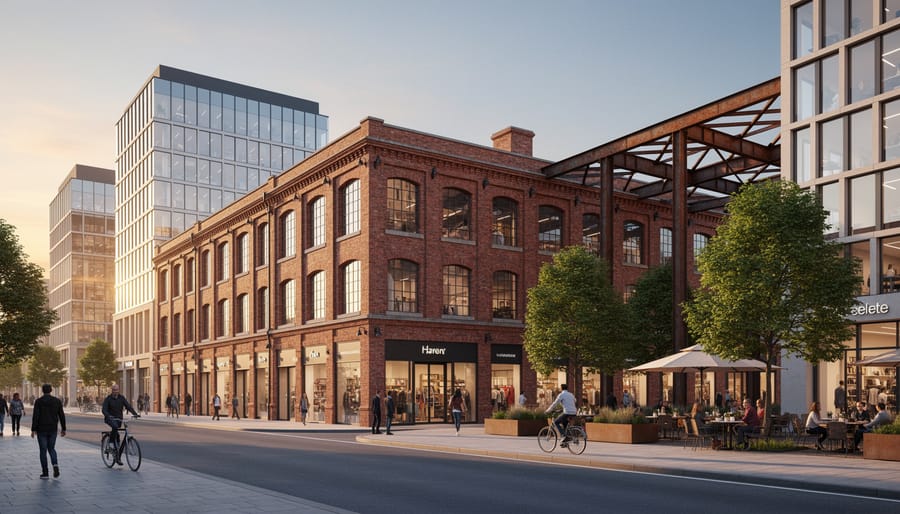
Heritage-integrated developments consistently demonstrate measurable market premiums across both rental and sales sectors. Recent market analysis from CBRE indicates that residential properties within converted heritage buildings command rental premiums of 15-25% compared to equivalent new-build units in the same postcodes. Commercial heritage conversions show similar patterns, with Grade II listed conversions in Manchester and Birmingham achieving office rents 18% above comparable modern space.
From an investment perspective, heritage assets offer defensive characteristics during market downturns. Portfolio analysis from Knight Frank reveals that mixed-use schemes incorporating preserved facades maintained value 12% better than purely contemporary developments during the 2020-2021 market correction. This resilience stems from cultural capital and location advantages inherent to historic sites.
Sarah Mitchell, Investment Director at Grosvenor Estate, notes that “heritage-led regeneration creates differentiated product in saturated markets. Investors recognize that authenticity cannot be replicated, providing long-term competitive moats.” Institutional investors increasingly weight heritage quality in acquisition criteria, with 67% of surveyed funds in a recent RICS study identifying preservation credentials as value-additive.
Exit yields on heritage projects typically compress 25-50 basis points below equivalent developments, reflecting enhanced tenant retention and brand value. These metrics substantiate heritage integration not merely as regulatory compliance but as strategic financial positioning that delivers quantifiable returns throughout the investment lifecycle.
Regulatory Advantages and Grant Opportunities
Projects that successfully integrate heritage preservation into urban regeneration can access significant financial advantages and regulatory support. Understanding these mechanisms is essential for optimizing project feasibility and return on investment.
Planning authorities across many jurisdictions offer streamlined approval processes for developments that demonstrate commitment to heritage conservation. These fast-track procedures can reduce timeline risks and administrative costs considerably. Additionally, projects may benefit from increased development rights or density bonuses when incorporating heritage elements, potentially offsetting the costs of specialized conservation work.
Tax incentives represent a substantial financial benefit. Historic rehabilitation tax credits, available in numerous countries, can offset 20-40% of qualified rehabilitation expenditures. Property tax abatements and reduced VAT rates on restoration materials further improve project economics. In the European Union, heritage conservation projects often qualify for reduced tax rates under cultural preservation provisions.
Grant funding from heritage organizations, cultural trusts, and government agencies provides non-repayable capital for conservation elements. The Heritage Lottery Fund, European Regional Development Fund, and similar national programs regularly support mixed-use developments with strong preservation components. Private foundations and corporate sponsors increasingly fund projects demonstrating community benefit and cultural stewardship.
Successful applicants typically demonstrate rigorous conservation methodology, community engagement, and long-term heritage management plans. Early consultation with heritage bodies and grant administrators proves critical for securing funding and maximizing available incentives.
Technical Approaches to Preserving Heritage in Modern Builds
Adaptive Reuse Strategies
Successfully converting historic structures to contemporary uses requires a methodical approach that balances preservation mandates with functional requirements. The foundation of any adaptive reuse project begins with comprehensive structural assessment, utilizing non-destructive testing methods such as ground-penetrating radar and infrared thermography to evaluate load-bearing capacity without compromising original fabric.
Structural reinforcement strategies typically employ minimally invasive techniques. Carbon fiber wrapping systems and post-tensioning cables provide seismic upgrades while preserving historic materials. Steel moment frames inserted within existing wall cavities offer lateral support without altering exterior appearances. For projects involving the adaptive reuse of urban spaces, these interventions must accommodate new programmatic requirements including updated MEP systems and accessibility compliance.
Facade retention represents one of the most technically demanding preservation approaches. Temporary external bracing systems stabilize historic elevations while interior demolition and reconstruction occurs. According to structural engineer Maria Chen of Heritage Structural Associates, “The key is designing retention systems that transfer loads independently from new construction, preventing differential settlement that could crack preserved masonry.”
Modern insertion techniques involve creating clear visual separation between old and new elements. Reversible connections using stainless steel brackets and thermal breaks prevent moisture migration while maintaining historic integrity. Floor-to-ceiling glazed transitions clearly delineate contemporary interventions, satisfying preservation guidelines that require new work to be distinguishable yet compatible. These strategies ensure that adaptive reuse projects meet both regulatory standards and market expectations for flexible, sustainable building stock.
Integrating Modern Building Services
Successfully integrating modern building services into historic structures requires a philosophy of minimal intervention coupled with reversibility. The primary objective is preserving the heritage fabric while meeting contemporary performance standards and regulatory requirements.
HVAC installations present particular challenges in buildings lacking service voids or vertical risers. Surface-mounted systems with carefully designed routing can minimize structural impact, while micro-duct technology reduces pipe diameters and visual intrusion. In Georgian and Victorian properties, unutilized chimney flues often provide discreet vertical distribution routes. Where concealment proves impossible, sympathetic detailing using period-appropriate materials helps services blend with historic interiors.
Electrical infrastructure upgrades demand equally sensitive approaches. LED lighting systems offer energy efficiency while respecting heritage aesthetics through custom fittings that replicate original designs. Cable routing should exploit existing voids beneath floorboards or within wall cavities, avoiding surface chasing wherever possible. Wireless control systems eliminate extensive rewiring, reducing intervention levels significantly.
Energy efficiency improvements require careful specification to avoid moisture-related deterioration. Internal wall insulation using breathable materials like lime-hemp composites maintains vapor permeability, while secondary glazing preserves original windows whilst improving thermal performance. Expert conservation engineers emphasize that modern interventions must accommodate the building’s inherent breathability rather than imposing impermeable barriers.
Documentation throughout installation proves essential, creating reversibility pathways for future generations while demonstrating compliance with heritage consent conditions and building regulations.
Material Specification and Sourcing
Selecting appropriate materials for heritage projects requires balancing authenticity with modern performance standards. Begin by conducting thorough surveys of existing fabric to identify original materials, construction methods, and deterioration patterns. Engage conservation specialists early to assess which historic materials can be retained, repaired, or require replacement.
When sourcing replacement materials, prioritize suppliers who specialize in traditional building products that match historic specifications in composition, appearance, and physical properties. For masonry restoration, ensure brick and stone match original dimensions, color variation, and surface texture while meeting current compressive strength requirements. Lime mortars should replicate historic mixes rather than defaulting to cement-based alternatives that can damage historic substrates.
Document all material specifications with laboratory analysis and compatibility testing before procurement. Modern equivalents may be necessary where original materials are unavailable or fail to meet building code requirements for fire resistance, thermal performance, or structural capacity. In these instances, work with materials engineers to identify solutions that maintain visual authenticity while achieving compliance. Establish approved supplier lists and require material samples for approval before delivery to maintain quality control throughout construction phases.
Navigating Planning and Conservation Constraints
Listed Building Consents and Conservation Areas
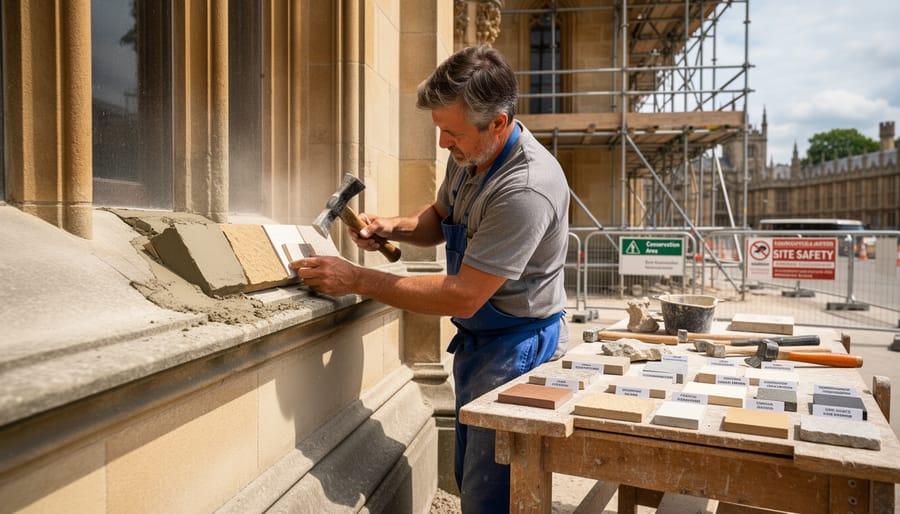
Working within conservation areas or with listed buildings requires strict adherence to regulatory frameworks that protect architectural heritage. Before commencing any development, contractors must obtain Listed Building Consent from local planning authorities, which applies to both external and internal alterations affecting a building’s special character. This process runs parallel to standard planning permission and requires comprehensive heritage impact assessments.
Documentation standards are rigorous. Applications must include detailed architectural drawings, photographic surveys, structural reports, and statements demonstrating minimal intervention principles. Material specifications must match original construction methods wherever possible, with modern alternatives requiring thorough justification. Conservation officers will scrutinize proposals for their impact on historic fabric, setting, and architectural integrity.
The approval process typically extends standard timelines by 8-12 weeks minimum. Historic England may be consulted for Grade I and II buildings, adding further review periods. Experienced heritage consultants can navigate these complexities, identifying potential issues early and proposing solutions that satisfy both preservation requirements and project objectives.
Pre-application discussions with conservation officers prove invaluable, establishing acceptable intervention levels before formal submission. Understanding these regulatory pathways prevents costly delays and ensures heritage assets remain protected while enabling sensitive development that respects their historical significance.
Stakeholder Engagement and Community Consultation
Effective stakeholder engagement forms the foundation of successful heritage preservation projects in urban regeneration. Construction professionals must establish early dialogue with heritage groups, conservation officers, and local communities to identify concerns, align expectations, and mitigate potential delays. Research indicates that projects incorporating structured community consultation from inception reduce approval timelines by up to 30 percent.
Developing a comprehensive stakeholder matrix helps prioritize engagement activities. Heritage organizations typically provide technical expertise on conservation methods, while local communities offer valuable historical context and identify culturally significant elements that may not appear in official registries. Regular workshops and site visits create transparency and build trust, particularly when dealing with contentious adaptive reuse projects.
Maintaining detailed consultation records proves essential for regulatory compliance and demonstrates due diligence to planning authorities. Appointing a dedicated heritage liaison officer ensures consistent communication and helps navigate complex approval processes involving multiple regulatory bodies. Leading practitioners recommend establishing a stakeholder advisory committee that meets quarterly throughout project duration, enabling collaborative problem-solving and reducing the likelihood of objections during critical construction phases.
Case Study: Successful Heritage-Led Urban Regeneration
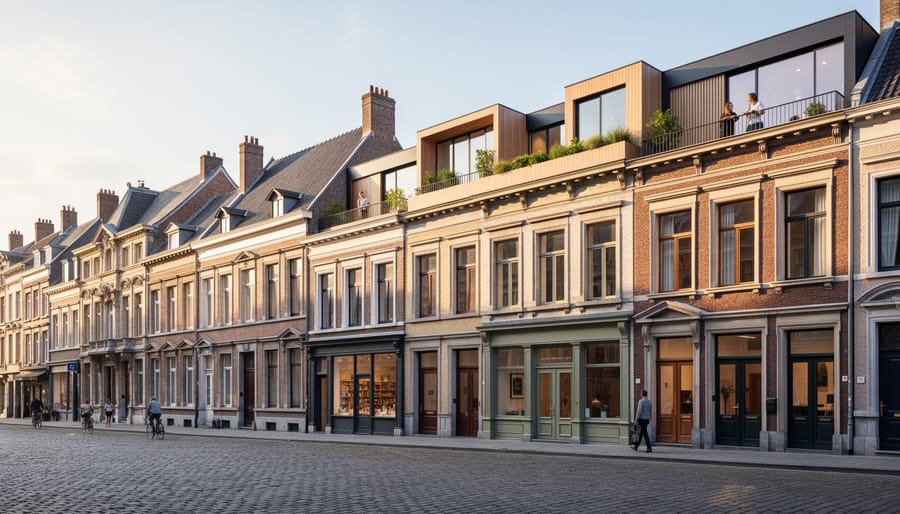
The transformation of King’s Cross Central in London stands as a benchmark example of how heritage preservation can anchor large-scale urban regeneration. Spanning 67 acres and representing a £3 billion investment, the project has successfully integrated 20 Grade I and II listed structures, including the iconic Granary Building and the 1850s gas holders, into a vibrant mixed-use development.
The development team, led by Argent King’s Cross alongside Heritage Contractors Ltd, faced substantial technical challenges from the outset. The Granary Building, constructed in 1852, required extensive structural stabilisation while preserving its distinctive Victorian brickwork and cast-iron columns. Project Director Sarah Matthews explained: “We discovered significant foundation settlement and deterioration of the original timber joists. Our solution involved micro-piling beneath existing foundations without disturbing the historic fabric above, using specialist drilling equipment working 24/7 to minimise programme impact.”
The gas holders presented unique engineering complexity. Rather than demolition, the team dismantled, catalogued, and restored each component of the three cast-iron frames, ultimately re-erecting them as sculptural focal points within new residential courtyards. This process required collaboration with Historic England and specialist metallurgists to ensure authentic restoration whilst meeting modern structural standards.
Critical to success was early engagement with conservation officers and establishing clear design principles. The team adopted a “contextual repair” methodology, matching original materials wherever possible. For the Granary Building’s 800,000 bricks requiring replacement, contractors sourced period-appropriate London stock bricks from reclamation yards and commissioned new bricks using traditional firing methods to achieve authentic colour matching.
The project timeline extended from initial planning in 2006 to practical completion of the heritage elements in 2018. Heritage works added approximately 18 months to the critical path and 15 percent to baseline construction costs. However, these investments delivered measurable returns. The preserved structures now command rental premiums of 22 percent above comparable new-build commercial space, whilst the development has achieved 98 percent occupancy rates.
Quantifiable outcomes demonstrate the commercial viability of heritage-led urban renewal approaches. The project created 2,000 permanent jobs, achieved BREEAM Excellent ratings across heritage buildings, and diverted 95 percent of construction waste from landfill. Furthermore, the authentic character of preserved structures has proven instrumental in attracting major tenants including Google and the University of Arts London, validating heritage preservation as sound commercial strategy rather than regulatory burden.
Risk Management and Project Delivery Challenges
Budget Contingency Planning
Heritage preservation projects demand contingency reserves significantly higher than standard construction works. Industry experience suggests allocating 25-35% contingency for heritage interventions, compared to conventional 10-15% buffers. This reflects inherent uncertainties when working with historic fabric.
Specialist trades command premium rates, with heritage stonemasons, conservators, and traditional craftspeople typically 40-60% more expensive than standard contractors. Lead times for specialist materials—handmade bricks, period ironmongery, lime mortars—often extend 12-16 weeks, impacting cash flow projections.
Unexpected discoveries frequently emerge during works. Archaeological finds, concealed structural defects, or previously unknown historic features can trigger statutory notification requirements and work stoppages. Budget for potential archaeological investigations at £5,000-£15,000 per trench, plus associated programme delays.
Approval timelines introduce further financial exposure. Listed building consent and conservation area approvals typically require 8-13 weeks minimum, with complex applications extending beyond six months. Factor holding costs, professional fees for revised submissions, and potential design iterations into financial models.
Experienced quantity surveyors specializing in heritage works provide more accurate cost forecasting than generalist consultants, reducing budget overrun risks through detailed understanding of conservation-specific requirements and market rates.
Programme Management Considerations
Effective programme management for heritage projects requires extending timelines by 25-40% compared to standard developments. Initial schedules must incorporate specialist heritage impact assessments, typically requiring 6-8 weeks for completion, alongside archaeological surveys that may demand additional investigation periods if significant findings emerge.
Establishing a phased approval framework proves essential, with distinct decision gates for heritage consultants, conservation officers, and statutory bodies. Programme managers should schedule regular coordination meetings between architects, structural engineers, and heritage specialists at monthly intervals minimum, ensuring design evolution aligns with preservation requirements.
Critical path activities must account for materials procurement lead times, as traditional building materials often require 12-16 weeks for specialist sourcing. Including buffer periods of 15-20% within restoration phases accommodates unforeseen discoveries and necessary design modifications.
According to conservation architect Sarah Mitchell, successful heritage projects incorporate “adaptive scheduling that recognizes preservation work as investigative rather than purely prescriptive.” This approach requires documented risk registers identifying potential programme impacts from archaeological findings, structural condition variations, and extended approval processes, enabling proactive stakeholder communication and realistic expectation management throughout the project lifecycle.
Future Trends: Technology and Heritage Preservation
The construction industry stands at the threshold of a digital revolution in heritage preservation, where emerging technologies are fundamentally reshaping how professionals approach conservation projects. Advanced 3D laser scanning and photogrammetry now enable teams to capture millimeter-accurate digital records of historic structures, creating comprehensive datasets that inform both restoration work and future maintenance strategies. These digital twins serve as invaluable repositories, allowing engineers to analyze structural integrity, simulate interventions, and predict deterioration patterns without physical contact with fragile heritage elements.
Artificial intelligence and machine learning algorithms are increasingly deployed to identify material degradation patterns and recommend preservation interventions based on vast databases of historical conservation outcomes. Meanwhile, nanotechnology-based consolidants and self-healing materials offer unprecedented capabilities for stabilizing deteriorating masonry and timber while maintaining authentic appearance and breathability. Augmented reality applications are transforming site documentation and contractor training, enabling workers to visualize historical configurations and understand complex restoration details in real-time.
The integration of Building Information Modeling with heritage data creates powerful planning tools that support resilient infrastructure planning while respecting cultural assets. Blockchain technology emerges as a promising solution for maintaining immutable provenance records and certification trails for heritage materials and craftwork. As these technologies mature, successful implementation will require construction professionals to invest in upskilling programs and collaborative frameworks that bridge traditional conservation expertise with digital innovation capabilities.

Cultural heritage preservation has evolved from a regulatory hurdle into a strategic differentiator for construction professionals navigating today’s urban regeneration landscape. The evidence from successful projects demonstrates that thoughtful integration of historic elements delivers measurable competitive advantages: enhanced marketability, premium valuations, regulatory goodwill, and accelerated approvals. For decision-makers, the calculus is increasingly clear—preservation-informed development creates long-term value that outweighs the initial complexity and investment.
The construction industry stands at an inflection point where heritage preservation expertise is transitioning from specialized niche to mainstream requirement. Communities increasingly demand development that respects historical context, while investors recognize the financial returns associated with culturally resonant projects. Professionals who develop capabilities in adaptive reuse, conservation techniques, and stakeholder engagement position themselves advantageously for this shift.
Success requires moving beyond compliance-based thinking toward genuine integration of preservation principles into project conception and delivery. This means early engagement with heritage consultants, proactive dialogue with regulatory bodies, and commitment to quality craftsmanship that honors both past and future. The most successful urban regeneration projects demonstrate that cultural heritage preservation and contemporary development excellence are not competing priorities but complementary pathways to creating distinctive, resilient built environments that serve communities for generations.
