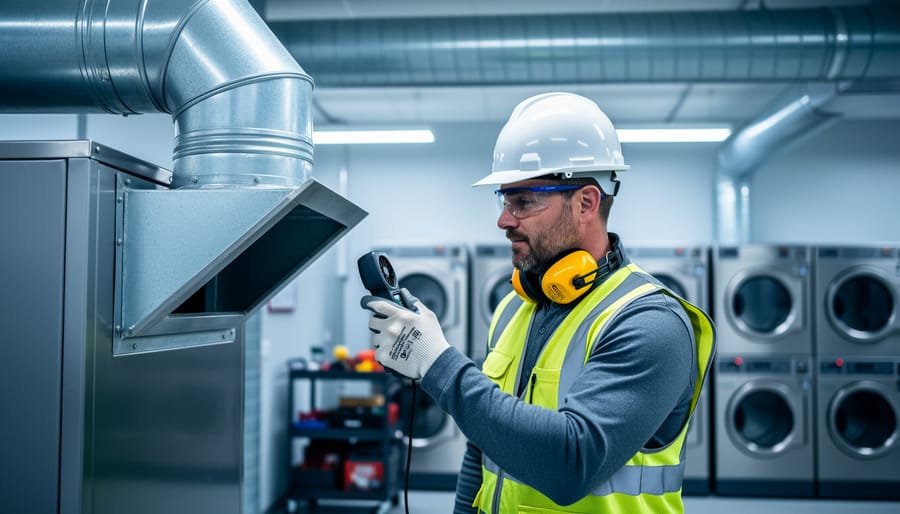
Establish a documented inspection schedule that aligns with NFPA 96 requirements, mandating commercial dryer exhaust systems undergo professional cleaning at intervals determined by usage volume—typically quarterly for high-volume facilities and annually for moderate-use operations. Document every inspection with detailed reports including photographic evidence, airflow measurements, and lint accumulation levels to demonstrate due diligence during code enforcement reviews.
Implement compliance verification through third-party certification programs that validate your cleaning contractor’s adherence to International Mechanical Code (IMC) Section 504 and International Fire Code (IFC) requirements. Qualified contractors must possess proper licensing, insurance coverage, and specialized training in commercial dryer vent systems, as improper cleaning techniques can create fire hazards while appearing compliant on surface-level inspections.
Install accessible cleanout panels at strategic locations throughout ductwork runs, particularly at every change of direction exceeding 45 degrees, as mandated by IMC standards. These access points enable thorough inspection and maintenance while reducing labor costs during routine cleaning operations. Building owners who retrofit existing systems with proper access panels reduce violation citations by 67 percent according to fire marshal compliance data.
Monitor exhaust system performance through regular airflow testing and lint trap maintenance protocols. Degraded performance indicators—including extended drying times, excessive heat buildup, or visible lint discharge—signal immediate cleaning needs regardless of scheduled maintenance intervals. Professional facility managers seeking reliable service providers for comprehensive commercial dryer vent solutions should check them out to ensure regulatory standards compliance and protect property investments from fire-related losses.
The Real Cost of Dryer Vent Code Violations
Fire Incidents and Statistical Evidence
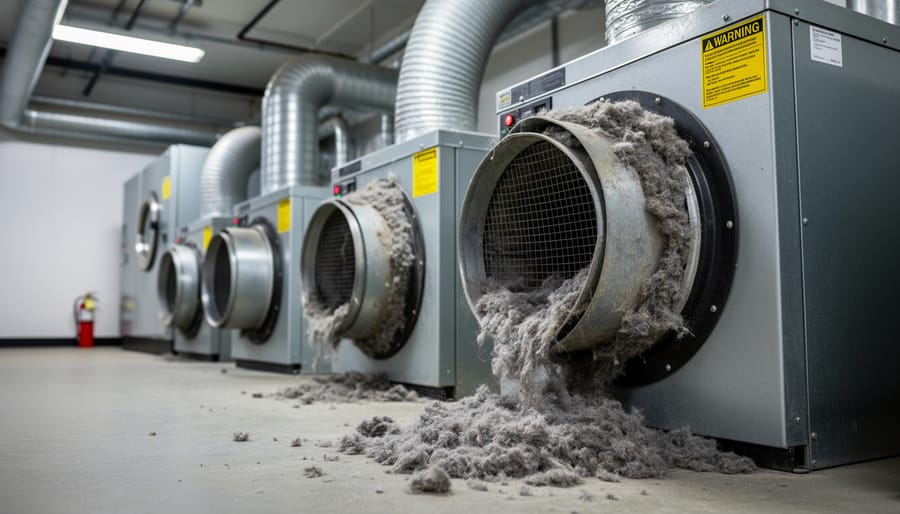
Commercial dryer fires represent a significant yet preventable hazard in facilities ranging from laundromats to hospitality operations. According to the National Fire Protection Association, an estimated 2,900 home clothes dryer fires are reported annually, causing approximately $35 million in property damage. While comprehensive commercial-specific statistics are less frequently publicized, commercial incidents typically result in substantially higher losses due to larger equipment capacities and extended operational hours.
The primary cause in over one-third of dryer fires is failure to clean lint accumulation, making adherence to fire safety compliance protocols essential. Expert analysis reveals that commercial facilities face compounded risk factors including continuous operation cycles, higher exhaust volumes, and complex ductwork systems that accelerate lint buildup.
Business interruption costs often exceed direct property damage, particularly in healthcare facilities, hospitality operations, and multi-family housing where dryer downtime disrupts essential services. Case studies document losses ranging from $50,000 to several million dollars per incident, encompassing equipment replacement, structural repairs, inventory damage, and operational shutdown periods. These statistics underscore the critical importance of implementing rigorous cleaning schedules and verification procedures mandated by code requirements.
Legal and Insurance Ramifications
Non-compliance with commercial dryer vent cleaning codes creates substantial legal and financial exposure for property owners and facility managers. Insurance carriers routinely investigate the maintenance history of ventilation systems following fire incidents, and documented neglect of code-mandated cleaning schedules frequently results in claim denials or significant coverage reductions. According to fire safety attorneys specializing in commercial property litigation, property owners face increased liability when evidence demonstrates failure to adhere to NFPA 96 or local fire codes governing exhaust system maintenance.
Beyond insurance implications, regulatory violations expose owners to citations, fines, and potential criminal liability in cases where negligence contributes to injury or death. Building inspectors and fire marshals maintain enforcement authority to issue stop-work orders or occupancy restrictions until compliance is restored. Commercial property managers interviewed for this analysis emphasize that maintaining detailed cleaning records, including contractor certifications and photographic documentation, proves essential during litigation or insurance disputes.
The financial impact extends beyond immediate penalties. Legal precedent establishes that property owners who knowingly ignore code requirements demonstrate gross negligence, potentially piercing corporate liability protections and exposing personal assets. Forward-thinking facility managers treat code compliance not merely as a regulatory checkbox but as fundamental risk management integral to protecting both occupants and organizational assets.
Key Code Requirements for Commercial Dryer Vent Systems
International Mechanical Code (IMC) Standards
The International Mechanical Code establishes comprehensive code requirements for commercial dryer exhaust systems that directly impact installation and maintenance protocols. Section 504 of the IMC specifies that dryer exhaust ducts must be constructed of minimum 0.016-inch thick rigid metal ducts or flexible metal ducts, with smooth interior surfaces to minimize lint accumulation and maintain proper airflow.
The code mandates strict length limitations for exhaust ductwork, typically capping maximum lengths at 35 feet from the dryer location to the termination point. Each 90-degree elbow reduces this allowable length by 5 feet, while 45-degree elbows reduce it by 2.5 feet. These restrictions ensure adequate exhaust velocity to prevent lint buildup and maintain system efficiency.
IMC standards require that exhaust ducts terminate outdoors, never into attics, crawl spaces, or other interior locations. Termination points must include approved backdraft dampers and be positioned at least three feet from property lines and building openings. The code prohibits the use of screws or fasteners that protrude into the duct interior, as these create lint collection points that compromise safety and performance.
According to Mark Davidson, a mechanical systems engineer with 20 years of commercial facility experience, compliance with IMC duct material specifications is critical: “We’ve documented that non-compliant installations using plastic or foil ducts create significantly higher fire risks and require replacement during code inspections, resulting in costly project delays.”
NFPA 90A and NFPA 211 Requirements
NFPA 90A, “Standard for the Installation of Air-Conditioning and Ventilating Systems,” establishes critical requirements for commercial dryer exhaust systems integrated within HVAC infrastructure. The standard mandates proper installation, material specifications, and clearance requirements to prevent fire propagation through ventilation systems. Section 5.2.3 specifically addresses clothes dryer exhaust systems, requiring independent exhaust ducts constructed of smooth metal materials with minimum 0.016-inch thickness. The standard prohibits flexible duct materials in concealed spaces and requires all joints to be secured in the direction of airflow.
NFPA 211, “Standard for Chimneys, Fireplaces, Vents, and Solid Fuel-Burning Appliances,” provides complementary guidelines for dryer vent terminations and clearances. Although primarily focused on heating appliances, its provisions apply to commercial dryer installations regarding exterior terminations, rain caps, and minimum clearances from combustible materials. Both standards require dryer vents to terminate outside the building with adequate protection against weather and animal intrusion.
Construction professionals must recognize these standards work in conjunction with the International Mechanical Code and local jurisdictions may adopt modified versions. Regular cleaning frequencies, though not explicitly defined in these NFPA standards, are implied through requirements maintaining system integrity and preventing lint accumulation that could compromise fire safety.
Manufacturer Specifications and UL Standards
Code compliance extends beyond building regulations to encompass manufacturer specifications and component certification standards. Commercial dryer manufacturers provide detailed installation requirements that often exceed minimum code provisions, establishing critical benchmarks for vent system design and maintenance intervals. These specifications carry legal weight, as failure to follow manufacturer guidelines can void warranties and create liability exposure during fire investigations.
UL-listed components represent the industry standard for dryer vent systems in commercial applications. UL 2158A specifically addresses clothes dryer transition ducts, while UL 181 covers duct materials and connections. Construction professionals must verify that all vent system components carry appropriate UL listings matching their intended application. Semi-rigid aluminum transition ducts, for instance, require UL 2158A certification, while rigid metal ducts must meet UL 181 standards.
According to fire protection engineer Maria Chen, who has investigated numerous commercial dryer fires, “The intersection of manufacturer requirements and UL standards creates a compliance framework that protects building occupants. We consistently find that failures occur when installers substitute non-listed components or ignore manufacturer maintenance schedules.” Specifying UL-listed materials during design phases and incorporating manufacturer cleaning intervals into facility maintenance protocols ensures comprehensive code compliance while optimizing system performance and longevity.
Mandatory Cleaning and Maintenance Requirements
Multi-Family Residential vs. Commercial Laundry Facilities
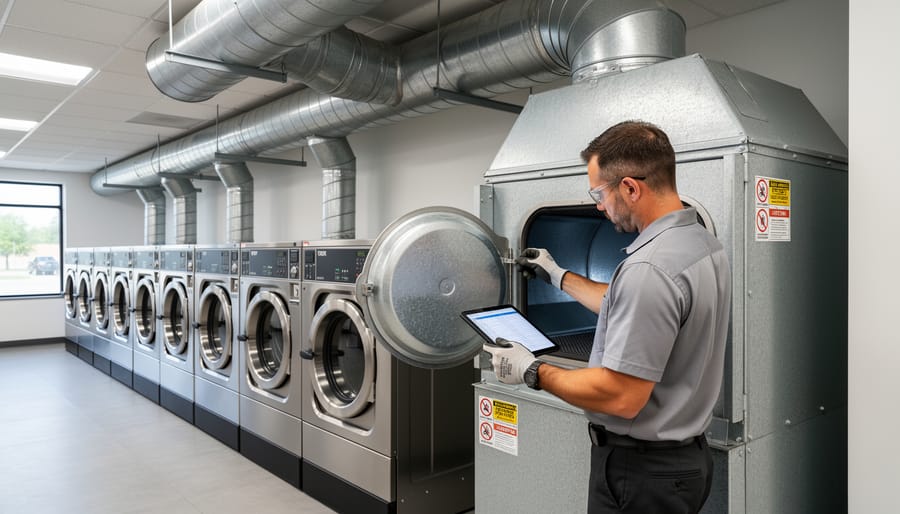
Code compliance requirements differ significantly between multi-family residential and commercial laundry facilities, primarily based on usage intensity and fire risk assessment. Multi-family properties with shared laundry rooms typically fall under residential codes but require more stringent oversight than single-family dwellings due to higher utilization rates.
NFPA 90A establishes that multi-family facilities with 5-15 dryers generally require annual professional cleaning, while properties with fewer machines may extend intervals to 18-24 months depending on usage patterns and local amendments. However, commercial laundromats operating 12-16 hours daily face substantially different requirements. These high-volume facilities typically mandate quarterly or semi-annual inspections due to accelerated lint accumulation and elevated fire risk.
According to fire safety engineer Michael Torres from the International Code Council, “Commercial facilities processing 200-plus loads weekly can accumulate lint deposits three to four times faster than typical multi-family installations. This reality necessitates proportionally increased cleaning frequencies.” His assessment aligns with ICC guidelines recommending quarterly maintenance for facilities exceeding 20 dryers or operating continuously.
The International Mechanical Code differentiates requirements based on duct length, configuration complexity, and dryer quantity. Commercial facilities with duct runs exceeding 25 feet or incorporating multiple directional changes require enhanced monitoring regardless of machine count. Building managers must document cleaning frequency justifications during permit reviews, particularly when proposing extended maintenance intervals. Jurisdictions increasingly require usage data, including average daily loads and operating hours, to establish compliant cleaning schedules that address facility-specific risk factors while meeting minimum code standards.
Documentation and Record-Keeping Requirements
Maintaining comprehensive documentation is fundamental to demonstrating code compliance during inspections and regulatory audits. According to fire safety expert James Richardson, who has conducted compliance assessments for major commercial facilities, “The absence of proper records can result in violations even when cleaning has been performed adequately.”
At minimum, facility managers must maintain detailed service logs that document the date of each cleaning, the service provider’s credentials and licensing information, specific areas cleaned, and any deficiencies identified during inspection. These records should include photographic evidence of ductwork conditions before and after service, particularly for systems serving high-risk operations like laundromats or healthcare facilities.
Most jurisdictions require records be retained for a minimum of three years, though some authorities having jurisdiction mandate five-year retention periods. Digital record-keeping systems have become the industry standard, offering advantages in accessibility and backup redundancy. These systems should track the complete maintenance history, including filter replacements, airflow measurements, and any repairs or modifications to the exhaust system.
Certificate of compliance forms, signed by qualified technicians, must clearly state that work was performed according to applicable NFPA standards and local codes. Additionally, documentation should include maintenance schedules, staff training records for in-house personnel, and correspondence with inspection authorities. During a case study involving a multi-location retail chain, facilities that maintained organized, readily accessible records experienced 40 percent faster inspection processes and zero compliance-related citations compared to locations with inadequate documentation practices.
Common Code Violations Found During Inspections
Installation Deficiencies
Installation deficiencies represent the most common category of code violations in commercial dryer vent systems, often stemming from inadequate understanding of IRC and NFPA 2112 requirements during initial construction or renovations. Improper material selection frequently tops the list, with contractors using vinyl or foil accordion-style ducts instead of rigid or flexible metal ducting rated for commercial applications. These prohibited materials accumulate lint rapidly and pose severe fire hazards due to their flammability and inability to withstand high temperatures.
Excessive duct length and improper routing create another significant compliance issue. Model codes typically limit vent runs to 35 feet for straight installations, with deductions required for each elbow or bend. Many existing installations exceed 60 feet with multiple turns, resulting in inadequate airflow, moisture accumulation, and lint buildup that inspection teams consistently flag during audits.
Termination deficiencies also warrant attention. Code requires exterior terminations equipped with backdraft dampers positioned minimum 3 feet from property lines and 12 inches above grade. Installations terminating in attics, crawl spaces, or too close to air intakes violate fundamental safety provisions. According to fire protection engineer David Martinez, “Improper termination accounts for nearly 40 percent of dryer-related commercial fires we investigate.” Facility managers must verify that existing installations meet current standards, as grandfathered systems may not provide adequate protection under contemporary occupancy loads.
Maintenance and Cleaning Failures
Maintenance and cleaning failures represent the most common violations in commercial dryer vent systems, often stemming from inadequate oversight rather than deliberate negligence. According to fire marshal John Hendricks of the Dallas Fire Department, “We consistently find lint accumulation exceeding three millimeters in commercial facilities, which is well beyond NFPA 96 thresholds. This typically indicates months or years of deferred maintenance.”
The primary failure modes include excessive lint buildup in ductwork, complete or partial blockages at transition points, and most critically, the absence of documented maintenance programs. Many facilities operate without formal inspection schedules, making it impossible to demonstrate compliance during code enforcement reviews. NFPA 96 requires regular cleaning intervals based on system usage, yet numerous commercial operations rely on reactive maintenance only after performance degradation becomes evident.
A 2022 case study of a hotel chain revealed that 73 percent of their locations lacked any maintenance documentation, despite having operational dryer systems for over five years. This documentation gap creates significant liability exposure during inspections and following fire incidents. Establishing comprehensive maintenance logs, including cleaning dates, technician certifications, and airflow measurements, provides essential proof of compliance. Building owners must implement proactive scheduling systems with automatic reminders to prevent these preventable violations that compromise both safety and operational efficiency.
Implementing a Compliant Maintenance Program
Selecting Qualified Service Providers
Selecting a qualified service provider for commercial dryer vent cleaning requires verification of industry-recognized certifications that demonstrate technical competency and adherence to established standards. The Chimney Safety Institute of America (CSIA) certification ensures technicians understand proper cleaning protocols and fire safety requirements specific to exhaust systems. Similarly, the National Air Duct Cleaners Association (NADCA) certification validates expertise in commercial ventilation maintenance and contamination control procedures.
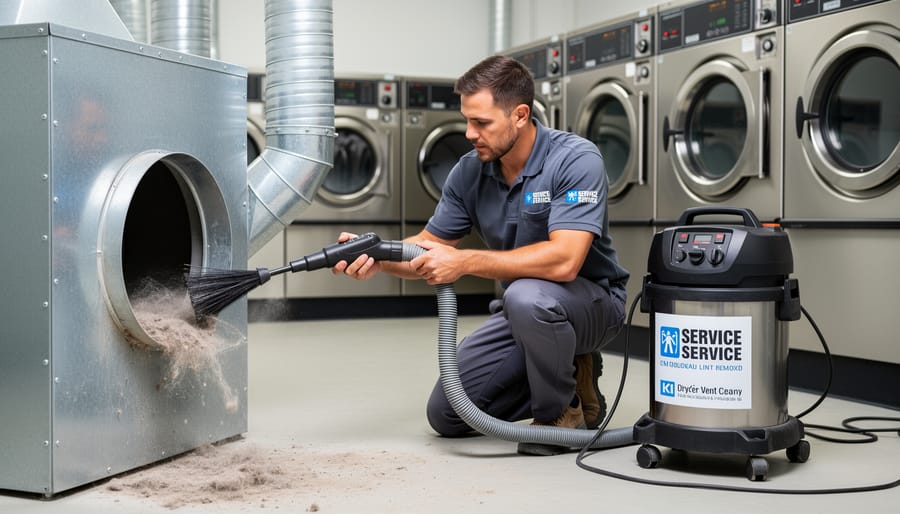
When evaluating contractors, verify their familiarity with NFPA 96 and local fire code requirements applicable to commercial laundry operations. Request documentation of previous commercial projects, liability insurance coverage, and compliance with OSHA safety standards. Qualified providers should conduct thorough pre-service inspections, utilize appropriate equipment such as rotary brush systems and high-powered vacuums, and provide detailed documentation of work performed.
Construction professionals should also confirm that service providers maintain current licenses and can supply certificates of completion that satisfy insurance and regulatory requirements. Establishing relationships with certified contractors during the design phase ensures proper system accessibility and long-term maintenance planning. Interview multiple candidates to assess their understanding of code-specific requirements and their ability to coordinate with facility operations schedules while minimizing business disruption.
Establishing Cleaning Schedules and Protocols
Determining the appropriate cleaning frequency for commercial dryer vents requires a comprehensive assessment of multiple operational factors. NFPA 120 establishes baseline requirements but allows flexibility based on system-specific conditions. Facility managers must evaluate dryer usage intensity, load volume, and operating hours when establishing maintenance intervals. High-volume commercial laundries processing hospital linens or hotel bedding typically require monthly inspections, while lower-volume facilities may safely operate on quarterly schedules.
System design significantly influences cleaning protocols. Longer duct runs, multiple bends, and vertical configurations accumulate lint more rapidly than straight, short runs. Conduct initial lint accumulation monitoring during the first 30, 60, and 90 days of operation to establish baseline rates. This data-driven approach enables customized scheduling that balances safety with operational efficiency.
Code compliance documentation should include detailed cleaning logs specifying the date, technician credentials, findings, and corrective actions taken. Many jurisdictions require certified technicians to perform inspections and maintain records for minimum three-year periods. Implementing automated reminder systems ensures consistent adherence to established protocols. Industry expert John Patterson, Fire Marshal for commercial facilities, recommends: “Never extend cleaning intervals beyond manufacturer recommendations, regardless of apparent system cleanliness. Hidden lint accumulation presents the greatest fire risk.”
Integration with Building Management Systems
Modern building management systems offer facility managers powerful tools to maintain code-compliant dryer vent operations through automated monitoring and predictive maintenance scheduling. These integrated platforms track critical performance metrics including airflow velocity, temperature variations, and lint accumulation rates in real-time, triggering alerts when systems deviate from established compliance parameters.
Advanced BMS integration enables facilities to document continuous compliance for regulatory inspections through comprehensive audit trails and automated reporting. Temperature sensors positioned strategically throughout vent runs detect dangerous heat buildup before it reaches critical thresholds, while airflow monitors identify restrictions indicating excessive lint accumulation requiring immediate attention.
According to facility management experts, buildings utilizing BMS-integrated dryer vent monitoring reduce code violations by up to 60% compared to manual inspection protocols alone. The systems automatically schedule preventive maintenance based on actual usage patterns and performance data rather than arbitrary time intervals, optimizing resource allocation while ensuring consistent code compliance.
Integration capabilities extend to direct communication with commercial cleaning contractors, automatically generating service requests when monitored parameters exceed acceptable ranges. This proactive approach transforms compliance from reactive crisis management into systematic risk mitigation, protecting building occupants while reducing long-term operational costs.
Case Study: Code Compliance Overhaul in a Major Multi-Family Development
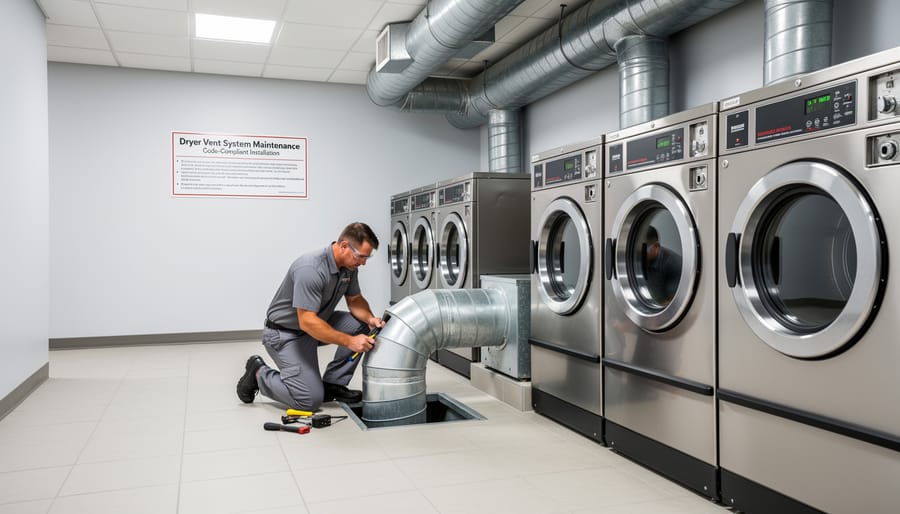
When Riverside Commons, a 284-unit multi-family development in Phoenix, Arizona, underwent a routine fire safety inspection in 2019, inspectors identified significant code violations in the property’s commercial laundry facilities. The building, constructed in 2004, featured centralized laundry rooms on each of its seven floors, with a total of 42 commercial dryers operating across the property. The inspection revealed that vent runs exceeded the maximum allowable length specified in the International Mechanical Code, lacked proper access panels, and had not been cleaned according to the required schedule.
“We faced a critical decision point,” explains Robert Chen, Director of Facilities Management for the property ownership group. “The inspector gave us 90 days to develop a comprehensive remediation plan. Failure to comply would result in shutting down all laundry facilities until we achieved full code compliance.”
The primary challenges included vent runs averaging 65 feet in length with multiple 90-degree turns, far exceeding IMC guidelines. The original installation used flexible aluminum ducting in several locations rather than rigid metal ducts, and cleaning access points were virtually non-existent. Previous cleaning attempts had been superficial at best, with lint accumulation measuring up to three inches thick in some sections.
The property’s engineering team partnered with a specialized commercial vent system contractor to develop a phased remediation approach. The solution involved replacing all flexible ducting with smooth-wall rigid metal ducts, installing code-compliant access panels every 12 feet, rerouting vent paths to reduce overall length and minimize turns, and implementing a quarterly professional cleaning schedule with documentation protocols.
The project required approximately six weeks to complete, with work conducted in phases to maintain partial laundry service for residents. Total project costs reached 87,000 dollars, including materials, labor, temporary service accommodations, and the first year of quarterly maintenance contracts.
The outcomes proved significant beyond mere compliance. The property experienced zero dryer-related fire incidents in the four years following remediation, compared to two small fires in the previous five years. Energy efficiency improved measurably, with dryer cycle times decreasing by an average of 18 percent due to improved airflow. Resident satisfaction scores for laundry facilities increased substantially, and insurance premiums for the property decreased by 12 percent after providing documentation of the upgraded system and maintenance protocols.
“This project transformed our perspective on preventive maintenance,” Chen notes. “The upfront investment was substantial, but the long-term benefits in safety, efficiency, and liability reduction have been invaluable.”
Working with Building Officials and Inspectors
Establishing collaborative relationships with building officials and inspectors before construction begins can significantly streamline the compliance process for commercial dryer vent installations. Schedule pre-construction meetings to review plans and discuss specific code interpretations, as Authority Having Jurisdiction (AHJ) requirements may vary based on local amendments to national codes.
Building officials appreciate proactive communication. Present detailed installation plans that clearly demonstrate compliance with NFPA 90A, NFPA 96, and applicable International Mechanical Code provisions. Include specifications for duct materials, clearances, termination points, and fire damper locations. Documentation of your commitment to safety standards helps establish credibility and expedites the review process.
Understanding that inspectors may have different interpretations of code requirements is essential. According to fire protection engineer Michael Chen, who has worked with commercial laundries across three states, “The same code section might be enforced differently depending on the jurisdiction. Some inspectors focus heavily on access panel placement, while others prioritize duct material specifications. Knowing these preferences beforehand prevents costly rework.”
Prepare comprehensive documentation for inspections, including manufacturer specifications, material certifications, and installation photographs. Create a compliance checklist that mirrors your local AHJ’s inspection criteria. This demonstrates due diligence and helps inspectors verify compliance efficiently.
When disagreements arise regarding code interpretation, reference specific code sections and provide supporting documentation from manufacturers or industry associations. Many building departments accept alternative methods or materials when backed by engineering analysis or testing data. Maintain professional dialogue and consider requesting written clarification on disputed items for future reference.
Schedule inspections at appropriate construction phases—rough-in, final, and any required intermediate stages. Never conceal work requiring inspection, as this creates liability issues and potential project delays. Building positive relationships with inspectors through transparency and professionalism benefits current projects and facilitates smoother future interactions.
Commercial dryer vent cleaning code compliance represents far more than a regulatory checkbox—it functions as a critical risk management strategy that protects building occupants, preserves property value, and shields organizations from liability exposure. The evidence is unequivocal: proactive adherence to IRC, IFC, NFPA 96, and local municipal codes directly correlates with reduced fire incidents, improved energy efficiency, and extended equipment lifecycles.
For construction professionals and facility managers, the path forward demands immediate action. Begin by conducting comprehensive audits of all dryer vent systems within your portfolio, documenting current conditions against applicable code requirements. Engage certified technicians familiar with the specific jurisdictional requirements governing your properties, as code interpretations vary significantly across municipalities. Establish formal maintenance schedules that exceed minimum code intervals where justified by usage patterns or environmental factors.
Implementation of a robust compliance program should include detailed record-keeping protocols, regular staff training on code updates, and integration of dryer vent specifications into new construction and renovation projects from the design phase. Building professionals must collaborate with fire marshals, mechanical engineers, and safety consultants to develop site-specific compliance strategies that address unique operational challenges.
The investment in comprehensive dryer vent compliance programs yields measurable returns through reduced insurance premiums, avoided citations, and elimination of catastrophic fire losses. Industry leaders recognize that compliance excellence differentiates professional operations from reactive management approaches. The question is not whether to prioritize code compliance, but how quickly you can establish systematic programs that transform regulatory requirements into competitive advantages and operational safeguards.
