
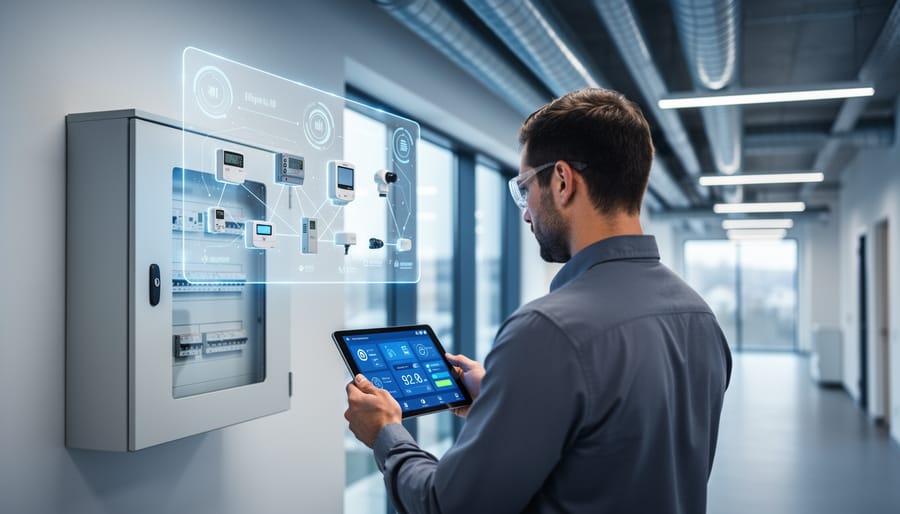
An energy management system (EMS) is a technology platform that monitors, controls, and optimizes energy consumption across building operations through real-time data collection, automated controls, and analytics. In 2026, these systems have become essential infrastructure in commercial and institutional buildings, delivering typical energy reductions of 15 to 30 percent while improving occupant comfort and operational efficiency.
For construction professionals and facility managers, understanding EMS technology is no longer optional. Today’s building codes increasingly mandate energy monitoring capabilities, and owners expect new construction to deliver measurable performance improvements from day one. An EMS transforms raw sensor data from HVAC systems, lighting circuits, and electrical panels into actionable intelligence that identifies waste, predicts maintenance needs, and automatically adjusts building systems based on occupancy patterns and weather conditions.
The practical value extends beyond energy savings. A properly specified EMS provides the documentation required for LEED certification, enables participation in demand response programs that generate revenue, and creates an audit trail that pinpoints equipment faults before they cascade into expensive failures. The difference between a building with an EMS and one without shows up clearly in utility bills, but it also appears in tenant satisfaction scores and asset valuations.
This article breaks down how modern energy management systems work, explains the core components that construction teams need to specify, and examines real-world applications across different facility types. We’ll also cover implementation considerations that affect project timelines and budgets, drawing on interviews with engineers who have deployed these systems at scale.
What an Energy Management System Means for Buildings
An Energy Management System is a structured framework that combines hardware, software, and operational protocols to track, analyze, and optimize how buildings consume energy. At its core, an EMS transforms raw utility data into actionable intelligence, enabling facility managers and building operators to reduce waste, lower costs, and meet increasingly stringent environmental targets.
Rather than simply recording energy use after the fact, an EMS actively manages consumption patterns across all building systems, HVAC equipment, lighting circuits, plug loads, and industrial processes. The system creates a continuous feedback loop: sensors and smart meters capture real-time data, analytics platforms identify inefficiencies and opportunities, and control mechanisms adjust equipment operation to align with energy goals and operational requirements.
Understanding several key concepts helps clarify how EMS functions in practice:
- Energy Monitoring
- The continuous measurement and recording of electricity, gas, water, and other utilities at circuit and equipment levels, providing granular visibility into consumption patterns.
- Demand Response
- The automated or manual reduction of energy consumption during peak pricing periods or grid stress events, often in response to utility signals or tariff structures.
- Load Management
- Strategic control of when equipment operates to distribute energy use more evenly, avoid demand charges, and prevent system overloads.
- Real-Time Optimization
- Dynamic adjustment of building systems based on current conditions like occupancy, weather, and energy prices to minimize consumption without compromising comfort or productivity.
In 2026’s regulatory environment, EMS has shifted from optional efficiency tool to essential building infrastructure. Tightening energy codes, carbon reporting mandates, and sustainability disclosure requirements make systematic energy management a compliance necessity. Beyond regulation, rising utility costs and corporate net-zero commitments drive adoption across commercial, industrial, and institutional sectors.
The technology also supports broader infrastructure goals. Buildings equipped with sophisticated EMS contribute to smart cities by participating in grid flexibility programs, integrating renewable energy sources, and communicating with utility networks to balance supply and demand across entire districts.
How Energy Management Systems Work
Data Collection and Monitoring
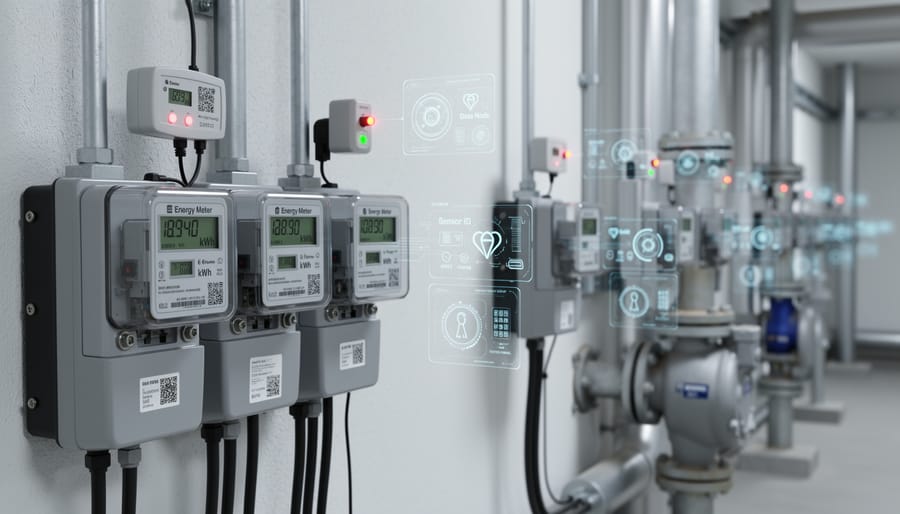
Energy management systems begin their work by collecting granular, real-time data from every significant energy-consuming system in a facility. Smart meters installed at main electrical feeds, sub-panels, and individual equipment circuits measure voltage, current, power factor, and consumption at intervals as short as one second. These meters communicate continuously with the central EMS platform, creating a live picture of energy use across the building.
Beyond electrical metering, EMS platforms pull data from dedicated sensors monitoring HVAC systems, lighting circuits, compressed air networks, and production equipment. Temperature sensors, flow meters, and pressure transducers feed operational data that the system correlates with energy consumption patterns. In manufacturing settings, the EMS often integrates directly with programmable logic controllers governing production lines, capturing energy use tied to specific processes or production runs.
This multi-point monitoring creates the foundation for all downstream EMS functions. Without accurate, continuous data collection, the system cannot identify waste, predict demand, or execute meaningful control strategies. Modern installations typically achieve 95% or better data availability, with edge computing devices buffering measurements during network interruptions to prevent gaps in the historical record.
Analysis and Decision-Making
Once raw meter data flows into the EMS platform, sophisticated analytics engines take over. Software algorithms compare actual consumption against historical baselines, identifying patterns that reveal waste, like equipment running outside scheduled hours or unusual spikes that indicate malfunctioning systems.
Machine learning models analyze these patterns to forecast energy demand across different timeframes. Short-term predictions help facilities prepare for the next hour’s load, while longer forecasts support monthly budgeting and capacity planning. The system flags anomalies automatically: a chiller consuming 30% more power than normal, or lighting circuits drawing current when spaces are unoccupied.
Modern platforms transform this analysis into ranked recommendations. They might calculate that adjusting HVAC setpoints by two degrees would cut peak demand by 12% with minimal comfort impact, or that shifting certain manufacturing processes to off-peak hours would save thousands monthly.
The output appears through visual dashboards showing real-time consumption, cost breakdowns by system or zone, and prioritized efficiency opportunities. Construction teams use these insights during commissioning to verify systems perform as designed, while facility managers rely on them for ongoing optimization decisions.
Control and Automation
Once the EMS platform identifies optimization opportunities, it executes control strategies through direct equipment adjustments. Modern systems automatically modify HVAC setpoints based on occupancy patterns, dim or switch off lighting in unoccupied zones, and cycle non-critical equipment during peak demand periods. Load shifting moves energy-intensive operations, like pre-cooling buildings or running chillers, to off-peak hours when electricity rates are lower.
Demand response automation is particularly valuable during utility peak events. The EMS can curtail predetermined loads within seconds, reducing demand charges that often represent 30-40% of commercial electricity bills. Controllers communicate with variable frequency drives, building automation systems, and smart breakers to implement these adjustments without manual intervention.
Most platforms allow facility managers to set automation rules, override thresholds, and approval requirements for critical systems. This balance between automated efficiency and human oversight ensures energy savings don’t compromise comfort or operations.
Core Components of Modern Energy Management Systems
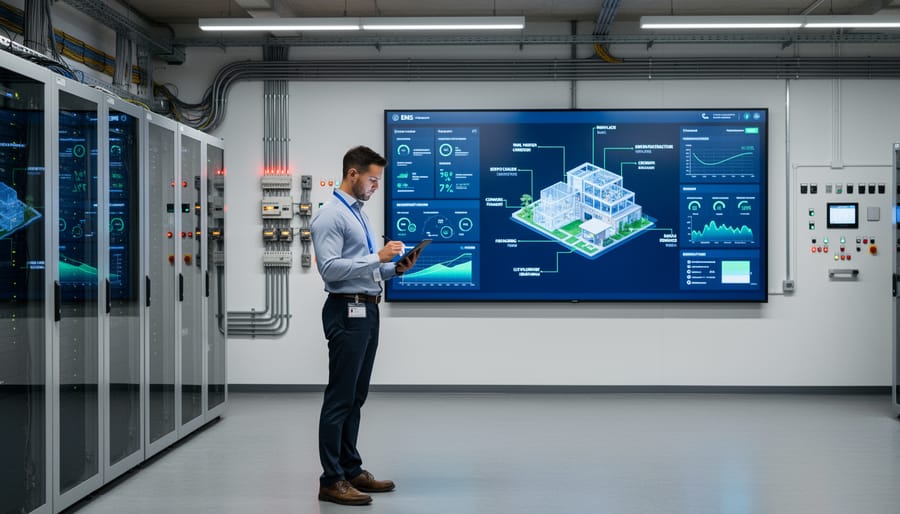
A comprehensive energy management system comprises multiple interconnected components that work together to monitor, analyze, and control energy consumption across a facility. Understanding these elements helps construction professionals specify appropriate systems and plan integration requirements during the design phase.
The foundation starts with the metering and sensing infrastructure. Smart meters provide granular consumption data at circuit or equipment level, replacing the single-point measurements of legacy systems. These devices capture voltage, current, power factor, and consumption patterns in real-time, transmitting data at intervals ranging from seconds to minutes. Modern installations supplement meters with IoT sensors monitoring temperature, humidity, occupancy, light levels, and equipment status. This distributed sensing creates a detailed picture of how energy flows through the building and which factors influence consumption.
The essential components that enable modern EMS functionality include:
- Smart meters: Digital devices measuring electrical consumption at high resolution with bidirectional communication capabilities
- IoT sensors: Distributed sensors tracking environmental conditions, occupancy patterns, and equipment operational status
- Communication gateways: Network devices aggregating data from meters and sensors, translating between protocols like Modbus, BACnet, and IP networks
- Analytics software: Cloud or on-premise platforms processing raw data into actionable insights through algorithms and machine learning models
- Control interfaces: User dashboards and mobile applications enabling system monitoring, manual adjustments, and automated rule configuration
- Reporting dashboards: Visualization tools presenting energy data, trends, and performance metrics for different user roles and compliance requirements
Communication networks tie the physical infrastructure together. Modern systems use a mix of wired Ethernet, wireless protocols, and cellular connections to transmit data between field devices and central platforms. This network layer must be robust and secure, particularly when EMS integrates with broader building management or SCADA systems.
The software platform represents the intelligence layer where smart EMS separates from legacy approaches. Cloud-based architectures enable remote access, automatic updates, and scalable storage for historical data. Machine learning algorithms identify consumption patterns, detect anomalies, predict equipment failures, and recommend optimization strategies that would be impossible to uncover through manual analysis. These platforms increasingly integrate with renewable energy systems, battery storage, and demand response programs, positioning buildings as active participants in grid management rather than passive consumers.
Applications Across Construction and Industrial Facilities
Commercial and Office Buildings
In commercial office buildings, energy management systems target the largest operational cost drivers: heating, cooling, lighting, and plug loads. Modern EMS platforms monitor real-time occupancy patterns through sensor networks, automatically adjusting HVAC set points and lighting levels in unused zones rather than conditioning entire floors continuously. This occupancy-based approach typically reduces energy consumption by 20-30% compared to fixed schedules.
Multi-tenant buildings benefit from submetering capabilities that track energy use by floor or suite, enabling accurate tenant billing and creating accountability for consumption. EMS software generates detailed reports showing each tenant’s usage patterns, supporting cost allocation and lease agreements tied to actual consumption rather than estimated square footage ratios.
Demand response integration allows office buildings to participate in utility programs, temporarily reducing non-essential loads during peak pricing periods. The system might pre-cool spaces before peak hours, then coast through expensive afternoon periods without sacrificing occupant comfort. These strategies deliver immediate operational savings while supporting broader grid stability objectives.
Industrial and Manufacturing Sites
Industrial facilities operate some of the most energy-intensive equipment in any building type, making them prime candidates for sophisticated energy management. An EMS in manufacturing environments monitors production lines, motors, compressors, furnaces, and process equipment to identify waste and coordinate demand.
Production scheduling becomes far more strategic with EMS data. The system can shift energy-intensive operations to off-peak hours when electricity rates drop, potentially cutting costs by 20-30% without reducing output. For operations running multiple shifts, load balancing across equipment prevents demand spikes that trigger penalty charges.
Compressed air systems, notorious energy consumers in manufacturing, benefit particularly from EMS oversight. These systems often leak air or run compressors unnecessarily; continuous monitoring catches inefficiencies that manual checks miss. Similarly, EMS platforms track motor performance across conveyor systems, pumps, and fans, flagging degrading efficiency before equipment fails.
Process optimization extends beyond individual machines. An EMS analyzes how temperature control, material handling, and assembly sequences affect total energy consumption, then recommends adjustments that maintain quality while reducing waste. For manufacturers facing both cost pressure and sustainability mandates, this granular control transforms energy from an overhead item into a manageable variable.
Data Centers and Critical Infrastructure
Data centers represent some of the most energy-intensive facilities in modern construction, where power consumption for servers, storage systems, and especially cooling infrastructure creates massive operational costs. Energy management systems in these environments focus on precision control rather than simple reduction, maintaining 99.99% uptime while eliminating waste requires sophisticated monitoring and automation.
Cooling systems consume 30-40% of total data center energy. EMS platforms continuously adjust CRAC and CHWR units based on real-time server load, ambient conditions, and hot aisle temperatures, using variable-speed controls to match cooling output precisely to thermal demand. Power distribution monitoring tracks energy flow from utility feeds through UPS systems to individual server racks, identifying inefficiencies and preventing overloads before they trigger outages.
Backup generator integration ensures EMS maintains energy visibility during grid failures while optimizing fuel consumption during extended power events. The system coordinates load shedding protocols, prioritizing critical systems and automatically reducing non-essential loads to extend runtime.
In hospitals, pharmaceutical facilities, and telecom hubs, other critical infrastructure environments, EMS provides similar redundancy-aware optimization. These systems respect operational constraints that make uptime non-negotiable while still achieving 15-25% energy savings through intelligent scheduling, predictive maintenance alerts, and eliminating simultaneous operation of redundant equipment during normal conditions.
Smart Energy Management Systems: The Connected Evolution

Smart energy management systems represent the contemporary standard for building energy control, distinguished by their digital connectivity and intelligent automation capabilities. These systems leverage cloud-based platforms and IoT sensors to create comprehensive, real-time visibility into energy consumption patterns across entire facility portfolios.
The defining characteristic of smart EMS is predictive capability. Machine learning algorithms analyze historical consumption data, weather forecasts, occupancy patterns, and utility rate structures to anticipate energy demand before it occurs. This enables proactive load management rather than reactive responses. For instance, a smart system can pre-cool a building during off-peak hours when electricity rates are lowest, reducing demand during expensive peak periods without compromising comfort.
Smart energy systems integrate seamlessly with on-site renewable generation and battery storage. The EMS coordinates solar panel output, battery charge cycles, and grid draw to maximize self-consumption of renewable energy while maintaining cost-effective operation. During high solar production, excess energy charges batteries or exports to the grid. When production drops, the system draws from storage before tapping grid power.
Interoperability with utility smart grid infrastructure enables automated demand response programs. When grid operators signal high demand events, the smart EMS can curtail non-essential loads, shift energy-intensive operations, or discharge stored energy back to the grid. These capabilities often generate revenue through utility incentive programs while supporting grid stability.
For construction projects in 2026, specifying legacy standalone EMS technology means installing systems that are functionally obsolete at commissioning. Smart EMS platforms provide the cyber-physical infrastructure necessary for achieving net-zero targets, complying with increasingly stringent building performance standards, and maintaining long-term operational flexibility as energy markets and technologies evolve.
Implementation Considerations for Construction Projects
Successfully implementing an EMS requires strategic planning from early design stages through commissioning and beyond. For new construction projects, the process starts with system sizing, calculating the number and placement of meters, sensors, and control points based on building load profiles, equipment diversity, and energy monitoring granularity requirements. Oversizing adds unnecessary cost; undersizing limits future optimization capabilities.
Network infrastructure deserves particular attention. Modern EMS platforms require robust digital infrastructure dedicated Ethernet backbones, wireless mesh networks for sensor communication, and reliable internet connectivity for cloud-based platforms. Coordinate this with IT teams early to avoid conflicts with cybersecurity policies or bandwidth constraints. Plan for physical cable pathways, equipment room space for servers or gateways, and power supplies for remote devices during electrical design.
Integration with MEP systems requires close coordination between electrical, mechanical, and controls contractors. EMS must interface with HVAC controls, lighting systems, and electrical distribution equipment through standardized protocols like BACnet or Modbus. Define integration points and communication requirements in specifications to prevent compatibility issues during installation.
Retrofit projects face different challenges. Existing buildings may lack metering infrastructure or have legacy systems incompatible with modern platforms. Conduct detailed energy audits to identify high-value monitoring points and prioritize phased implementation. Wireless sensors reduce installation costs where running new conduit proves prohibitive.
Commissioning represents a critical but often underestimated phase. Allocate time for verifying sensor accuracy, testing control sequences, validating data flows, and training facility staff. An EMS only delivers value when operators understand its capabilities and maintain it properly. Budget for ongoing training as staff turnover occurs and system capabilities expand.
Finally, consider future scalability. Specify systems with open protocols and modular architectures that accommodate additional equipment, renewable energy integration, or battery storage as building needs evolve.
Common Questions About Energy Management Systems
What’s the typical ROI timeline for an energy management system?
Most commercial and industrial facilities see payback periods between 2-5 years, depending on facility size, energy costs, and existing infrastructure efficiency. Facilities with high energy consumption or outdated equipment often achieve faster returns, while comprehensive smart systems with advanced analytics may require longer initial investment periods but deliver greater long-term savings.
How does an EMS differ from a building management system?
A BMS controls building systems like HVAC, lighting, and security, while an EMS specifically focuses on monitoring, analyzing, and optimizing energy consumption across those systems. Modern installations often integrate EMS capabilities into BMS platforms, creating unified smart building infrastructure that handles both operational control and energy optimization.
Can energy management systems scale from small buildings to large campuses?
Yes, EMS solutions range from single-building systems with basic monitoring to enterprise platforms managing multi-site portfolios. Cloud-based smart systems offer particularly flexible scaling, allowing organizations to start with core facilities and expand coverage as needed without replacing infrastructure.
What cybersecurity risks come with connected energy systems?
Network-connected EMS platforms face the same cybersecurity threats as other IT infrastructure, including unauthorized access, data breaches, and potential equipment manipulation. Professional installations address these risks through network segmentation, encrypted communications, regular software updates, and access controls, similar practices used for smart water systems and other connected building technologies.
Beyond technical concerns, construction professionals frequently ask about compliance advantages. Energy management systems simplify regulatory reporting by automatically collecting and organizing consumption data required for building codes, energy benchmarking mandates, and sustainability certifications like LEED or BREEAM. This automated documentation reduces administrative burden while supporting compliance with increasingly stringent efficiency standards. The integration of EMS with broader smart building infrastructure, extending to construction site management systems during the build phase, creates cohesive data ecosystems that streamline both project delivery and operational performance verification.
Energy management systems have evolved from nice-to-have monitoring tools into essential infrastructure for modern construction projects. The shift toward smart, connected EMS platforms reflects broader changes in how buildings operate in 2026: as dynamic systems that respond to real-time conditions, optimize resources automatically, and generate the performance data that owners, tenants, and regulators increasingly demand.
The business case centers on measurable outcomes. Facilities implementing comprehensive EMS typically achieve 10-30% reductions in energy costs through demand management, equipment optimization, and waste elimination. These savings compound over building lifecycles, improving asset value while advancing corporate sustainability commitments. Smart systems deliver additional benefits through predictive maintenance alerts that prevent costly failures and automated reporting that streamlines compliance with evolving energy codes.
For construction professionals, EMS specification isn’t optional anymore. Buildings designed without robust energy management capabilities face obsolescence, struggle to meet tenant expectations, and carry operational liabilities that diminish returns. Smart EMS platforms provide the foundation for net-zero strategies, integrating renewable generation, battery storage, and grid services that will define high-performance buildings in coming decades. The question isn’t whether to include energy management systems, but how comprehensive to make them from day one.
