

Brazil’s sports betting legalization has catalyzed a construction revolution inside stadiums, where operators like 5500 bet vip are demanding sophisticated architectural solutions that balance regulatory compliance with fan experience. As the nation’s gaming industry matures, facility designers face unique challenges: integrating betting kiosks and lounges within existing stadium infrastructures while maintaining structural integrity, managing egress requirements, and accommodating complex power and data distribution networks that support real-time wagering technologies.
The market opportunity is substantial. With over 800 professional football stadiums nationwide and recent legislative changes permitting on-site betting operations, Brazilian venues require approximately 15,000 to 25,000 square feet of dedicated betting space per facility, depending on capacity. These spaces must incorporate secure cash-handling rooms, climate-controlled server areas maintaining precise environmental standards, and patron areas designed for high-density occupancy during peak match events.
Design complexities extend beyond spatial planning. Architects must navigate Brazil’s evolving gaming regulations, coordinate with multiple stakeholders including stadium operators and betting licensees, and implement security protocols that satisfy both federal gaming oversight and local building codes. Mechanical systems require redundant power supplies, sophisticated HVAC configurations to manage heat loads from electronic equipment, and network infrastructure supporting thousands of simultaneous transactions.
This article examines successful case studies from São Paulo’s Neo Química Arena and Rio de Janeiro’s Maracanã Stadium, providing technical specifications, regulatory insights, and procurement strategies. Through expert interviews with lead architects and project managers, construction professionals will gain actionable knowledge for navigating this emerging specialization, from preliminary design through commissioning and operational handover.
The Regulatory Shift That Changed Brazilian Stadium Design
Licensing and Zoning Requirements for In-Stadium Betting
Navigating Brazil’s regulatory landscape for in-stadium betting facilities requires understanding both federal gaming legislation and state-level jurisdictional variations. Following the legalization of sports betting through Law 13.756/2018 and subsequent regulatory frameworks established by the Ministry of Finance, construction professionals must coordinate with multiple governmental bodies to ensure compliance before breaking ground on betting infrastructure.
Spatial requirements mandate dedicated areas ranging from 150 to 500 square meters depending on stadium capacity, with clear separation from general concourse traffic. The regulatory framework requires minimum distances of 15 meters from food service areas and 20 meters from family zones or youth-designated sections. Ceiling heights must accommodate surveillance infrastructure, typically requiring 3.5 meters minimum clearance.
Security protocols necessitate specialized design considerations. Facilities must incorporate reinforced cash handling rooms with dual-access controls, dedicated server rooms with environmental controls, and segregated employee access points. Video surveillance systems require 180-day retention capabilities, demanding substantial data storage infrastructure integrated during initial construction phases.
Age verification infrastructure presents unique architectural challenges. Entry points must accommodate biometric scanning stations, document verification kiosks, and physical barriers preventing unauthorized access. Brazilian regulations require real-time integration with federal identification databases, necessitating robust telecommunications infrastructure and backup power systems.
Jurisdictional variations across states like São Paulo, Rio de Janeiro, and Minas Gerais create additional complexity. Some states impose stricter proximity restrictions to educational institutions or residential areas, while others mandate enhanced ventilation systems or specific lighting levels. Project managers should engage local legal counsel early in the design process to identify state-specific requirements that may impact structural, mechanical, or electrical systems planning.
Architectural Design Considerations for Betting Facilities
Space Optimization and Fan Flow Management
Space optimization in Brazilian stadium sports betting facilities requires strategic architectural planning that addresses both operational efficiency and patron experience during high-traffic match days. Architects are implementing multi-layered circulation strategies that separate betting traffic from general concourse flow, preventing bottlenecks at critical junctures.
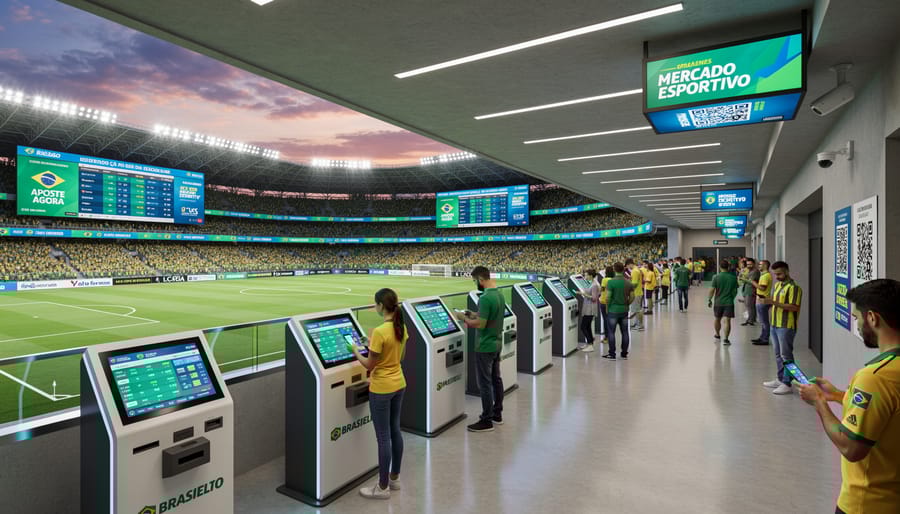
Leading design approaches position self-service kiosks in alcove configurations along main corridors, recessing units 1.2 to 1.5 meters from primary walkways to create queuing zones without obstructing pedestrian movement. This configuration typically accommodates four to six kiosks per cluster, with minimum 2.5-meter clearances maintained for emergency egress compliance. Biometric verification terminals integrate within these layouts, requiring careful coordination with data infrastructure placement.
Dedicated betting lounges present distinct spatial challenges. Contemporary designs allocate 15 to 25 square meters per lounge, positioned strategically between seating tiers to distribute patron loads across multiple levels. These spaces incorporate transparent partitioning systems that maintain visual connections to the field while providing acoustic separation, addressing the dual requirement for immersive viewing and focused wagering activities.
According to Marcelo Santos, principal architect at Arena Project Consultores, “The critical factor is understanding peak demand curves. We model crowd dynamics for 15 minutes pre-match and halftime intervals, designing for surge capacity that’s 40 percent above average loads.”
Vertical circulation integration proves essential in multi-tier stadiums, with betting facilities positioned within 30 meters of stair and elevator cores. This proximity reduces dwell times and facilitates rapid patron redistribution, particularly crucial during interval periods when betting activity concentrates into compressed timeframes.
Technology Infrastructure and Digital Integration
Modern betting facilities demand robust technology infrastructure that supports real-time wagering, data processing, and seamless integration with stadium systems. Electrical requirements include redundant power supplies with uninterruptible power systems (UPS) rated for minimum 30-minute runtime, backed by diesel generators capable of supporting full operational loads during outages. Dedicated electrical panels with surge protection safeguard sensitive equipment from voltage fluctuations common in high-traffic venues.
Network connectivity specifications require fiber-optic backbone infrastructure delivering minimum 10 Gbps bandwidth to handle concurrent user traffic during peak events. Server rooms must maintain temperature controls between 18-27°C with humidity levels at 40-60%, incorporating hot-aisle/cold-aisle configurations and N+1 redundancy for cooling systems. Physical security measures including biometric access controls and 24/7 monitoring protect critical hardware processing financial transactions.
Integration with stadium-wide digital screens demands standardized APIs enabling real-time odds updates across LED displays, while mobile betting platforms require robust Wi-Fi 6 networks providing 500+ Mbps per access point. According to infrastructure specialist João Mendes from Arena Tech Solutions, “Brazilian stadiums implementing betting facilities must provision 40% additional network capacity beyond initial projections to accommodate adoption growth curves we’ve observed across Latin American markets.”
Data center specifications should follow Tier III standards minimum, ensuring 99.982% uptime availability. Cable management systems using Category 6A or fiber-optic cabling throughout betting areas facilitate future technology upgrades without extensive retrofitting requirements.
Premium vs. General Access Betting Areas
Spatial differentiation between premium and general access betting areas demands careful consideration of both operational efficiency and brand positioning within Brazilian stadium environments. Premium betting lounges typically occupy 150-250 square meters within corporate suite levels, while general concourse installations range from 8-15 square meters per kiosk station.
VIP betting facilities incorporate high-specification finishes including engineered stone countertops, climate-controlled environments with individual zone controls, and acoustic treatments meeting NC-30 ratings for conversation privacy. These spaces feature dedicated cocktail service areas, integrated audiovisual systems with multiple screen configurations, and ergonomic seating arrangements accommodating 12-20 patrons per lounge. Electrical infrastructure supports 40-50 watts per square meter for digital displays, personal device charging stations, and point-of-sale systems.
General concourse betting kiosks prioritize durability and throughput capacity. Specifications include impact-resistant laminate surfaces, tempered glass security screens, and simplified HVAC integration tied to existing stadium systems. Footprint allocation follows 1.2-1.5 square meters per transaction terminal, with queuing zones requiring additional 4-6 square meters per kiosk to prevent circulation bottlenecks during peak periods.
Material selection diverges significantly between tiers. Premium installations employ custom millwork, leather upholstery, and branded glass partitions, while concourse units utilize powder-coated steel frames, commercial-grade vinyl finishes, and standardized modular components facilitating rapid installation and maintenance accessibility. Both configurations must accommodate fiber optic connectivity requirements and comply with sight-line preservation mandates established by CBF stadium certification protocols. Lighting specifications range from 500 lux at transaction surfaces in general areas to adjustable 200-400 lux ambient levels in premium lounges, supporting varied patron activities and comfort expectations.
Energy and Mechanical Systems for 24/7 Operations
Power Redundancy and Backup Systems
Betting facilities demand uninterrupted power delivery to prevent transaction failures and data loss during matches. A robust power redundancy strategy begins with comprehensive load calculations that account for betting terminals, servers, networking equipment, display systems, and cooling infrastructure. Industry standards recommend N+1 redundancy at minimum, with high-stakes facilities implementing 2N configurations for critical systems.
Uninterruptible Power Supply (UPS) systems must provide sufficient runtime to maintain operations during grid fluctuations and brief outages. For Brazilian stadium betting facilities, sizing UPS capacity requires analyzing simultaneous betting peaks during major events, typically occurring at match kickoff and halftime. Engineering consultants recommend 15-30 minute runtime specifications, allowing adequate transition to backup generators while preventing abrupt system shutdowns that compromise betting integrity.
Generator capacity calculations must account for full facility load plus 25-30 percent overhead for motor starting currents and future expansion. Diesel generators rated between 500-1500 kVA typically serve medium to large installations, with automatic transfer switches engaging within 10 seconds of power disruption. Installation requires dedicated fuel storage complying with Petrobras specifications and local fire codes, typically providing 24-72 hours of continuous operation.
According to Ricardo Mendes, electrical engineering director at Construtora Andrade Gutierrez, “We implement hierarchical power distribution with separate circuits for Tier 1 betting systems, ensuring financial transactions receive absolute priority during partial power scenarios. This tiered approach optimizes generator sizing while maintaining operational continuity where it matters most.”
HVAC Considerations for High-Density Betting Areas
High-density betting areas present unique HVAC challenges that demand careful engineering, particularly within Brazil’s tropical and subtropical climate zones. Server rooms housing betting terminals and data processing equipment require precision cooling systems maintaining temperatures between 18-27°C with relative humidity controlled at 40-60%. These spaces typically demand cooling loads of 200-400 watts per square foot, necessitating dedicated Computer Room Air Conditioning (CRAC) units with N+1 redundancy to prevent system failures during peak operations.
Betting lounges accommodating high occupant densities require substantially increased fresh air ventilation rates beyond standard assembly space requirements. Design professionals should calculate approximately 20-25 CFM per person to maintain indoor air quality while managing the combined heat load from occupants, electronic displays, and betting terminals. In regions like Rio de Janeiro and Salvador, where outdoor temperatures regularly exceed 32°C with high humidity, variable refrigerant flow (VRF) systems offer efficient zoning capabilities for spaces experiencing fluctuating occupancy throughout match days.
Integration of energy recovery ventilators (ERVs) becomes economically justified given the substantial temperature differential between conditioned indoor spaces and outdoor ambient conditions. Additionally, specified equipment should account for coastal salt air corrosion in stadium locations near Brazil’s extensive coastline, requiring enhanced coil coatings and corrosion-resistant materials. Backup cooling provisions, including temporary chiller connections, protect revenue-generating operations during maintenance periods or equipment failures.
Case Study: Arena Castelão’s Betting Integration Retrofit
Arena Castelão in Fortaleza, Ceará, represents one of Brazil’s most instructive examples of integrating sports betting facilities into an existing stadium infrastructure. Originally constructed in 1973 and extensively renovated for the 2014 FIFA World Cup, the venue underwent a strategic retrofit in 2023 to accommodate licensed betting operations following regulatory changes at both federal and state levels.
The project team, led by São Paulo-based architectural firm Projetos Esportivos Ltda, faced immediate spatial constraints. Unlike new construction, the retrofit demanded integration without compromising the stadium’s 63,903-seat capacity or disrupting ongoing event schedules. The design solution positioned twelve betting kiosks across three concourse levels, each measuring 4.5 square meters with modular components that could be installed during off-season windows.
“The primary challenge was infrastructure overlay,” explains Ricardo Mendes, project structural engineer. “We couldn’t simply cut through existing concrete to route new electrical and data systems. Every penetration required engineering analysis to ensure we weren’t compromising the World Cup-era structural upgrades.” The solution involved surface-mounted conduit systems with architectural cladding that matched existing finishes, adding approximately 180,000 reais to the initial 2.8 million real budget.
Timeline compression emerged as a critical concern. The project scope specified a five-month completion schedule, but concealed conditions discovered during demolition extended the timeline to seven months. Original plans assumed access to chase spaces documented in as-built drawings, but field verification revealed discrepancies requiring redesign of approximately 40 percent of the data distribution infrastructure.
Fire safety compliance presented unexpected complications. Ceará’s state fire code, updated in 2022, imposed stricter requirements for enclosed spaces within assembly occupancies than the original federal guidelines under which the project was initially designed. The team added fire-rated partition assemblies and dedicated smoke detection systems, increasing material costs by 12 percent while delaying the critical path by three weeks.
Budget management proved essential given the fixed-price contract structure. Value engineering sessions identified cost savings through standardized millwork components and locally-sourced digital display systems rather than imported equipment, recovering approximately 340,000 reais without compromising operational functionality.
The project’s most valuable lesson centered on stakeholder coordination. Weekly meetings with Ceará’s gaming regulatory authority prevented costly rework by addressing compliance interpretations proactively rather than during final inspections. This collaborative approach established protocols that subsequent Brazilian stadium betting retrofits have adopted as industry best practice, demonstrating that regulatory engagement represents a critical success factor in specialized facility integration projects.
Security and Surveillance Design Requirements
Designing robust security and surveillance infrastructure for Brazilian stadium betting facilities requires a multi-layered approach that addresses both physical and digital threats. Camera systems must provide comprehensive coverage of betting windows, self-service kiosks, and patron circulation areas, with particular attention to blind spots where disputes or fraudulent activity could occur. Industry experts recommend minimum 4K resolution cameras with 90-day recording retention, strategically positioned to capture facial recognition data and transaction verification.
Cash handling facilities demand specialized architectural features including reinforced walls meeting Brazilian NBR standards, dual-access mantrap entries, and discrete transport corridors separate from public circulation. According to Paulo Mendes, security consultant for Arena Corinthians’ betting operations, “The cash room should function as a vault within a vault, with biometric access controls and real-time monitoring integrated with stadium command centers.”
Server room design must accommodate redundant cooling systems, fire suppression, and uninterruptible power supplies rated for minimum 30-minute operation during outages. These spaces require raised flooring for cable management and environmental controls maintaining 18-27°C temperatures with 40-60% relative humidity. Physical separation from public areas through dedicated service corridors prevents unauthorized access while facilitating maintenance operations.
Integration with existing stadium security infrastructure presents unique coordination challenges. Access control systems should utilize centralized management platforms compatible with venue-wide credentialing, allowing security personnel to monitor betting areas alongside general stadium operations. Panic buttons at each betting station must connect directly to stadium security dispatch, with average response times under two minutes. Emergency lockdown capabilities should isolate betting facilities independently while maintaining safe egress routes compliant with Brazilian fire codes.
Construction Procurement and Project Delivery Challenges
Integrating sports betting facilities into Brazilian stadiums presents unique project delivery challenges that require specialized procurement approaches and careful coordination. Project managers must navigate complex regulatory approvals while managing tight construction windows that minimize disruption to stadium operations.
Procurement strategies should prioritize contractors with demonstrated experience in both gaming infrastructure and live venue retrofits. According to industry experts, pre-qualification criteria must include verifiable track records in installing secure betting systems, fiber optic networks, and integrated security infrastructure. Design-build delivery methods have proven most effective for these projects, allowing for concurrent design development and regulatory approval processes that can reduce overall timelines by 20-30 percent.
Specialized subcontractor requirements extend beyond traditional construction trades. Projects typically require gaming equipment suppliers certified by Brazilian regulatory authorities, security system integrators familiar with Anti-Money Laundering compliance infrastructure, and audiovisual contractors experienced with real-time odds display systems. Early engagement with these specialty trades during preconstruction is critical, as procurement lead times for gaming terminals and secure server equipment often extend 12-16 weeks.
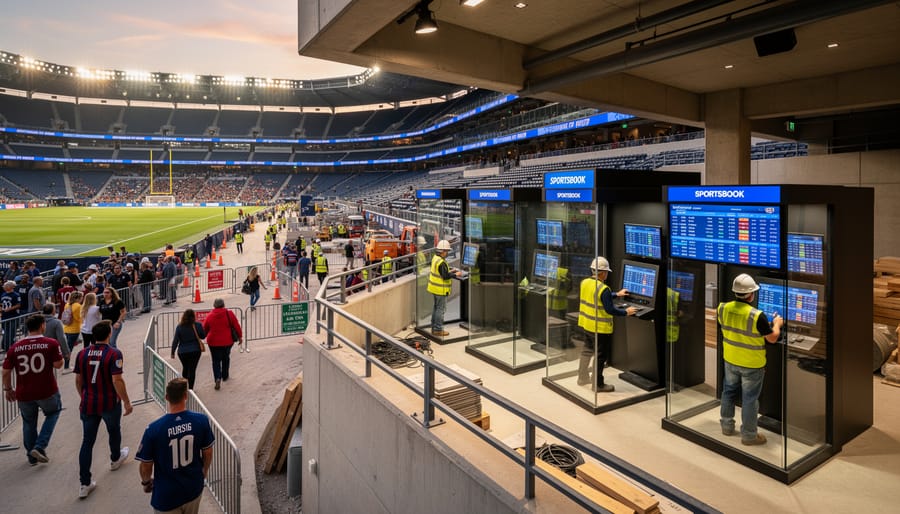
Coordination with stadium operations during retrofits demands meticulous planning. Most successful projects implement phased construction schedules that align with off-season periods or utilize modular construction approaches for rapid installation during brief operational windows. One Rio de Janeiro stadium retrofit completed betting lounge construction in just 45 days by prefabricating entire wall and ceiling assemblies off-site, minimizing on-site work to final connections and systems integration.
Typical project timelines from design initiation to operational handover range from 8-14 months, depending on facility complexity and whether construction involves new-build or retrofit scenarios. Regulatory approval processes alone can consume 3-4 months, emphasizing the importance of parallel path scheduling. Successful project managers report that establishing dedicated communication channels with gaming regulators early in design development significantly reduces approval-related delays and prevents costly design revisions during construction phases.
Expert Perspective: Interview with Stadium Architect
We spoke with Roberto Mendes, Principal Architect at Mendes & Associados, who has designed integrated betting facilities for three major Brazilian stadiums including Arena Pernambuco and collaborated on renovations at Estádio do Maracanã. His firm specializes in multifunctional sports venue design with particular expertise in regulated gaming environments.
Q: What’s the most significant trend you’re observing in Brazilian stadium betting facility design?
A: The integration philosophy has completely shifted. Five years ago, clients wanted betting areas segregated and almost hidden. Now, we’re seeing demand for transparent, premium spaces that enhance the overall stadium experience. The successful projects incorporate betting facilities as part of hospitality zones, with high-quality finishes, natural light where possible, and sightlines to the pitch. These aren’t afterthoughts anymore; they’re revenue drivers that require architectural consideration from the initial planning stages.
Q: What common mistakes do you encounter in retrofit projects?
A: The biggest issue is inadequate infrastructure planning. Many older stadiums weren’t designed with the electrical loads and data requirements that modern betting operations demand. We’ve seen projects where the data backbone simply couldn’t support real-time odds distribution across multiple terminals, requiring expensive remediation. Another frequent problem is poor spatial analysis. Operators often underestimate queuing requirements during high-traffic periods, leading to congestion that impacts both the betting area and surrounding circulation paths. Climate control is also consistently underspecified, particularly problematic in Brazil’s varied climate zones.
Q: How do regulatory requirements influence your design approach?
A: Brazilian gaming regulations mandate specific security features, surveillance coverage, and age verification zones that fundamentally shape spatial organization. We design entry sequences with clear segregation between betting areas and general concourses, incorporating biometric verification points that don’t create bottlenecks. Transparency requirements mean extensive use of glazing for regulatory oversight while maintaining patron privacy. The surveillance infrastructure alone requires significant coordination with security consultants and can represent fifteen to twenty percent of the technology budget.
Q: What advice would you give project managers approaching these designs?
A: Engage specialists early. Betting facility design sits at the intersection of architecture, technology, security, and regulatory compliance. Attempting to retrofit requirements late in the design process invariably increases costs and compromises functionality. Also, consider operational flexibility. The betting technology landscape evolves rapidly, so build in infrastructure capacity and spatial adaptability for future system upgrades.
The integration of sports betting facilities represents a paradigm shift in Brazilian stadium design, fundamentally altering how construction professionals approach venue development. This transformation extends beyond simple spatial additions, demanding comprehensive reconsideration of circulation patterns, infrastructure capacity, security protocols, and regulatory compliance frameworks. For construction firms entering this specialized market segment, the financial implications are substantial, with betting facility retrofits averaging R$15-30 million per major stadium and new construction projects allocating 8-12% of total budgets to betting-related infrastructure.
Several high-profile projects currently in development underscore the sector’s momentum. Arena Fonte Nova in Salvador is planning a 2,500-square-meter betting facility scheduled for completion in late 2025, while Estádio Mineirão’s expansion will incorporate biometric access systems and dedicated high-roller lounges. These projects exemplify the sophisticated technical requirements that construction professionals must master, including advanced HVAC systems for optimal air quality, redundant power supplies ensuring uninterrupted operations, and cybersecurity infrastructure protecting financial transactions.
The competitive advantage belongs to firms that invest in specialized knowledge early. Understanding Lei 14.790/2023 compliance requirements, developing relationships with betting technology providers, and building expertise in high-security construction protocols will differentiate market leaders from followers. As Brazil’s sports betting market matures, construction professionals who recognize this specialized segment’s unique demands will position themselves advantageously for sustained project pipelines. The convergence of traditional stadium construction expertise with betting facility specialization creates unprecedented opportunities for forward-thinking firms prepared to navigate this complex, regulated, and rapidly expanding market landscape.
