
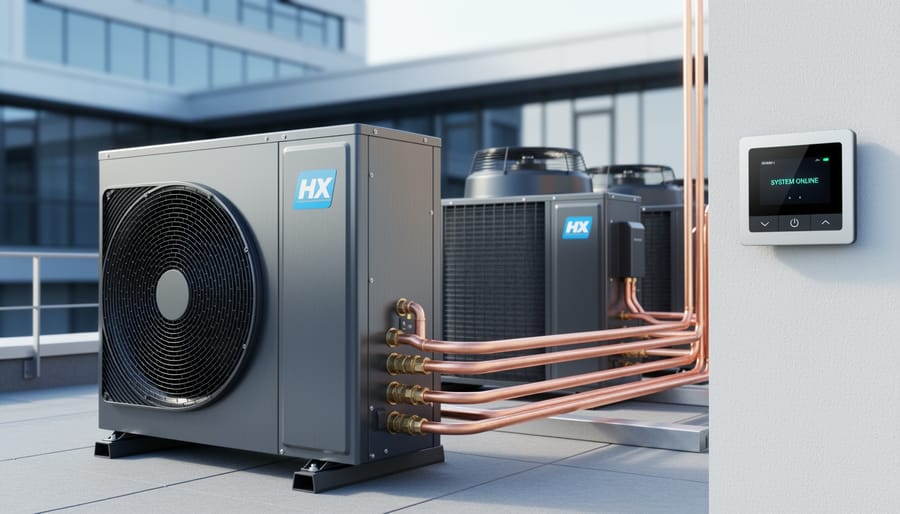
Thermal energy rating in air conditioning units is a standardized metric that quantifies how efficiently an HVAC system converts electrical input into cooling or heating output under specified operating conditions. For construction professionals specifying equipment in 2026, these ratings translate directly to lifecycle operating costs, peak demand charges, and compliance with increasingly stringent building energy codes.
The ratings landscape has grown more complex as smart HVAC integration becomes standard practice. Where traditional SEER and EER metrics measure performance at fixed conditions, newer rating frameworks account for variable-speed operation, load-following behavior, and communication with building automation systems. Understanding which rating applies to your application determines whether a unit will perform as modeled or fall short during commissioning.
This matters because thermal energy ratings drive three critical decisions: equipment selection during design development, energy modeling for permit submissions, and operational optimization after occupancy. A high-rated unit poorly matched to load profiles can underperform a lower-rated system engineered for actual demand patterns. MEP engineers routinely encounter this gap between nameplate ratings and field performance, particularly in mixed-use developments where cooling loads shift throughout the day.
This article breaks down how thermal ratings are calculated, what each metric measures in real operating scenarios, and how to apply them when integrating condensing units with smart controls and variable refrigerant flow systems. You’ll also find guidance on reconciling manufacturer data with energy code requirements and selecting ratings that align with your building’s operational profile rather than simply chasing the highest number on the spec sheet.
What Thermal Energy Rating Means for HVAC Performance
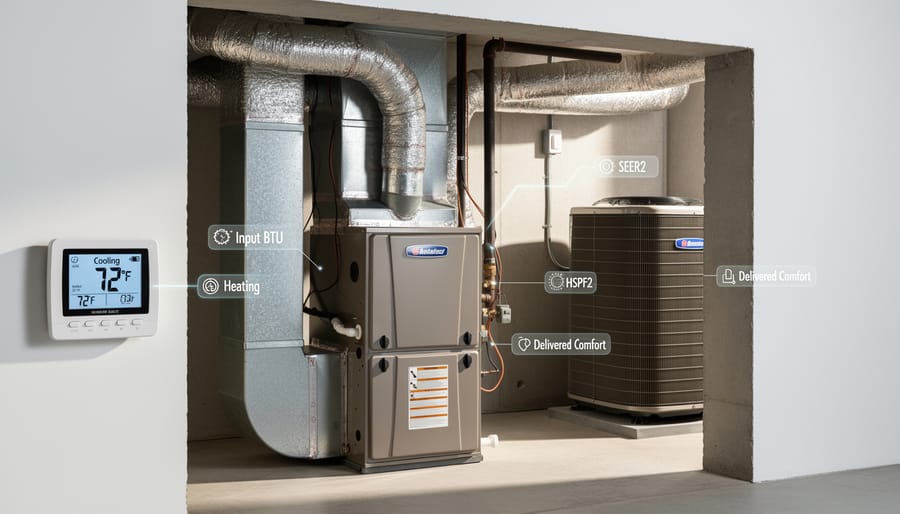
Thermal energy rating serves as the construction industry’s essential benchmarking tool for quantifying how effectively an air conditioning unit moves heat from one space to another. At its core, this standardized metric measures the relationship between electrical energy consumed and thermal energy transferred, a fundamental performance indicator that directly impacts both operational costs and building energy compliance.
The rating system expresses cooling capacity in two primary units: BTU per hour (British Thermal Units per hour) in North American markets, or kilowatts in regions using metric standards. A unit rated at 36,000 BTU/h (approximately 10.5 kW) can remove that quantity of heat from conditioned space under specified test conditions. This capacity measurement tells you the size of the thermal load the equipment can handle, but it reveals only half the performance picture.
Energy efficiency ratios complete the assessment by comparing thermal output to electrical input. These ratios expose how much cooling or heating you receive per unit of electricity consumed, the critical factor that determines lifecycle operating costs and carbon footprint. A higher ratio means more thermal energy transfer per watt of grid power, translating directly to lower utility bills and reduced environmental impact across the building’s operational lifespan.
- BTU (British Thermal Unit)
- The amount of heat required to raise one pound of water by one degree Fahrenheit; the standard unit for measuring thermal energy transfer in HVAC systems.
- kW (kilowatt)
- A metric unit measuring both electrical power consumption and thermal energy transfer rate; 1 kW equals approximately 3,412 BTU/h.
- EER (Energy Efficiency Ratio)
- The ratio of cooling capacity (BTU/h) to electrical power input (watts) at a specific operating condition, typically 95°F outdoor temperature. Higher EER values indicate better peak efficiency.
- SEER (Seasonal Energy Efficiency Ratio)
- A weighted-average efficiency metric that accounts for varying outdoor temperatures throughout a typical cooling season, providing a more realistic annual performance estimate than EER alone.
- COP (Coefficient of Performance)
- The ratio of thermal energy output to electrical energy input, expressed as a pure number rather than BTU/watt; commonly used for heat pumps and in metric-system specifications.
For building performance specifications, these ratings determine whether proposed HVAC equipment meets energy code minimums, qualifies for utility rebates, and aligns with sustainability targets. An MEP engineer specifying a variable refrigerant flow system for a commercial office needs thermal ratings to calculate annual energy consumption, size electrical infrastructure, and demonstrate code compliance. The difference between a 14 SEER unit and an 18 SEER unit represents a 28% reduction in cooling energy use, a gap that compounds across thousands of operating hours and dozens of zones in a large facility.
How Thermal Energy Rating Systems Work
Testing Standards and Certification
Two primary standards govern thermal energy rating verification in North America and internationally. AHRI 210/240, administered by the Air-Conditioning, Heating, and Refrigeration Institute, establishes the testing protocol for unitary air conditioners and heat pumps under 65,000 BTU/h. This standard mandates testing at specific operating conditions: 95°F outdoor temperature for cooling mode and 47°F for heating mode, with indoor conditions held at 80°F dry bulb and 67°F wet bulb.
ISO 5151 provides the international framework, using slightly different test conditions but measuring the same fundamental parameters: cooling capacity, power input, and energy efficiency ratio. Both standards require testing in psychrometric chambers that precisely control temperature and humidity.
Independent laboratories certified by AHRI conduct the actual testing. Manufacturers submit units for evaluation, and the lab records thermal performance across multiple operating points. The certification process includes random market sampling to verify that production units match rated specifications. Units passing verification earn the AHRI Certified mark, which construction specifications typically require. Ratings must be reverified whenever manufacturers change compressors, coils, or refrigerants that affect thermal performance.
Real-World Performance vs. Rated Capacity
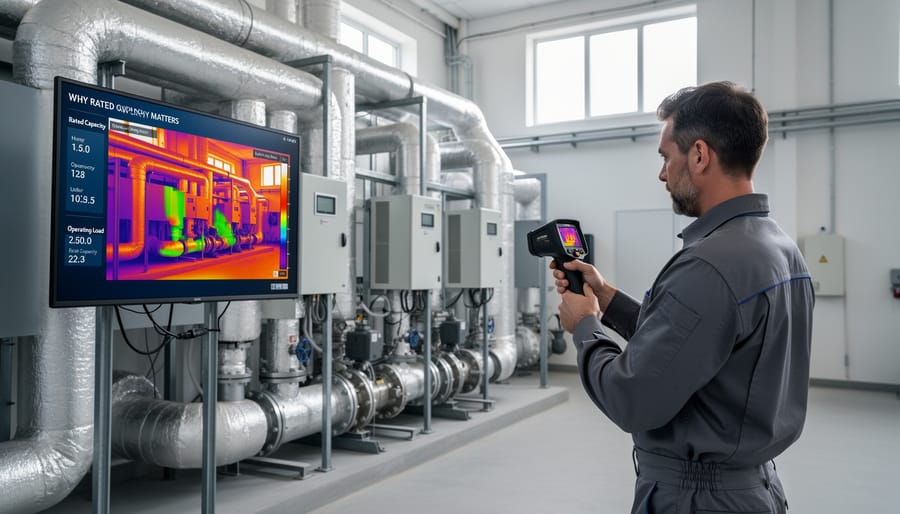
Laboratory-tested thermal energy ratings provide a standardized baseline, but field performance typically falls 10-30% below these certified numbers. This gap exists because testing occurs under controlled conditions that don’t reflect the messy realities of actual installations.
Installation quality creates the most significant performance variance. Improper refrigerant charge, even 10% off specification, can reduce efficiency by 20%. Incorrectly sized or sealed ductwork forces the system to work harder, driving energy consumption up while cooling capacity drops. A unit rated at 18,000 BTU/h might deliver only 14,000 BTU/h if duct leakage exceeds 15% of airflow.
Climate conditions rarely match test parameters. Standard ratings use 95°F outdoor temperature and 80°F indoor with 50% humidity. Units operating in Phoenix’s 115°F summers or Houston’s 90% humidity conditions see measurably lower efficiency than their nameplate ratings suggest.
Building envelope issues compound the problem. Air leakage, inadequate insulation, and thermal bridging increase the actual cooling load beyond design calculations, forcing equipment to run longer cycles at reduced efficiency. A properly rated unit becomes undersized when the building itself underperforms.
For accurate performance predictions, apply a 15-20% derating factor to manufacturer specifications when conditions deviate from standard test protocols.
Categories of Thermal Energy Ratings
The HVAC industry uses several distinct thermal energy rating systems, each designed to measure performance under specific operating conditions. Understanding which rating applies to your project ensures you’re comparing units on the appropriate metric for your climate zone and building type.
SEER and SEER2 (Seasonal Energy Efficiency Ratio) measure cooling efficiency across an entire cooling season rather than at a single operating point. The rating reflects average performance during varying temperatures and humidity levels, from mild spring evenings to peak summer heat. SEER2, introduced in 2023, uses updated testing conditions that better reflect real-world ductwork scenarios and is now the required standard for residential and light commercial equipment. A SEER2 rating of 14.3 meets the minimum federal requirement in southern states, while 13.4 applies to northern regions. High-efficiency units reach SEER2 values of 20 or higher, though the cost premium requires careful payback analysis.
EER (Energy Efficiency Ratio) measures cooling performance at a fixed outdoor temperature of 95°F with 80°F indoor conditions. This single-point rating matters most in consistently hot climates where units operate near peak capacity for extended periods. Data centers, server rooms, and facilities in desert climates should prioritize EER alongside SEER2 because peak load performance directly affects electrical demand charges. An EER of 12 represents good efficiency; commercial units can exceed 14.
For heat pumps, HSPF and HSPF2 (Heating Seasonal Performance Factor) measure heating efficiency across a winter season. HSPF2, the current standard, requires a minimum of 7.5 for split systems in most regions. Projects in heating-dominated climates should weight HSPF2 more heavily than cooling ratings. Cold-climate heat pumps maintain rated capacity down to -15°F or lower, a critical specification for northern construction projects where heating loads dominate annual energy use.
IEER (Integrated Energy Efficiency Ratio) applies to commercial variable-capacity units operating under part-load conditions. Unlike EER’s full-load snapshot, IEER weights performance at 100%, 75%, 50%, and 25% capacity to reflect how commercial buildings actually operate throughout the day. A rooftop unit serving office space runs at part-load 80% of operating hours, making IEER the most relevant metric for commercial projects. IEER values typically exceed EER by 20-30% for the same equipment.
Climate zone drives which rating matters most. Cooling-dominated regions in the Southeast prioritize SEER2 and EER. Mixed climates require balanced SEER2 and HSPF2. Heating-focused northern projects should maximize HSPF2 even if it means accepting lower SEER2 values.
Applications in Smart Energy HVAC Systems

Modern smart energy systems leverage thermal energy ratings as foundational data for automated HVAC optimization. Building automation systems (BAS) continuously compare actual thermal output against rated capacity to identify performance degradation, efficiency losses, and opportunities for load shifting. When an air handler delivers 85% of its rated cooling capacity while drawing 100% rated power, the BAS flags the unit for inspection and compensates by redistributing load to higher-performing equipment in adjacent zones.
Energy management platforms now integrate thermal rating data with real-time utility pricing, weather forecasts, and occupancy patterns. During peak demand periods, the system precools spaces using high-SEER equipment during off-peak hours, then reduces compressor runtime when electricity costs spike. This demand response capability, guided by each unit’s thermal performance profile, can cut cooling costs by 20-30% in commercial facilities without sacrificing occupant comfort.
Predictive maintenance protocols track thermal output against baseline ratings over time. A gradual decline from rated capacity, say, a 3-ton unit consistently delivering 2.7 tons, triggers work orders before catastrophic failure occurs. This performance monitoring extends equipment life and prevents emergency replacements during peak cooling season.
Integrating thermal ratings into distributed energy management systems yields measurable benefits:
- Automated load balancing across multiple units based on real-time efficiency ratios
- Energy cost optimization through demand-responsive staging of high-rated equipment
- Predictive equipment replacement planning driven by performance trend analysis
- Compliance documentation for energy benchmarking and green building certifications
Zone-level optimization represents the practical payoff. Smart platforms adjust airflow, refrigerant pressure, and compressor staging based on each zone’s cooling load relative to installed capacity. A conference room requiring 60% of rated capacity runs its variable-speed compressor at optimal efficiency, while perimeter zones with higher solar loads draw from units sized and rated for peak conditions. This granular control, impossible without accurate thermal rating data, delivers whole-building energy savings that compound across heating and cooling seasons.
Selecting AC Units Based on Thermal Ratings
Choosing the right air conditioning unit starts with matching thermal ratings to your specific project requirements, not defaulting to the highest-rated equipment available. Begin with a detailed building load calculation that accounts for occupancy patterns, internal heat gains from lighting and equipment, solar exposure through glazing, and envelope thermal performance. These calculations define the required cooling capacity, and only then should you evaluate efficiency ratings against that baseline need.
Climate zone profoundly shapes which thermal ratings matter most. In hot-humid regions like ASHRAE Zone 1, prioritize high SEER2 values and robust dehumidification capabilities. In hot-dry climates (Zone 2), peak EER becomes critical for handling afternoon temperature spikes. For mixed climates, balanced SEER2 and HSPF2 ratings deliver year-round performance. The current 2026 DOE minimum standards require commercial packaged units to meet 11.0 EER for air-cooled systems under 65,000 BTU/h, but most commercial specifications target 12.5-14.0 EER for meaningful operational savings.
Cost-benefit analysis should extend beyond first costs to total cost of ownership. A unit with 15 SEER2 versus 13 SEER2 might carry a 12-18% price premium, but in a 50,000-square-foot office running 12 hours daily, that efficiency gap translates to $3,200-4,800 in annual energy savings at typical commercial rates. Payback periods of 3-5 years are common for higher-rated equipment, particularly when integrated with smart grid tech that optimizes run times around demand charges.
What is a good SEER rating for commercial buildings?
Commercial buildings should target SEER2 ratings of 14-16 for standard applications, with values above 16 reserved for high-performance buildings or utility incentive programs. The specific target depends on climate zone, operating hours, and energy cost structure.
How do thermal ratings affect operational costs?
Each point of SEER improvement typically reduces cooling energy consumption by 7-8%, directly lowering utility bills and demand charges. Over a unit’s 15-20 year lifespan, efficiency gains from higher ratings can exceed the initial equipment cost difference.
Do higher ratings always justify the upfront cost?
Not always, payback depends on runtime hours, local energy rates, and available utility rebates. Buildings with limited cooling seasons or low occupancy may not recover the premium for top-tier efficiency.
How often are rating standards updated?
DOE typically updates minimum efficiency standards every 5-7 years, with the most recent commercial AC standards taking effect in 2023. Industry rating methodologies like SEER2 were introduced in 2023 to reflect more realistic field conditions.
Factor in utility incentive programs that can offset 10-25% of the incremental cost for high-efficiency equipment. Many jurisdictions now require efficiency levels above federal minimums for permit approval, making thermal ratings a compliance issue beyond performance optimization. Cross-reference ratings with warranty terms, as higher-efficiency units often include extended compressor coverage that reduces lifecycle risk.
Understanding thermal energy ratings has become essential for construction professionals navigating today’s performance-driven building environment. These standardized metrics provide the foundation for informed HVAC specification decisions, enabling teams to predict actual energy consumption, compare equipment objectively, and meet increasingly stringent efficiency mandates.
The integration of thermal rating data with smart energy management platforms represents a fundamental shift in how we approach HVAC performance. Real-time monitoring of thermal efficiency against rated capacity allows building systems to self-optimize, delivering measurable reductions in operational costs while maintaining occupant comfort. For projects targeting LEED certification or net-zero performance, this data-driven approach transforms thermal ratings from compliance checkboxes into strategic design tools.
As DOE standards continue to tighten and testing protocols evolve toward more realistic operating conditions, thermal energy ratings will play an expanding role in building decarbonization efforts. The construction professionals who master these metrics now position themselves to specify systems that meet both current code requirements and future performance expectations, ensuring their projects remain energy-competitive throughout their operational lifespan.
