
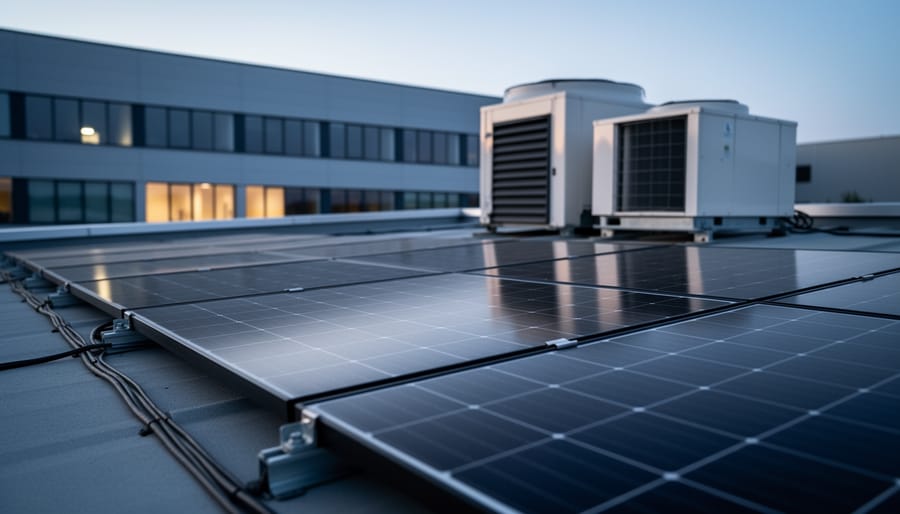
Zero-energy buildings achieve net-zero annual energy consumption by generating as much renewable energy on-site as they consume, primarily through the integration of solar photovoltaic arrays with highly efficient HVAC systems and building envelopes designed to minimize thermal loads. For construction professionals and engineers planning ZEB projects in 2026, success hinges on understanding how renewable energy systems, advanced HVAC technologies, and building design work together as an integrated system rather than as separate components added to a conventional structure.
The technical and economic landscape has shifted dramatically. What seemed experimental a decade ago now represents proven, scalable technology with documented performance in commercial, institutional, and residential applications across diverse climate zones. Projects completed between 2020 and 2025 have generated substantial real-world data on system performance, maintenance requirements, and actual versus modeled energy consumption, providing the evidence base that early adopters lacked.
The critical challenge lies not in whether zero-energy performance is achievable but in how to design and specify systems that deliver reliable results without cost overruns or performance gaps. HVAC system selection and sizing represent the most consequential decisions in ZEB design. Oversizing equipment to meet peak loads using conventional methods undermines the entire energy model, while undersizing creates comfort and durability issues that no amount of renewable generation can solve.
This analysis examines how renewable-powered HVAC systems function within zero-energy buildings, drawing on recent case studies, system performance data, and insights from mechanical engineers and architects who have designed and commissioned successful projects. We’ll address practical design strategies, equipment specifications, integration challenges, and cost considerations that determine whether a zero-energy building meets its performance targets or falls short.
Understanding Zero-Energy Buildings: Definition and Core Principles
A zero-energy building produces as much energy on-site as it consumes over the course of a year, achieving net zero energy over a year through a combination of aggressive efficiency measures and renewable generation. This annual energy balance distinguishes ZEBs from simply “efficient” buildings: the structure must generate power, typically via photovoltaic arrays or other on-site renewable systems, to offset 100% of its grid-supplied energy.
The distinction between net-zero energy, net-zero carbon, and nearly zero-energy buildings matters for specification and compliance. Net-zero energy focuses strictly on the kilowatt-hour balance between consumption and generation, measured at the building’s meter. Net-zero carbon extends this to include embodied carbon in materials and construction, plus operational carbon emissions based on grid fuel sources. Nearly zero-energy buildings, common in European standards, achieve very high efficiency with minimal renewable generation, but don’t necessarily reach the full zero threshold.
- Net-Zero Energy
- A building that produces at least as much energy on-site as it consumes annually, measured in kilowatt-hours at the utility meter. The energy balance can be calculated using site energy or source energy metrics.
- Net-Zero Carbon
- Extends net-zero energy to account for both operational carbon emissions and embodied carbon from materials and construction. Requires offsets or renewable generation sufficient to eliminate the building’s carbon footprint.
- Energy Use Intensity (EUI)
- The total annual energy consumption divided by gross floor area, expressed as kBtu/sf/year or kWh/m²/year. ZEBs typically target an EUI below 25 kBtu/sf/year before adding renewable generation.
- Site vs. Source Energy
- Site energy is measured at the building boundary; source energy accounts for losses in generation and transmission from power plants to the site. Source energy provides a more accurate picture of total energy impact.
The fundamental principle underlying all ZEB definitions is load reduction first, generation second. You can’t simply bolt solar panels onto a conventional building and call it zero-energy. Construction teams must achieve dramatic reductions in baseline energy demand through envelope improvements, efficient mechanical systems, and smart controls before sizing renewable arrays. This sequence determines feasibility: a building with a 50 kBtu/sf/year EUI might require an impossibly large photovoltaic array, while one at 20 kBtu/sf/year can reach zero with a reasonably-sized rooftop installation.
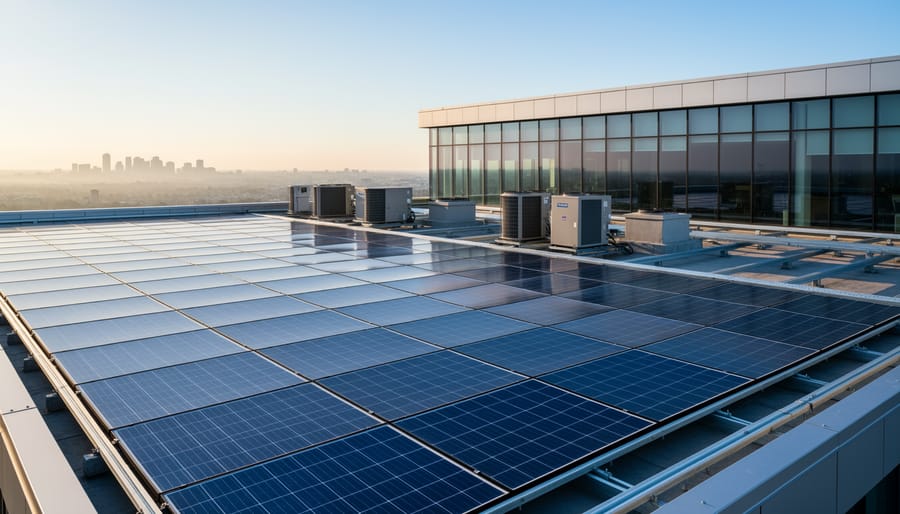
The Critical Role of HVAC Systems in Achieving Zero-Energy Performance
Energy-Efficient HVAC Technologies Enabling Zero-Energy Design
Achieving zero-energy performance requires HVAC systems that slash consumption by 40-70% compared to conventional equipment while seamlessly interfacing with renewable generation. Four technology categories have proven essential in operational ZEBs.
Ground-source heat pumps deliver heating and cooling at coefficients of performance between 3.5 and 5.0, meaning they move three to five units of thermal energy for every unit of electricity consumed. By exchanging heat with stable subsurface temperatures rather than outdoor air, these systems maintain efficiency even during peak demand periods when renewable HVAC systems face their greatest stress. Loop field sizing typically requires 150-200 feet of bore depth per ton of capacity, making upfront costs substantial but operational savings dramatic.
Variable refrigerant flow systems use inverter-driven compressors and refrigerant modulation to match output precisely to instantaneous loads. Unlike conventional systems cycling on and off, VRF equipment runs continuously at partial capacity, eliminating the efficiency penalties of startup transients. Simultaneous heating and cooling capability allows heat recovery between zones, reducing overall building load by 20-30% in mixed-use applications.
Dedicated outdoor air systems decouple ventilation from space conditioning, allowing each to operate at optimal efficiency. DOAS units precondition fresh air using energy recovery wheels that capture 70-85% of heating and cooling energy from exhaust streams, then deliver neutral-temperature ventilation directly to spaces while separate systems handle sensible loads.
Radiant heating and cooling panels eliminate ductwork losses and leverage low-temperature water loops ideal for heat pump efficiency. Because radiant systems move energy through water rather than air, pump energy represents just 2-5% of thermal delivery versus 10-15% for fan energy in forced-air systems, further reducing the renewable generation capacity required to achieve net-zero performance.
Renewable Energy Integration: Solar, Wind, and Geothermal
Sizing renewable generation starts with accurate HVAC load modeling under actual operating conditions, not theoretical peaks. Most zero-energy projects target photovoltaic arrays capable of producing 110-130% of annual HVAC consumption to account for system losses, inverter inefficiency, and seasonal variation. A typical 50,000-square-foot commercial building with optimized HVAC might require 150-200 kW of solar capacity, sized after load reduction measures cut demand by 40-50% below conventional baselines.
The integration methodology differs fundamentally from standard grid-tied systems. Engineers must map hourly HVAC load profiles against site-specific solar production curves to identify mismatches. Ground-source heat pumps shift load patterns favorably because heating and cooling demands often align with shoulder seasons when solar production remains strong. Variable refrigerant flow systems allow zone-level modulation that better matches incremental generation throughout the day.
Battery storage has become economically viable for managing the evening peak when HVAC loads persist but solar production drops. Lithium-ion systems sized for 3-4 hours of HVAC operation, typically 75-150 kWh for commercial applications, bridge the gap without excessive grid draw. The renewable energy system must include real-time monitoring to prioritize direct HVAC use over battery charging or export.
Grid interaction remains necessary for true zero-energy performance despite on-site generation. Net metering agreements allow excess daytime production to offset nighttime HVAC draw, achieving annual balance even with daily imbalances. Advanced inverters provide grid support functions, frequency regulation, voltage support, that strengthen the business case when utility programs compensate for these services. Wind turbines rarely pencil out for commercial projects given zoning restrictions and inconsistent urban wind resources, while geothermal systems serve as the foundation load-reduction strategy rather than a generation source, cutting HVAC demand that PV arrays must offset.
Design Strategies for Zero-Energy Building Success
Passive Design and Building Envelope Optimization
Passive design strategies form the foundation of any zero-energy building by dramatically reducing HVAC loads before mechanical systems are specified. The principle is straightforward: every kilowatt-hour not consumed is a kilowatt-hour that doesn’t need to be generated, making renewable energy systems smaller, less expensive, and more feasible.
Building orientation on the site can reduce cooling loads by 20-30% simply by minimizing east and west glazing exposure to harsh morning and afternoon sun. South-facing facades in northern climates maximize winter solar heat gain while allowing for effective shading during summer months. Window-to-wall ratios in high-performance ZEBs typically range from 25-35%, compared to 40-60% in conventional commercial buildings, strategically balancing daylighting benefits against thermal losses.
The building envelope functions as the primary thermal barrier. Continuous insulation values of R-30 to R-40 for walls and R-50 to R-60 for roofs are common in zero-energy construction, compared to code-minimum R-13 to R-20 wall assemblies. Air tightness targets of 0.25 air changes per hour at 50 pascals pressure (ACH50) eliminate infiltration losses that plague conventional buildings, which often test at 3-7 ACH50.
Thermal mass strategies using concrete floors or masonry walls moderate interior temperature swings by absorbing excess heat during the day and releasing it at night, flattening demand curves for microgrid solutions and HVAC equipment. When properly executed, these passive measures can reduce mechanical heating and cooling loads by 50-70% compared to baseline construction.
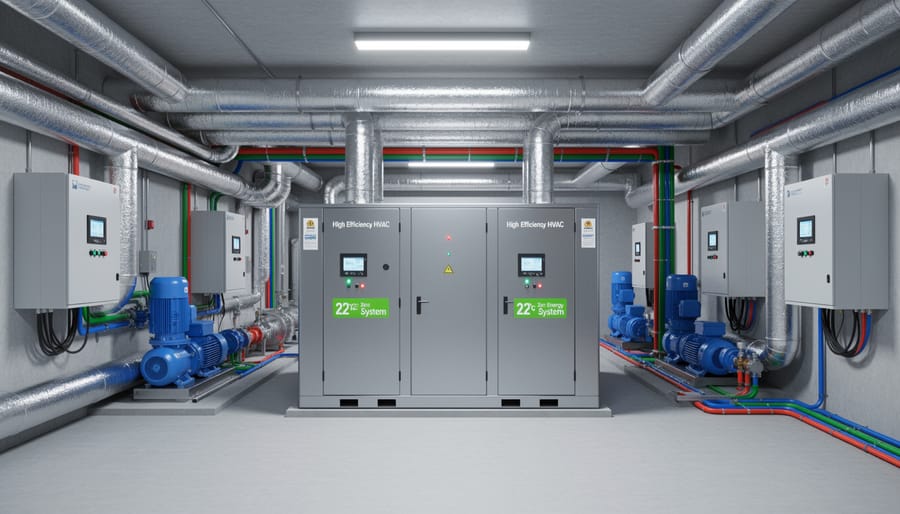
Load Reduction Before Generation
The most fundamental principle of zero-energy building design is deceptively simple: reduce energy demand before generating it. Every kilowatt-hour eliminated through efficiency measures means one less solar panel on the roof, a smaller battery system in the mechanical room, and reduced upfront capital costs.
Construction professionals should target 40-60% energy reduction compared to conventional buildings through efficiency alone. This isn’t aspirational, projects like the Bullitt Center in Seattle achieved 83% reduction before renewable generation. The practical impact is substantial: a building requiring 30 kWh/sf/year instead of 50 kWh/sf/year needs 40% less PV capacity, translating to $200,000+ savings on a 50,000 sf project.
The load reduction hierarchy starts with envelope improvements delivering the highest returns. High-performance glazing, continuous insulation, and air sealing reduce HVAC loads by 30-40%. LED lighting with daylight harvesting cuts electrical demand another 20-30%. High-efficiency HVAC equipment, heat recovery ventilators, variable speed drives, demand-controlled ventilation, addresses the remaining load.
This aggressive efficiency approach transforms renewable energy from an overwhelming requirement into a manageable addition. When base loads drop to 20-25 kWh/sf/year, achievable roof-mounted PV arrays can realistically offset annual consumption, making net-zero performance financially viable for commercial construction.
Real-World Case Studies: Zero-Energy Buildings in Practice
The Bullitt Center in Seattle remains the gold standard for commercial zero energy buildings having achieved net-zero operation for over a decade. This six-story, 50,000-square-foot office building demonstrates how aggressive passive strategies coupled with right-sized mechanical systems deliver verifiable results. The design team oriented the building on a true east-west axis, maximizing southern exposure for both daylighting and the 575 kW rooftop solar array. Rather than conventional forced-air systems, the project uses a combination of operable windows for natural ventilation, radiant floor heating supplied by ground-source heat pumps, and an energy recovery ventilation system for times when windows cannot be opened. The building’s actual energy use intensity of 16 kBtu/sq ft/year consistently undercuts the predicted 17 kBtu/sq ft/year, with the PV system generating 110-115% of annual consumption. Critical to this performance: an airtight envelope (0.12 cfm50/sq ft of surface area) and a daylighting strategy that eliminated perimeter electrical lighting during occupied hours.
Discovery Elementary in Arlington, Virginia, proves that zero-energy performance works for the unique demands of K-8 schools. This 100,000-square-foot educational facility handles high ventilation rates, varied occupancy schedules, and kitchen loads while hitting net-zero verified through four years of operation. The mechanical approach centered on two 120-ton ground-source heat pumps coupled with a dedicated outdoor air system featuring energy recovery wheels. The DOAS pre-conditions ventilation air before it reaches the heat pumps, dramatically reducing the load on the ground loop. A 392 kW rooftop PV array covers 60% of the roof area, generating roughly 460,000 kWh annually against consumption of 445,000 kWh. The project achieved an EUI of 27.2 kBtu/sq ft/year, 72% below the national average for schools.
| Project Name | Type / Size | HVAC System | PV Capacity | EUI Achieved |
|---|---|---|---|---|
| Bullitt Center | Office / 50,000 sq ft | GSHP + radiant + ERV | 575 kW | 16 kBtu/sq ft/yr |
| Discovery Elementary | School / 100,000 sq ft | GSHP + DOAS + ERV | 392 kW | 27.2 kBtu/sq ft/yr |
| Petal House | Residential / 2,400 sq ft | Air-source HP + HRV | 9.8 kW | 18 kBtu/sq ft/yr |
Petal House in Austin, Texas, translates these principles to residential scale with a compact 2,400-square-foot single-family home that has met net-zero for three consecutive years. The project uses a high-efficiency air-source heat pump (19.5 SEER cooling, 11 HSPF heating) with a heat recovery ventilator providing continuous fresh air. A 9.8 kW solar array occupies most of the south-facing roof, generating about 14,500 kWh annually. The modest mechanical system works because the passive design eliminated most of the load: R-38 walls, R-60 roof, triple-pane windows (U-0.18), and an air infiltration rate of 0.6 ACH50. Monthly utility data confirms annual net generation of 480 kWh above consumption, demonstrating that residential zero-energy doesn’t require exotic technology or massive PV arrays when the envelope fundamentals are handled correctly first.
Cost Considerations and Return on Investment
Zero-energy buildings typically require an upfront cost premium of 3-12% compared to code-compliant conventional construction, with the wide range reflecting project scale, complexity, and regional market conditions. For a 50,000-square-foot commercial office building, this translates to approximately $150,000-$600,000 in additional first costs. The largest contributors to this premium are high-performance envelope components (40-50%), advanced HVAC systems (30-35%), and on-site renewable generation (20-25%).
Integrated renewable HVAC systems represent a significant portion of the investment. A properly sized ground-source heat pump system with a distributed PV array might cost $45-$65 per square foot installed, compared to $25-$35 per square foot for a conventional system. However, this comparison misses the critical point: the ZEB’s reduced loads mean both the HVAC equipment and renewable generation capacity can be smaller than simple addition would suggest.
The financial case becomes compelling when analyzing lifecycle costs. Zero-energy buildings eliminate or drastically reduce utility expenses, the second-largest operating cost after labor for most commercial facilities. A building consuming 25 kBtu/sf/year at conventional utility rates versus essentially zero purchased energy yields annual savings of $1.50-$2.50 per square foot, depending on local rates. Over a 30-year analysis period, these savings typically exceed the initial premium by factors of 2-4x.
Federal investment tax credits (30% for solar through 2032), accelerated depreciation schedules, and state-level incentives further improve returns. Many jurisdictions now offer rebates specifically for renewable HVAC integration, reducing effective first costs by 15-25%.
Realistic payback periods for zero-energy commercial buildings range from 8-15 years without incentives, dropping to 5-10 years when available programs are maximized. Projects with higher energy costs (laboratories, data centers, hospitals) see faster returns. The equation shifts dramatically in new construction versus retrofits; purpose-built ZEBs achieve better economics than conversions attempting to reach zero energy.
Regulatory Landscape and Emerging Standards
The regulatory environment for zero-energy buildings has shifted from aspirational to mandatory across much of North America. The 2024 International Energy Conservation Code (IECC) introduced the most aggressive efficiency requirements yet, establishing a clear trajectory toward zero-energy commercial construction by 2030. Many jurisdictions have adopted these standards ahead of schedule, with California’s Title 24 requiring solar-ready construction for most commercial buildings and increasingly stringent HVAC efficiency thresholds that effectively necessitate heat pump technology and advanced controls.
State-level mandates are accelerating adoption faster than federal policy. Washington requires all new commercial buildings over 50,000 square feet to demonstrate net-zero readiness by 2030. New York City’s Local Law 97 imposes carbon caps on existing buildings that make renewable-powered HVAC retrofits economically compelling. Colorado has enacted stretch codes that allow municipalities to require near-zero energy performance, which Denver and Boulder have already implemented for commercial projects.
Beyond code compliance, voluntary certification programs are establishing market leadership standards. LEED Zero certification requires actual net-zero energy, water, waste, or carbon performance verified through at least 12 months of operational data, a significant departure from design-intent ratings. The Living Building Challenge remains the most rigorous framework, demanding net-positive energy generation and eliminating any grid-supplied fossil fuel energy, including for HVAC systems.
For construction professionals, these evolving standards mean zero-energy design is transitioning from specialized green building to baseline expectation. Projects beginning design in 2026 must account for codes that will be in effect at occupancy, often 18-24 months forward, making renewable HVAC integration a planning necessity rather than an enhancement.
Implementation Challenges and Practical Solutions
Despite their proven benefits, zero-energy buildings still face significant hurdles in widespread adoption. Construction professionals encounter five recurring challenges: upfront cost premiums, the complexity of coordinated design, gaps in contractor expertise, difficulty verifying actual performance, and unpredictable occupant behavior that can undermine designed efficiency.
The cost barrier remains the most cited obstacle. Integrated renewable HVAC systems and enhanced building envelopes typically add 8-15% to initial construction budgets, though this premium has dropped from 20-25% just five years ago. The solution lies in reframing the conversation with clients around total cost of ownership rather than first cost alone. Present lifecycle cost analyses that show net savings within 7-12 years, and aggressively pursue available incentives, federal tax credits, state rebates, and utility programs can offset 20-40% of the renewable energy system costs. Value engineering should target low-impact items rather than compromising core performance features; cutting insulation or downsizing the PV array to save 3% upfront often doubles the payback period.
Design complexity multiplies when coordinating passive strategies, high-efficiency HVAC, and renewable generation systems. The practical solution is implementing integrated design workshops during early schematic phases, before major decisions lock in. Bring your architect, MEP engineers, energy modeler, and key subcontractors into the same room for facilitated sessions focused on trade-offs and synergies. This front-loaded collaboration identifies conflicts early, like ensuring the roof structure can support planned solar arrays while maintaining optimal tilt angles, and prevents expensive redesigns during construction documents.
Contractor unfamiliarity with ZEB systems creates execution risks that no design can overcome. Many trades have limited experience with ground-source heat pump installations, advanced air sealing details, or PV system integration with HVAC controls. Address this through pre-construction training sessions for your key trades, focusing on critical details like maintaining continuous insulation, proper DOAS installation, and commissioning requirements. Consider partnering with specialty subcontractors for first projects, then transitioning knowledge to your regular trade partners. Require mock-ups for unfamiliar assemblies before full-scale installation.
Performance verification separates true zero-energy buildings from those that merely promised it on paper. The gap between modeled and actual performance averages 25-30% in buildings without rigorous commissioning and monitoring. Build commissioning costs into every ZEB budget, typically 1-2% of project cost, and insist on a minimum one-year monitoring period with monthly energy reporting. Install submetering for major loads so you can identify underperforming systems rather than discovering problems through utility bills alone. Establish performance targets in your contracts with consequences for missing them, and ensure your commissioning agent has authority to reject work that doesn’t meet air tightness or system efficiency specifications.
Occupant behavior remains the wildcard. Employees who prop open doors, override temperature setpoints, or leave equipment running can increase energy consumption by 20-40%. Counter this through building-specific user guides, hands-on training sessions during move-in, and real-time energy dashboards that make consumption visible. Some successful projects establish “energy champions” among occupants who receive training and advocate for proper building use. Design your controls with reasonable user control, overly restrictive systems prompt workarounds, but limit adjustments that compromise core performance.
Zero-energy buildings have crossed the threshold from aspirational concept to practical construction reality. The market momentum in 2026 demonstrates that ZEBs are no longer niche demonstration projects but increasingly standard offerings for clients prioritizing operational cost reduction, regulatory compliance, and sustainability commitments. Construction professionals who master the integration of renewable energy-powered HVAC systems position themselves at the forefront of this transition.
The evidence is clear: buildings achieving net-zero performance rely fundamentally on the marriage of high-efficiency HVAC technology with appropriately sized renewable generation. The case studies examined show that when ground-source heat pumps, advanced air handling, and radiant systems are paired with solar arrays and energy storage, annual energy balance becomes achievable across diverse building types and climate zones. The initial cost premium of 8-15% is increasingly offset by available incentives, long-term operational savings, and enhanced asset value.
Looking ahead, regulatory pressures will intensify rather than diminish. Building codes continue their march toward mandatory net-zero targets, with California, Washington, and New York leading state-level requirements that other jurisdictions will follow. Construction firms that treat zero-energy design as optional risk obsolescence within the next decade.
The practical path forward involves upskilling project teams in integrated design processes, establishing relationships with specialized HVAC and renewable energy contractors, and developing internal expertise in energy modeling and performance verification. The complexity is manageable with proper planning and collaboration from project inception.
Zero-energy buildings represent the future baseline for commercial construction. The question facing professionals today is not whether to engage with this market shift, but how quickly to build the capabilities that clients will demand as standard practice.
