
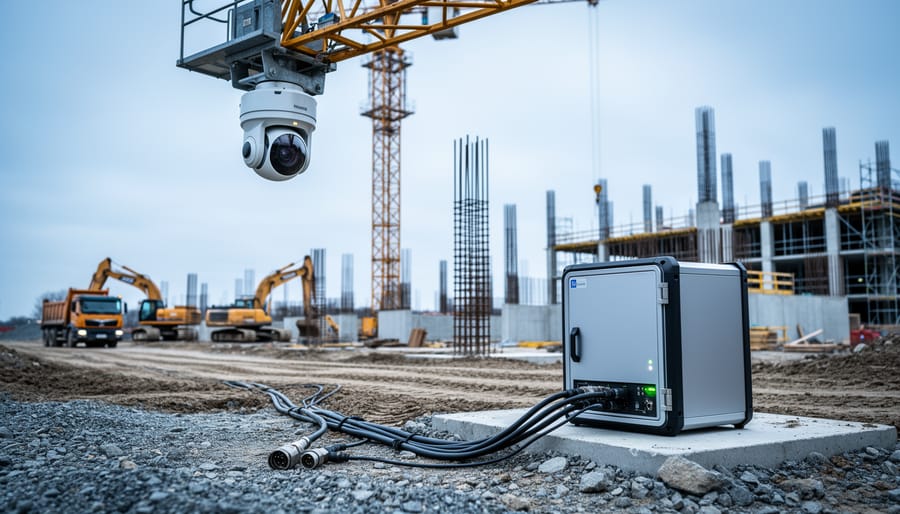
In edge computing, data is processed locally at or near the source where it’s generated, rather than being sent to a distant cloud server or centralized data center. On construction sites, this means sensors, cameras, drones, and connected equipment analyze information right on the job site using edge devices like gateways, onboard computers, or ruggedized servers positioned within the construction zone itself.
This local processing architecture solves a critical challenge for construction professionals: the need for real-time decision-making in environments where connectivity is unreliable and delays are costly. When a crane-mounted camera detects a potential safety hazard, or when a concrete sensor flags incorrect curing conditions, waiting seconds or minutes for cloud processing isn’t acceptable. Edge computing delivers answers in milliseconds.
The “where” matters because construction sites generate massive volumes of data on building sites from BIM model updates and equipment telemetry to environmental sensors and worker location tracking. Transmitting all of this raw data off-site creates bandwidth bottlenecks, increases costs, and introduces latency that undermines the value of real-time monitoring systems.
Industry adoption has accelerated significantly since 2024, driven by smarter jobsite equipment and growing recognition that construction’s digital transformation requires computing infrastructure as robust as its physical infrastructure. Leading contractors now deploy edge solutions for applications ranging from autonomous equipment coordination to quality control verification, processing terabytes of sensor data without overwhelming network connections or cloud storage budgets.
Understanding where your construction data is processed, and why that location provides strategic advantages, has become essential knowledge for project managers and technology decision-makers evaluating digital tools for modern job sites.
Where Edge Computing Actually Processes Construction Data
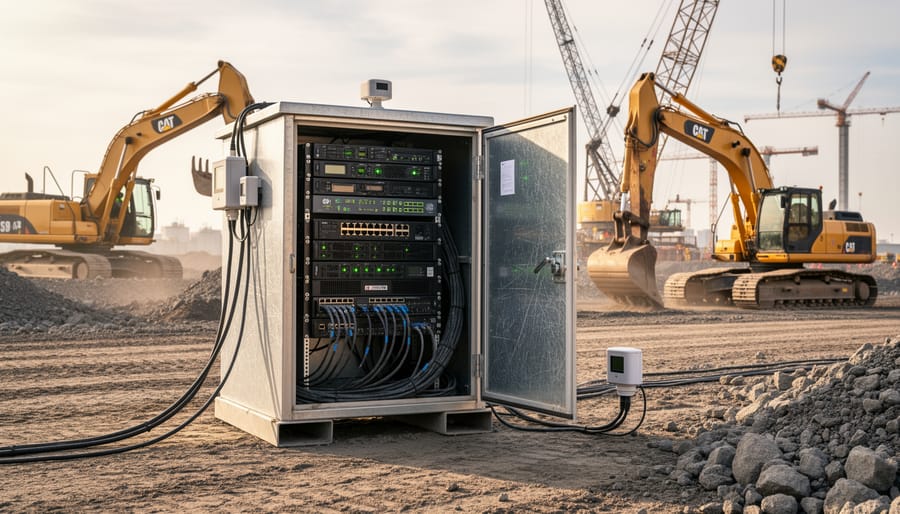
On a construction site, edge computing processes data across three primary physical locations, each serving distinct roles in the data handling chain.
The first processing tier happens directly at the data source, individual IoT sensors, connected machinery, and smart devices deployed throughout the site. A crane’s load sensor, for example, processes weight data locally within milliseconds, triggering immediate alerts if safe limits are approached. Similarly, environmental monitors embedded in concrete analyze moisture and temperature readings on-device, making real-time curing decisions without external consultation. These endpoint devices handle simple but time-critical computations: threshold checks, basic pattern recognition, and immediate control signals.
The second tier consists of on-site edge servers or gateway devices, typically housed in weatherproof enclosures within site trailers or equipment rooms. These ruggedized compute units, ranging from industrial PCs to dedicated edge appliances, aggregate data streams from hundreds of connected devices. A site gateway might collect feeds from forty safety cameras, process them through computer vision algorithms to detect unauthorized access or unsafe behavior, then store only flagged incidents locally while discarding routine footage. This intermediate layer handles more complex analytics that single sensors cannot: correlating data across multiple sources, running predictive maintenance models, or coordinating autonomous equipment movements.
The third tier, sometimes called the “fog layer,” bridges the edge and cloud. Regional data centers or mobile command units positioned near construction zones provide additional processing capacity for workloads too demanding for site hardware but still requiring lower latency than distant cloud servers. A contractor managing ten urban sites might use a metropolitan fog node to synchronize BIM models and process drone photogrammetry data for all projects within that region.
The cloud itself processes only data that benefits from centralized analysis, historical trends, enterprise-wide reporting, and machine learning model training that feeds improved algorithms back to edge devices. This tiered architecture keeps urgent, operational processing local while relegating strategic, long-term analytics to remote infrastructure. The physical boundary matters: edge processing happens within the construction site perimeter or immediately adjacent infrastructure, measured in meters from the data source rather than hundreds of kilometers away in a regional data center.
How Construction Data Flows from Collection to Processing
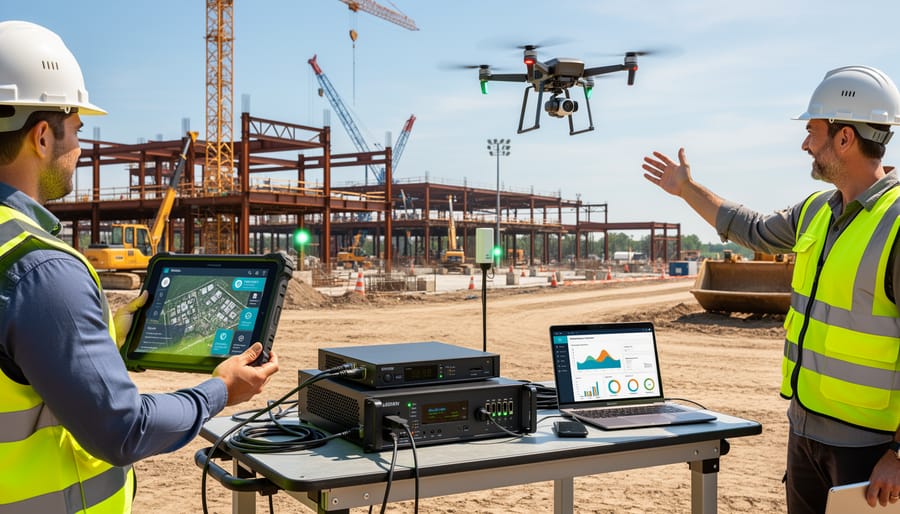
On a modern construction site, data moves through several distinct stages before it reaches its final destination. Understanding this flow clarifies exactly where edge computing performs its processing work and why local handling matters.
The journey starts at the point of capture. Sensors embedded in concrete, RFID tags on materials, GPS units on equipment, and cameras mounted on cranes all generate streams of raw data continuously throughout the day. A single excavator might produce telemetry readings every second, location coordinates, fuel consumption, hydraulic pressure, engine temperature.
Here’s how that data moves through the edge computing architecture:
- Initial captureIoT devices, sensors, and connected equipment collect raw data points from job site activities, environmental conditions, and machinery operations.
- Local preprocessingEdge devices immediately filter and normalize the data, discarding redundant readings and formatting information for analysis.
- On-site analysisEdge servers or gateways run algorithms to detect patterns, anomalies, or threshold violations that require immediate response.
- Action triggersCritical findings generate instant alerts or automated responses without waiting for external systems to process the information.
- Data aggregationEdge systems compile processed results into summary reports and relevant datasets for transmission.
- Selective cloud syncOnly meaningful insights and condensed records transmit to centralized cloud platforms for long-term storage and broader analytics.
This staged approach drastically reduces the volume of data leaving the site. Rather than uploading gigabytes of raw sensor readings, edge systems might send just megabytes of processed insights and exception reports. A thermal camera monitoring concrete curing doesn’t need to stream full-resolution video to the cloud. The edge device processes frames locally, extracts temperature data, compares it against curing specifications, and transmits only the compliance status and flagged anomalies.
The filtering happens at the network’s periphery, where the data originates. By the time information reaches the cloud, it has already been analyzed, validated, and compressed into actionable intelligence rather than overwhelming streams of unprocessed readings.
Key Advantages of On-Site Data Processing for Construction Projects
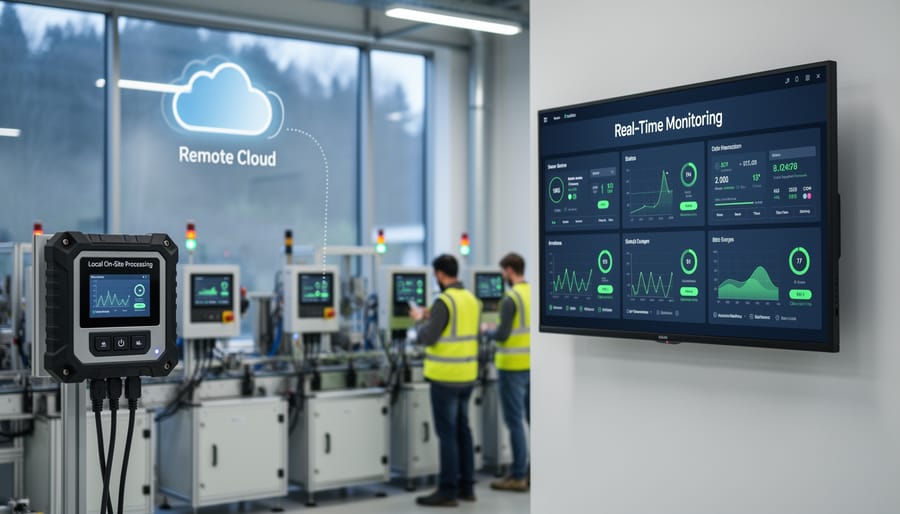
Real-Time Safety and Equipment Monitoring
Edge processing transforms safety and equipment monitoring from reactive notifications into instantaneous responses that prevent incidents before they escalate. When a worker enters a restricted zone, an on-site edge server analyzes sensor data and triggers an alert within milliseconds, fast enough to stop machinery before contact occurs. Cloud-based systems, by contrast, introduce latency of 100-200 milliseconds or more, a delay that proves critical when excavators swing near personnel or cranes operate in confined spaces.
Equipment diagnostics benefit equally from local processing. Construction machinery generates continuous streams of vibration, temperature, and performance data. Edge devices analyze these metrics in real time, detecting anomalous patterns that signal bearing wear, hydraulic failures, or overheating components. The system alerts operators immediately and can automatically throttle equipment to prevent catastrophic failure, all without waiting for cloud analysis.
Collision detection systems rely on this speed. Edge-processed data from proximity sensors, cameras, and LIDAR enables autonomous equipment to navigate job sites safely, adjusting paths and velocities based on constantly changing conditions. A cloud round-trip would render these systems dangerously slow, unable to react to workers stepping into operating zones or materials suddenly blocking pathways.
Reduced Dependency on Network Connectivity
Construction sites in remote locations or developing regions often face unreliable or nonexistent internet connectivity, yet projects still demand real-time monitoring and control systems. Edge computing solves this by processing critical data locally, allowing operations to continue independently of cloud access.
When excavators, cranes, and safety sensors process data at the edge, they don’t require constant internet connection to function. Equipment can make operational decisions, like adjusting load distribution or triggering proximity alerts, using local processing power. Only summary data or critical alerts need transmission to central systems when connectivity becomes available.
This architecture proves essential for infrastructure projects in rural areas, mining operations in isolated locations, or construction in regions with developing telecommunications infrastructure. A bridge project in a remote valley, for example, can maintain full IoT sensor monitoring, automated quality checks, and equipment coordination without waiting for cloud connectivity.
The edge devices buffer collected data locally, synchronizing with central systems during periodic connectivity windows. This means project managers still receive comprehensive reports, but the actual site operations never pause due to network outages, a fundamental reliability advantage over cloud-dependent systems.
Construction Applications Currently Using Edge Data Processing
Edge computing enables a growing range of practical applications where construction sites process critical data locally rather than sending it to distant servers. Autonomous construction equipment now operates with edge processors that analyze sensor feeds and navigation data in real time, allowing excavators and bulldozers to adjust grading operations within milliseconds based on site conditions. This immediate processing eliminates the dangerous delays that would occur if each decision required a cloud round-trip.
Drone surveying systems capture thousands of high-resolution images during daily site flights, then process initial photogrammetry and change detection algorithms on portable edge devices right at the site office. Rather than uploading terabytes of raw imagery over limited site connections, only refined 3D models and identified variances get transmitted to project stakeholders, reducing bandwidth requirements by 80 percent or more while delivering actionable insights the same day.
Predictive maintenance applications monitor vibration patterns, temperature fluctuations, and operating hours across excavators, cranes, and concrete pumps using edge analytics that flag anomalies immediately. When a bearing shows early wear signatures or hydraulic pressure deviates from normal ranges, maintenance teams receive alerts within seconds rather than waiting for overnight batch processing, preventing costly breakdowns and equipment downtime.
Energy management systems track power consumption across temporary facilities, lighting arrays, and electric tool charging stations through edge gateways that optimize load distribution and identify wasteful patterns without constant cloud communication. These systems adjust generator output and redistribute loads autonomously based on real-time demand.
BIM coordination platforms increasingly rely on edge servers deployed in site trailers to process clash detection, coordinate updates from multiple trades, and render 3D models without depending on internet speed. Field teams access current building information models instantly, make annotations that process locally, then synchronize changes during scheduled intervals. As construction technologies become more data-intensive, this local processing architecture proves essential for maintaining productivity regardless of connectivity conditions.
Expert Perspective: Edge Computing Implementation on Major Projects
When Turner Construction deployed edge computing across their $800 million hospital project in Phoenix, IT Director Marcus Reynolds faced challenges that textbooks never mention. “Everyone talks about processing power, but nobody warns you about dust,” Reynolds explains. “We learned fast that industrial-grade enclosures aren’t optional, standard server equipment failed within weeks.”
The infrastructure investment proved substantial but justified. Turner installed ruggedized edge servers at five staging areas, each handling data from 200+ IoT sensors monitoring concrete curing, HVAC commissioning, and equipment location. Initial hardware costs ran $180,000, but the system paid for itself in eight months through reduced rework and faster issue resolution.
“The biggest surprise was bandwidth savings,” Reynolds notes. “We went from uploading 4 terabytes daily to the cloud down to 80 gigabytes. Everything gets filtered locally, only exceptions and summaries go up. Our connectivity costs dropped 70%.”
Practical challenges extended beyond hardware. Coordinating with 40+ subcontractors required clear protocols about which devices connected to edge infrastructure versus going straight to cloud. Reynolds’s team created simple decision criteria: real-time equipment and safety systems stay at the edge; reporting and documentation can route through cloud.
Measurable outcomes validated the approach. Safety incident response times improved from 3-7 minutes to under 45 seconds. Predictive maintenance alerts reduced unplanned equipment downtime by 34%. Most significantly, the project finished two weeks ahead of schedule, partly because edge-processed data caught coordination conflicts during installation rather than after inspection failures.
“You need someone on-site who understands both IT infrastructure and construction workflows,” Reynolds advises. “That hybrid knowledge makes the difference between edge computing that actually works and expensive equipment sitting unused.”
Common Questions About Edge Computing Data Processing in Construction
What hardware infrastructure is needed on construction sites for edge computing?
A basic edge computing setup requires ruggedized edge servers or industrial gateways, IoT sensors and connected devices, and reliable local networking equipment (typically industrial Wi-Fi or 5G). Many sites start with compact edge servers that can withstand dust, temperature variations, and vibration common to construction environments.
Does all construction data stay on-site with edge computing?
No, edge computing processes data locally but typically sends filtered, aggregated data to cloud systems for long-term storage, advanced analytics, and project-wide visibility. The edge retains time-sensitive data and processes critical decisions locally, while non-urgent information syncs to the cloud when bandwidth allows.
How does edge computing integrate with existing BIM and project management platforms?
Edge systems connect to digital construction platforms through standard APIs and data exchange protocols. Most edge solutions are designed to feed processed data into popular BIM tools, ERP systems, and project dashboards without requiring complete platform replacement.
What are typical costs for implementing edge computing on construction projects?
Initial hardware costs range from a few thousand dollars for small site deployments to six figures for large projects with extensive sensor networks. However, ongoing bandwidth savings, reduced cloud storage fees, and productivity gains from real-time processing often offset infrastructure investment within 12-18 months on medium to large projects.
Beyond these technical and financial considerations, construction teams should evaluate their site’s specific connectivity challenges and data processing needs before committing to edge infrastructure. Remote sites with limited internet access see the most immediate benefits, while urban projects with reliable connectivity might prioritize edge computing for latency-sensitive safety applications rather than connectivity workarounds. The decision ultimately depends on your project’s scale, complexity, and tolerance for the delays inherent in cloud-only processing.
Edge computing fundamentally shifts data processing from distant cloud servers to the construction site itself, on-site edge servers, IoT devices, connected machinery, and local gateways handle the heavy lifting right where data originates. This architecture isn’t just a technical detail; it directly addresses construction’s operational realities. Sites gain real-time responsiveness for safety systems and equipment monitoring, maintain functionality despite spotty connectivity, reduce bandwidth costs, and keep sensitive project data under tighter control.
As construction projects generate exponentially more data from sensors, drones, autonomous equipment, and BIM coordination tools, the edge infrastructure that processes this information locally becomes essential rather than optional. Major contractors are already deploying these systems on complex projects, seeing measurable improvements in safety response times, equipment uptime, and operational efficiency.
The question isn’t whether edge computing will reshape construction data management, it’s how quickly your projects can adopt the on-site processing capabilities that turn raw data streams into actionable insights without the delays, costs, and vulnerabilities of cloud dependency. The construction sites processing data at the edge today are building tomorrow’s competitive advantage.
