
Conceptual illustration of construction stakeholders connected through a blockchain network, with visual representations of smart contracts and material tracking.

Blockchain Technology Is Transforming Construction Supply Chains – Here’s How

Transforming traditional supply chains through blockchain technology in construction has become imperative for modern enterprises seeking enhanced transparency, security, and efficiency. By implementing distributed ledger solutions, organizations can now track materials from source to site with unprecedented accuracy, reduce documentation errors by up to 90%, and eliminate costly verification delays. Smart contracts automatically execute predefined agreements, ensuring timely payments …

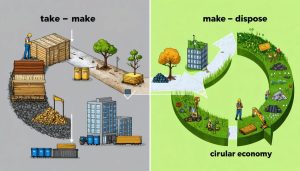
Conceptual illustration showing the contrast between linear construction waste piles and circular construction practices with material reuse and modular structures.

Why Urban Circular Economy Could Save Construction Companies Millions

The construction industry stands at a pivotal crossroads between sustaining traditional linear production models and embracing circular economy principles that could revolutionize how we build. While linear economies follow the “take-make-dispose” pathway that has dominated construction for centuries, circular economies reimagine waste as a resource, transforming our $11.5 trillion global construction sector through systematic material reuse and regenerative design.
Recent data reveals that construction generates 35% of global waste, with only 20% currently being recycled or repurposed. The circular economy model …

"A diverse team of construction professionals, including architects, contractors, and project managers, collaborating around a digital table with architectural plans and BIM models, highlighting teamwork and integrated project delivery."

Why Stakeholder Collaboration Is Critical for Construction Project Success

In today’s complex construction landscape, effective stakeholder engagement strategies determine the success or failure of major projects. Stakeholder collaboration transforms traditional project delivery by breaking down silos between owners, contractors, architects, and other key players, creating a unified approach to project execution. This integrated methodology has revolutionized how construction projects are conceived, planned, and delivered, reducing conflicts by up to …

Conceptual illustration of a city skyline blended with digital network lines and glowing nodes, symbolizing the integration of digital infrastructure systems in urban environments.

Smart Cities Need Smart Foundations: Digital Infrastructure Revolutionizing Urban Planning

Digital infrastructure forms the invisible backbone of modern cities, powering everything from traffic management systems to public utilities and emergency response networks that are transforming urban planning. This critical framework encompasses interconnected systems of data centers, fiber-optic networks, IoT sensors, and cloud computing platforms that enable seamless communication, data processing, and service delivery across urban environments.
From intelligent transportation …

A conceptual depiction of a futuristic city skyline illustrating osmosis construction technology, featuring self-healing building surfaces and illuminated membranes, emphasizing the integration of advanced, sustainable materials in urban environments.

Osmosis Construction: The Next Frontier in Self-Healing Building Materials

Osmosis construction, a groundbreaking advancement in smart building materials, is revolutionizing how we approach sustainable infrastructure development. This innovative technology harnesses the natural process of osmosis to create self-healing structures that actively respond to environmental stresses and structural damage. By incorporating semi-permeable membranes and specialized ionic solutions into building materials, osmosis construction enables structures to automatically repair micro-…

A digital collage showing a smart home with integrated energy management systems, including smart devices, HVAC systems, and solar panels, highlighting modern energy optimization technologies.

Smart Homes Slash Energy Costs: Real Data from Modern Residential Buildings

Building energy consumption represents one of the most significant challenges facing the construction industry today, accounting for nearly 40% of global energy use and carbon emissions. Modern energy efficient home design integrates advanced monitoring systems, smart technologies, and innovative architectural solutions to optimize resource utilization while maintaining occupant comfort. The convergence of IoT sensors, machine learning algorithms, and building automation systems has …

A modern industrial facility with dynamic digital overlays representing smart energy systems and sustainable energy management.

Smart Energy Systems Transform Industrial Buildings Into Cost-Saving Powerhouses

Transforming industrial energy consumption requires sophisticated smart energy management systems that leverage real-time data analytics and artificial intelligence. Today’s facilities face unprecedented pressure to reduce operational costs while meeting stringent sustainability targets, making intelligent energy optimization no longer optional but essential for competitive advantage.
Advanced building management systems now integrate seamlessly with IoT sensors, machine learning …

Conceptual depiction of a futuristic urban skyline with eco-friendly skyscrapers featuring green rooftops, solar panels, vertical gardens, and wind turbines, representing smart and sustainable building design.

Smart Buildings That Save: How Sustainable Design is Reshaping Construction

Transforming the construction industry demands a fundamental shift toward sustainable practices that balance environmental stewardship with economic viability. As global resources become increasingly scarce and climate change accelerates, the imperative for sustainable design and construction has evolved from an optional consideration to a critical business imperative. Industry leaders are pioneering innovative approaches that merge cutting-edge technology with time-tested ecological principles, reducing environmental impact while enhancing building performance and occupant well-being.
The integration of sustainable practices …

Conceptual illustration of a smart building featuring electrochromic glazing, automated shading elements, and integrated digital systems for enhanced energy efficiency.

Smart Building Tech That’s Revolutionizing Construction Energy Efficiency

Revolutionary advances in construction engineering are fundamentally transforming how we design, build, and optimize modern structures. From artificial intelligence-driven project management to breakthrough energy efficiency solutions, the industry is experiencing an unprecedented technological renaissance. Smart materials with self-healing properties, robotics-enabled construction processes, and digital twin technology are driving productivity gains of up to 50% while reducing project timelines by one-…

An imaginative cityscape featuring skyscrapers and buildings made from sustainable materials like mycelium bricks and engineered timber, integrated with greenery and solar panels, representing the future of eco-friendly urban development.

These Revolutionary Building Materials Are Reshaping Sustainable Construction

Revolutionizing the construction industry demands urgent attention as innovative, eco-friendly building materials emerge to address climate change and resource scarcity. Today’s sustainable construction practices are being transformed by breakthrough materials that combine performance with environmental responsibility.
From carbon-negative concrete alternatives to bio-based composites derived from agricultural waste, these next-generation materials are redefining …