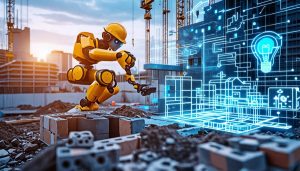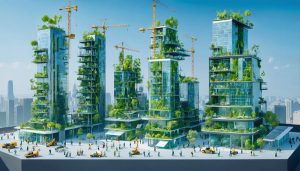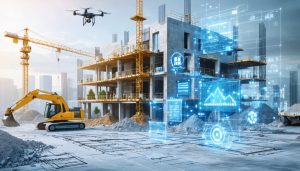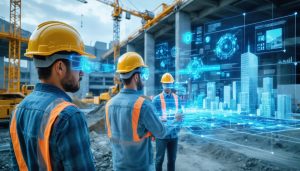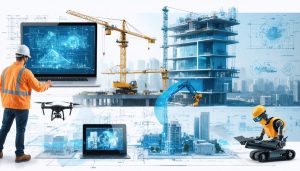
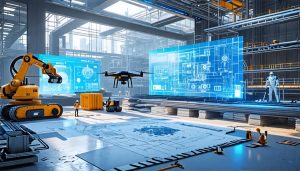
A dynamic construction site featuring IoT sensors and devices, with an augmented reality overlay displaying real-time data analytics and connectivity among equipment and workers.

IoT Sensors Are Revolutionizing Construction Analytics (Here’s How)

The Internet of Things (IoT) is revolutionizing construction project delivery, driving a 25% increase in productivity and reducing project costs by up to 30% across major construction sites worldwide. From real-time equipment tracking to predictive maintenance systems, IoT sensors and connected devices are transforming traditional construction workflows into data-driven operations. Industry leaders leveraging IoT technologies report significant improvements in site safety, resource optimization, and project timeline adherence.
Smart construction sites now utilize interconnected systems of sensors, wearables, and automated machinery …

Illustration of futuristic construction site featuring robotic machinery, digital twin technology, and engineers collaborating using advanced AI-driven design tools to represent R&D innovation in digital construction.

R&D Innovation is Transforming Digital Construction (Here’s How)

Research and Development (R&D) innovation stands as the cornerstone of digital transformation in modern construction, driving unprecedented advances in building technology, material science, and project delivery methods. As the industry grapples with challenges of sustainability, productivity, and cost efficiency, strategic R&D investments are reshaping how we conceive, design, and execute construction projects.
Leading construction firms are leveraging artificial intelligence, robotics, and advanced materials to achieve breakthrough improvements in project outcomes. From autonomous construction equipment to self-healing …

A futuristic construction site featuring humanoid robots and autonomous machines working alongside human engineers, with digital data flows illustrating IoT integration.

How Robotics is Revolutionizing Construction Safety and Efficiency

Robotics and automation are fundamentally reshaping the construction industry, delivering unprecedented gains in productivity, safety, and precision. From autonomous excavators navigating job sites to robotic arms performing complex welding operations, these technologies are addressing the sector’s most pressing challenges – labor shortages, project delays, and quality control issues. Industry leaders implementing robotics solutions report up to 30% reduction in project completion times and a 25% decrease in construction costs.
The convergence of artificial intelligence, sensors, and advanced robotics is enabling …

A state-of-the-art 3D printer building a structure with specialized concrete materials, embodying the transformative impact of additive manufacturing in construction.

Revolutionary Materials Transforming 3D-Printed Construction Projects

The rapid advancement of the 3D printing revolution in construction has fundamentally transformed material science in the building sector. Contemporary construction-grade materials now encompass specialized concrete composites, polymer-modified cementitious mixtures, and advanced geopolymer formulations specifically engineered for additive manufacturing processes. These materials must meet precise requirements for extrudability, layer adhesion, and structural integrity while maintaining …

A vibrant and futuristic construction site bustling with autonomous machinery, drones, and digital overlays representing BIM and data analytics, depicting technological transformation in the construction industry.

Construction Tech That’s Actually Transforming Job Sites Today

Digital transformation is revolutionizing the construction industry, driving unprecedented improvements in project efficiency, safety, and profitability. From artificial intelligence-powered project management platforms to autonomous equipment and drone-based site surveillance, technology adoption has become a critical differentiator between industry leaders and laggards. Recent studies indicate that construction firms implementing integrated digital solutions report up to 35% reduction in project delivery times and 20% decrease in overall costs.
The convergence of Building Information Modeling (BIM), Internet of Things (IoT) …

An artistic representation of a construction site overlapped with virtual design elements, showcasing 3D building models, data analytics, and cloud-based collaboration symbols.

Virtual Design & Construction: How Modern Teams Are Revolutionizing Project Delivery

Virtual Design and Construction (VDC) stands at the forefront of construction’s digital revolution, transforming how we plan, execute, and deliver complex building projects. By integrating 3D modeling, real-time collaboration tools, and data-driven decision-making processes, VDC empowers construction teams to identify conflicts before breaking ground, reduce costly rework, and accelerate project delivery timelines by up to 30%.
In today’s competitive construction landscape, where margins are tight and schedules demanding, VDC emerges as the critical differentiator between project success and failure. Leading construction…

A split-screen image showing the contrast between traditional paper blueprints and modern digital construction plans displayed on a tablet, highlighting the evolution in construction communication.

Digital Construction Platforms Are Transforming Project Communication (Here’s How)

Digital communication platforms have revolutionized how construction teams collaborate, driving unprecedented efficiency and transparency across projects. As digital transformation in construction accelerates, these platforms have become indispensable tools for managing complex workflows and diverse stakeholder interactions.
Modern construction projects generate thousands of daily communications—from RFIs and submittals to change orders and progress updates. Traditional methods of …

Futuristic cityscape with a modern high-rise building showcasing digital twin technology. Transparent layers reveal digital data streams and IoT sensors over the building, set against an urban backdrop with smart infrastructure elements.

Digital Twins Transform Smart Buildings: Real-World Impact and ROI

Digital twin technology is revolutionizing urban development, creating virtual replicas of cities that transform how we plan, build, and manage urban infrastructure. As digital twins in construction become increasingly sophisticated, smart cities are leveraging this technology to optimize operations, enhance sustainability, and improve citizen services in real-time.
By combining IoT sensors, AI-driven analytics, and advanced 3D modeling, digital twin smart cities create living, …

A futuristic construction site featuring autonomous robots and drones with digital overlays of data analytics, illustrating the integration of technology and traditional construction methods.

These Breakthrough Construction Technologies Are Reshaping How We Build

The construction industry stands at the cusp of its most transformative era, driven by breakthrough technologies that are revolutionizing how we design, build, and manage infrastructure. From autonomous robots laying bricks with precision to artificial intelligence optimizing project schedules, emerging construction technologies are addressing decades-old challenges of productivity, safety, and sustainability. Digital twins now enable real-time project monitoring and predictive maintenance, while 3D-printed buildings demonstrate the potential for reducing construction time by up to 70% while minimizing material waste. As global …

Futuristic construction site with a large 3D concrete printer building a residential structure, surrounded by digital design blueprints and modern architecture elements, highlighting the technological advancements in construction.

3D Concrete Printing Transforms Construction Sites: Real Projects Proving Its Worth

Three-dimensional concrete printing stands at the forefront of a technological revolution that is transforming construction in the next decade. This groundbreaking technology merges advanced robotics, material science, and digital design to fundamentally reshape how we construct buildings and infrastructure. By depositing concrete layers with precision previously impossible through traditional methods, 3D printing enables the creation of complex architectural forms while potentially …