
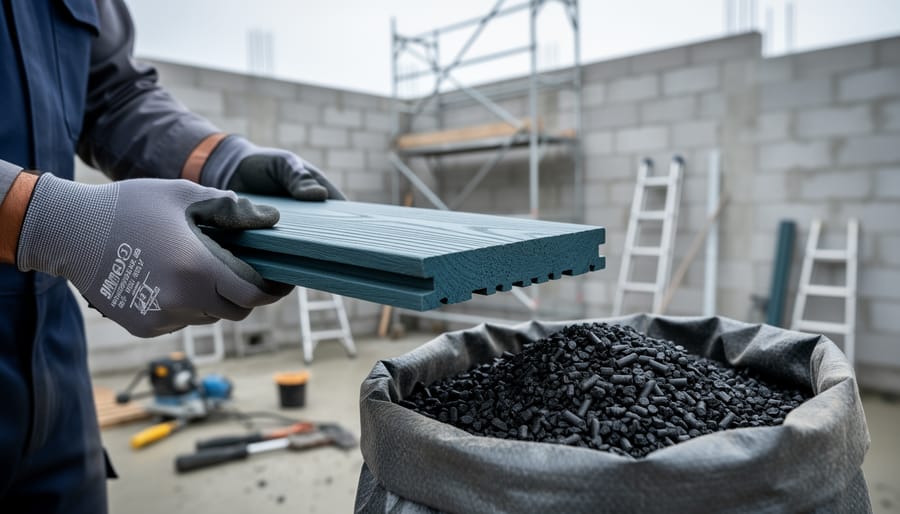
Recycled plastic in construction refers to post-consumer or post-industrial plastic waste that has been reprocessed into new building materials, ranging from composite lumber and insulation to concrete additives and structural components. For construction professionals evaluating these materials in 2026, safety encompasses three critical dimensions: chemical stability, structural performance, and regulatory compliance.
The construction industry’s adoption of recycled plastics has accelerated as zero waste initiatives drive demand for circular economy solutions. Yet the question of safety remains complex. Unlike virgin plastics manufactured under controlled conditions, recycled materials originate from diverse waste streams with varying contamination levels, degradation states, and chemical compositions. The reprocessing itself introduces variables that affect long-term durability, off-gassing potential, and structural integrity.
Current standards from ASTM International, the International Code Council, and regional building authorities provide frameworks for vetting recycled plastic products, but compliance varies significantly across material types and manufacturers. Some recycled plastics, particularly those used in non-structural applications like landscaping timbers or drainage components, have decades of proven field performance. Others, especially newer composite formulations for load-bearing applications, require rigorous third-party testing and careful specification.
This article examines the technical realities of recycled plastic safety in construction contexts. We’ll decode the reprocessing methods that determine material integrity, review applicable regulatory standards, analyze real-world case studies from commercial and infrastructure projects, and provide decision frameworks for specifying these materials with confidence. The evidence reveals that safety isn’t binary but depends on matching the right recycled plastic type to appropriate applications with proper verification protocols.
What Recycled Plastic in Construction Means
Recycled plastic in construction refers to polymer materials recovered from waste streams and reprocessed into products that meet the structural, safety, and performance requirements of building applications. These materials undergo controlled collection, sorting, cleaning, and reformulation to create construction-grade components that function alongside or replace traditional building materials.
The construction industry uses two primary categories of recycled plastic, distinguished by their origin point in the supply chain:
- Post-Consumer Recycled (PCR) Plastic
- Material recovered from products that have completed their intended consumer use, such as bottles, packaging, and household items collected through municipal recycling programs. PCR content requires more extensive processing to remove contaminants and restore material properties.
- Post-Industrial Recycled (PIR) Plastic
- Manufacturing scrap and production waste recovered directly from industrial processes before reaching consumers. PIR materials typically contain fewer contaminants and maintain more consistent quality, making them easier to reprocess into construction-grade products.
- Virgin Plastic Equivalents
- Recycled plastic products reformulated to match the technical specifications, performance characteristics, and safety standards of materials made from new petroleum-based polymers. These equivalents must demonstrate identical structural integrity and durability through testing.
- Recycled Content Certification
- Third-party verification that confirms the percentage and type of recycled material in a construction product, validated through documentation of material sourcing and chain-of-custody tracking throughout the manufacturing process.
The transformation from waste plastic to construction material involves mechanical or chemical recycling processes that break down used polymers and reconstitute them into pellets, sheets, or profiles. Mechanical recycling melts and reshapes plastics without altering their chemical structure, while chemical recycling breaks polymers down to molecular building blocks for complete reformulation. Both methods produce materials that manufacturers combine with additives, stabilizers, and sometimes virgin content to achieve specifications for structural lumber, decking, piping, insulation, and composite materials that builders specify for projects across residential, commercial, and infrastructure sectors.
How Recycled Plastic Processing Works in Construction Manufacturing
Sorting and Decontamination Protocols
Recycled plastics destined for construction applications undergo rigorous sorting that begins with automated optical scanners identifying polymer types, PE, PP, PVC, and PET, through infrared spectroscopy. This segregation is critical because different polymers have incompatible melting points and chemical properties; mixing them produces structurally unreliable materials. Manual sorting follows automated processes to remove metal fasteners, paper labels, and composite materials that scanners miss.
Decontamination protocols address safety directly. Industrial washing systems use heated alkaline solutions to strip adhesives, oils, and surface contaminants, while flotation tanks separate remaining foreign matter by density. Some facilities employ near-infrared sorting a second time post-wash to catch remaining contaminants. For plastics entering high-specification construction products, protocols include testing for heavy metals, persistent organic pollutants, and residual chemicals that could leach or off-gas. Facilities processing construction-grade recycled plastics maintain documented chain-of-custody procedures similar to those used in construction waste management ensuring traceability from collection through reformulation.
Reformulation and Quality Testing
Once cleaned and sorted, recycled polymers undergo rigorous reformulation to restore molecular chains degraded during their first lifecycle. Manufacturers blend recycled resins with specific additives, stabilizers, impact modifiers, UV inhibitors, to compensate for thermal history and mechanical stress from prior use. This compounding process transforms reclaimed material into high-performance recycled materials that match virgin polymer specifications.
Quality testing verifies every critical parameter. Tensile strength tests measure load-bearing capacity under stress. Melt flow index analysis confirms consistent processing characteristics. Differential scanning calorimetry checks thermal stability and crystallinity. Chemical composition analysis screens for residual contaminants, particularly heavy metals and volatile organic compounds that could compromise indoor air quality or structural performance.
Construction-grade recycled plastics must pass the same ASTM and ISO standards that govern virgin materials. Third-party laboratories conduct batch testing for flexural modulus, impact resistance, weathering tolerance, and dimensional stability. Products failing any benchmark get rejected or downgraded to non-structural applications. This multi-stage verification ensures that certified recycled plastics perform identically to conventional alternatives in demanding construction environments.
Types of Recycled Plastic Products in Construction

Structural and Load-Bearing Applications

Recycled plastic lumber has emerged as a viable alternative to traditional timber in load-bearing applications, with products certified to meet structural performance standards equivalent to conventional materials. High-density polyethylene (HDPE) and polypropylene formulations are engineered to specified load capacities, with third-party testing verifying compressive strength, flexural modulus, and deflection limits under sustained loads. These products carry ICC-ES (International Code Council Evaluation Service) reports or similar certifications that document their structural adequacy for specific applications.
Composite decking systems incorporating recycled content are rated for residential and commercial foot traffic loads, typically supporting 40-100 pounds per square foot depending on joist spacing and product specification. Manufacturers provide structural span tables and installation guidelines that align with building code requirements for walking surfaces and elevated platforms.
Recycled plastic reinforcement elements, including geogrids and soil stabilization products, demonstrate tensile strength and creep resistance suitable for retaining walls, embankments, and foundation support. These applications position recycled plastics among proven sustainable building materials that deliver code-compliant performance when properly specified and installed. Engineers specify these products based on published mechanical properties and certification documentation rather than material origin, ensuring safety standards are maintained regardless of recycled content percentage.
Non-Structural Building Components
Recycled plastics serve extensive roles in non-structural construction applications where safety standards emphasize chemical resistance, moisture control, and dimensional stability rather than load-bearing capacity. Drainage systems manufactured from recycled high-density polyethylene (HDPE) demonstrate equivalent or superior performance to virgin materials in foundation perimeter drainage, stormwater management, and underfloor ventilation systems. These products meet ASTM D3034 standards for sewer pipe and related products, ensuring proper flow characteristics and chemical resistance to soil conditions.
Vapor barriers and moisture membranes produced from recycled polyethylene films provide effective protection against water intrusion in crawl spaces, beneath concrete slabs, and within wall assemblies. Manufacturers verify thickness, puncture resistance, and permeability ratings to meet building code requirements for vapor retarders, typically achieving Class A vapor barrier classifications with permeance ratings below 0.1 perms.
Acoustic panels incorporating recycled PET content offer sound absorption properties comparable to traditional materials while diverting post-consumer plastic bottles from landfills. These panels undergo testing per ASTM C423 for sound absorption coefficients and meet fire safety classifications required for interior finishes. Finishing materials including wall cladding, trim profiles, and decorative elements demonstrate durability and consistent appearance without the maintenance demands of wood or metal alternatives.
Safety Standards and Regulatory Framework
Building Code Compliance Requirements

Building codes draw no distinction between recycled and virgin plastics when evaluating material suitability for construction use. Both must satisfy identical performance benchmarks established by the International Building Code (IBC) and regional amendments. Fire resistance ratings, for instance, require recycled plastic products to achieve the same flame spread index and smoke development values as their virgin counterparts, typically Class A, B, or C classifications depending on application and building type. Load-bearing components manufactured from recycled polymers undergo the same structural testing protocols, demonstrating equivalent compressive strength, flexural modulus, and long-term creep resistance before receiving approval for specified loads.
Durability specifications impose equally rigorous demands. Recycled plastic materials must withstand accelerated weathering tests simulating decades of UV exposure, temperature cycling, and moisture penetration without degrading below acceptable thresholds. Products intended for outdoor or high-moisture environments face additional scrutiny through freeze-thaw cycling and fungal resistance evaluations. The material’s origin, whether recycled or virgin, becomes irrelevant once it passes standardized testing per ASTM D6662 for structural lumber or ASTM E84 for surface burning characteristics. Compliance documentation submitted to building officials must demonstrate that the final product, regardless of feedstock, meets every applicable code provision. Some manufacturers pursue CPSC third-party testing for additional verification when products involve consumer contact applications.
Certification and Third-Party Verification
Independent testing by accredited laboratories confirms that recycled plastic products meet published performance and safety standards. Organizations such as Underwriters Laboratories (UL), Intertek, and NSF International conduct rigorous material testing for flame spread, structural load capacity, chemical composition, and durability under environmental stress. Products that pass these evaluations earn certification marks that serve as third-party proof of compliance.
APR PCR third-party verification specifically addresses post-consumer recycled content, confirming that materials have been processed according to established protocols and meet purity thresholds. This certification reduces uncertainty about contamination and processing quality.
Beyond product-level testing, manufacturing facilities undergo audits to verify consistent quality control, traceability systems, and adherence to safety protocols throughout production. Specifiers should look for multiple certification marks on technical data sheets, not just compliance claims, and verify that certifications match the intended application. Products certified for non-structural use should never be specified for load-bearing roles, regardless of marketing language. Third-party verification provides the documented assurance needed for code compliance and liability protection.
Health and Environmental Safety Considerations
Recycled plastics in construction applications undergo rigorous safety testing, but specific health and environmental considerations warrant careful evaluation before specification. The primary concerns center on chemical leaching, volatile organic compound emissions, and the potential presence of legacy contaminants from the original feedstock.
Chemical leaching presents minimal risk in properly manufactured recycled plastic construction products, particularly in applications without direct water contact or food exposure. Non-structural components like drainage pipes, vapor barriers, and plastic lumber maintain stable polymer chains that resist chemical migration under normal environmental conditions. However, products intended for potable water systems or surfaces with human contact require additional certification to verify that no harmful substances leach at detectable levels.
Off-gassing and VOC emissions from recycled plastics typically occur during the initial installation period, similar to virgin materials. Third-party testing for indoor air quality compliance confirms that certified recycled plastic products meet the same low-emission standards required for interior finishes and components. Products carrying certifications like GREENGUARD or FloorScore have demonstrated acceptable emission levels for occupied spaces, making them suitable for real-world sustainable projects where indoor environmental quality is paramount.
Do recycled plastics release harmful chemicals indoors?
Certified recycled plastic products that meet low-VOC emission standards pose no greater indoor air quality risk than virgin materials. Proper ventilation during and after installation minimizes any temporary off-gassing.
Can contaminants from recycled feedstock compromise safety?
Modern sorting and decontamination protocols remove hazardous substances before processing. Third-party certification verifies that finished products contain no detectable levels of heavy metals, pesticides, or toxic additives.
Are recycled plastics safe for outdoor exposure?
UV-stabilized recycled plastic products designed for exterior use resist degradation and do not release harmful substances into surrounding soil or water systems when properly manufactured.
Long-term exposure studies indicate that recycled plastics in construction maintain chemical stability over decades, with no documented cases of health impacts from properly certified materials in building applications. The environmental safety profile extends to end-of-life disposal, where inert polymer structures resist breakdown in landfills and can often be reprocessed again, avoiding the release of microplastics or degradation byproducts that plague some conventional materials.
How Recycled Plastics Are Used in Modern Construction Projects
Residential Construction Applications

Recycled plastic has become a mainstream choice for residential decking, where composite boards blending reclaimed HDPE or LDPE with wood fiber resist rot, splintering, and moisture damage far better than conventional lumber. These products carry the same structural certifications as virgin-material alternatives and require minimal maintenance over decades of exposure. Fencing systems made from recycled plastic offer identical durability benefits, withstanding UV radiation and temperature swings without warping or fading. In below-grade applications, recycled plastic drainage pipes and French drain sleeves meet ASTM standards for flow capacity and crush resistance, while vapor barriers manufactured from post-consumer film provide code-compliant moisture protection in foundations and crawl spaces. Multi-family developments increasingly specify recycled plastic acoustic underlayment for sound mitigation between units, a non-structural application where recycled content poses no safety trade-off and delivers measurable cost savings without compromising performance.
Commercial and Infrastructure Projects
Large-scale infrastructure and commercial developments have validated recycled plastic’s safety through decades of field performance. Airports including Denver International and London Heathrow incorporated recycled HDPE drainage systems and moisture barriers during expansion projects, with materials now exceeding 15-year service life without degradation. These installations passed rigorous fire safety and structural load testing before approval.
Highway departments in 22 states have embedded recycled plastic into asphalt pavements, creating polymer-modified roadways that withstand heavy truck traffic and temperature extremes. California’s Caltrans specifications require these materials to meet identical performance standards as virgin additives, with ongoing monitoring confirming no leaching or structural failures after a decade of service.
Bridge construction has adopted recycled plastic lumber for walkways, handrails, and non-structural components. The New Jersey Turnpike Authority replaced traditional timber on multiple pedestrian bridges with glass-fiber reinforced recycled plastic composites, citing superior weather resistance and elimination of chemical treatments required for wood preservation.
Municipal water treatment facilities increasingly specify recycled plastic piping and tank components after third-party NSF certification confirms no contamination risk. Seattle’s South Treatment Plant retrofit used recycled HDPE for secondary containment structures, meeting strict environmental protection standards while diverting 400 tons of waste from landfills.
Performance and Durability Compared to Virgin Materials
When properly manufactured to construction-grade specifications, recycled plastic materials demonstrate performance characteristics that match or exceed virgin plastics in most building applications. Independent testing by organizations like the American Society for Testing and Materials reveals that high-quality recycled HDPE and polypropylene products maintain structural integrity comparable to virgin equivalents across critical metrics.
Structural performance tests show recycled plastic lumber and composite materials meeting the same load-bearing specifications as virgin products when manufactured under controlled conditions. A 2025 National Association of Home Builders study found that certified recycled plastic decking systems withstood 15 years of outdoor exposure with less than 5% degradation in tensile strength, essentially matching virgin material performance. The key differentiator lies in the quality of feedstock sorting and processing rather than whether the material is recycled.
Weather resistance represents one area where recycled plastics actually outperform some virgin materials. Because recycled products often undergo additional UV stabilization during reformulation, many exhibit superior fade resistance and dimensional stability. Testing conducted across varied climates shows recycled plastic lumber maintaining structural dimensions within acceptable tolerances after 20 freeze-thaw cycles, whereas some virgin plastics required additional additives to achieve equivalent performance.
Maintenance requirements favor recycled plastics across all categories. Unlike traditional wood or even some virgin plastic products, recycled plastic construction materials require no painting, staining, or sealing. They resist moisture absorption, rot, and insect damage without deterioration. The primary performance limitation concerns temperature sensitivity during installation and high-heat applications, where both recycled and virgin plastics exhibit similar expansion characteristics requiring proper gap allowances in design specifications.
Properly certified recycled plastics meet the same rigorous safety standards as virgin materials in construction applications. The evidence from regulatory frameworks, third-party testing protocols, and real-world performance data demonstrates that recycled plastic products, when manufactured according to established standards and verified through independent certification, deliver equivalent structural integrity, durability, and safety performance.
The distinction lies not in whether the material originated from recycled or virgin sources, but in verification and appropriate specification. Construction professionals must prioritize products with documented compliance to relevant building codes, material certifications from recognized testing bodies, and manufacturer transparency regarding polymer composition and processing methods. Safety concerns emerge from inadequate testing or misapplication, not from the recycled nature of the material itself.
Selection criteria should focus on matching product specifications to application requirements. Load-bearing applications demand structural certifications and performance data; moisture-exposed installations require verified resistance properties; interior applications need documentation of low-VOC emissions and fire ratings. The same specification discipline applied to any construction material applies to recycled plastics.
Industry adoption continues to accelerate as manufacturing processes mature and testing protocols become more standardized. The regulatory landscape is evolving toward harmonized standards that treat recycled content as a material attribute rather than a separate category, reinforcing that performance and safety verification, not source material, determine suitability for construction use. This trajectory positions recycled plastics as mainstream construction materials backed by the same technical rigor professionals expect from any building component.
