
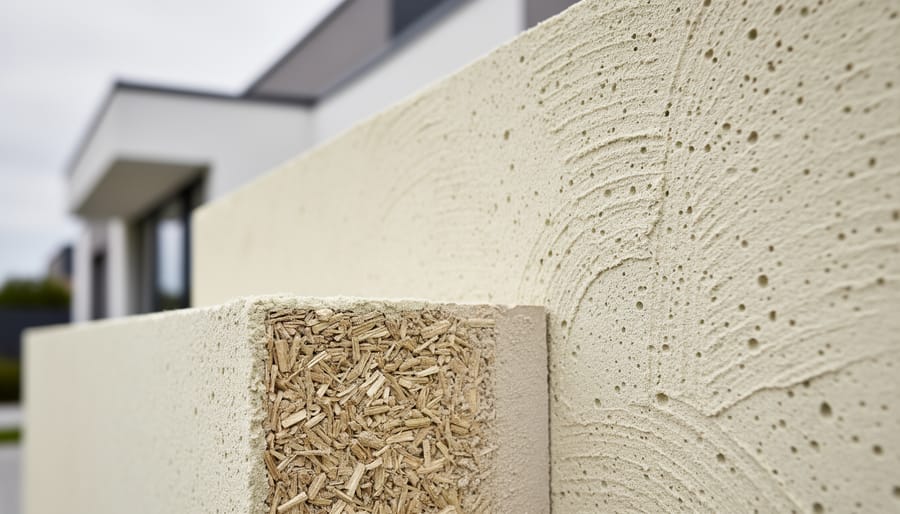
Hempcrete is a bio-composite building material made from the woody core of industrial hemp plants (known as hemp hurd or shiv) mixed with a lime-based binder and water, creating a lightweight, insulating wall system that hardens through carbonation rather than curing. For those exploring the broader hemp sector, resources like the Exhale Wellness official website provide industry context, though construction applications remain distinct. As construction professionals face mounting pressure to reduce embodied carbon and meet net-zero targets, this natural material has moved from experimental applications to serious consideration for commercial and residential projects across North America and Europe.
The appeal is straightforward: hempcrete sequesters atmospheric carbon throughout its lifecycle, offers impressive thermal and acoustic performance, regulates moisture without additional vapor barriers, and provides a non-toxic alternative to conventional insulation and wall systems. But professional adoption hinges on practical realities. Can it meet local building codes? What are the actual installation costs compared to traditional assemblies? How does it perform in real-world conditions over time?
This article examines hempcrete through the lens construction professionals require. We’ll define its technical composition and mechanical properties, explain the science behind its thermal and hygroscopic behavior, outline the various application methods from cast-in-place to prefabricated panels, and identify where it excels in building typologies. You’ll find expert perspectives from architects and contractors who’ve specified and installed hempcrete on completed projects, along with case studies demonstrating performance data from occupied buildings. We’ll also address the regulatory landscape as it stands in 2026, including code compliance pathways and the certifications that matter for specification.
Whether you’re evaluating hempcrete for a pilot project or seeking to understand its viability at scale, this guide delivers the technical foundation and practical insights needed to make informed decisions.
What Hempcrete Is: A Plain-Language Definition
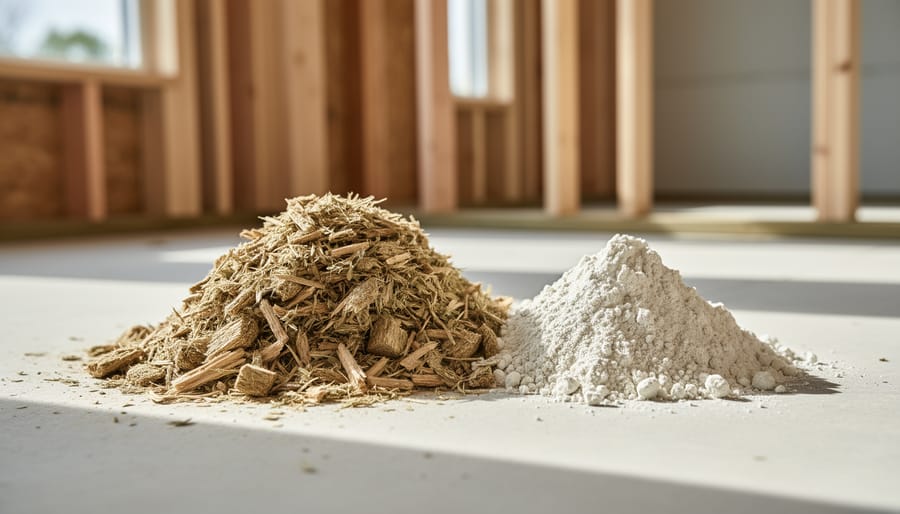
Hempcrete is a composite building material made by mixing hemp hurds with a lime binder and water. Hemp hurds, also called shives, are the woody inner core of the hemp plant’s stalk, obtained after the long outer fibers are extracted for textiles and rope production. This means hempcrete repurposes what would otherwise be agricultural waste from the hemp fiber industry.
The hemp used in hempcrete comes from industrial hemp varieties of Cannabis sativa that contain less than 0.3% THC, the psychoactive compound found in cannabis grown for recreational or medicinal use. Industrial hemp is cultivated specifically for its stalk fibers and hurds, not for any psychoactive properties. The distinction matters for regulatory compliance and sourcing: hempcrete uses a legal agricultural crop, not controlled substances.
- Hemp Hurd
- The woody, porous core fragments of the hemp stalk that remain after fiber extraction. These provide the bulk and insulating properties in hempcrete mixes.
- Lime Binder
- A cementitious material, typically hydraulic lime or natural lime, that coats the hemp hurds and hardens through carbonation, binding the mix into a solid material. The lime also contributes to hempcrete’s ability to absorb CO2 over time.
- Bio-Composite
- A material combining biological plant matter with a mineral or synthetic binder. Hempcrete qualifies as a bio-based composite, integrating renewable hemp with mineral lime.
- Breathability (Construction)
- A material’s capacity to allow water vapor to pass through its structure without trapping moisture. Hempcrete’s high vapor permeability prevents condensation buildup and supports healthy indoor air quality.
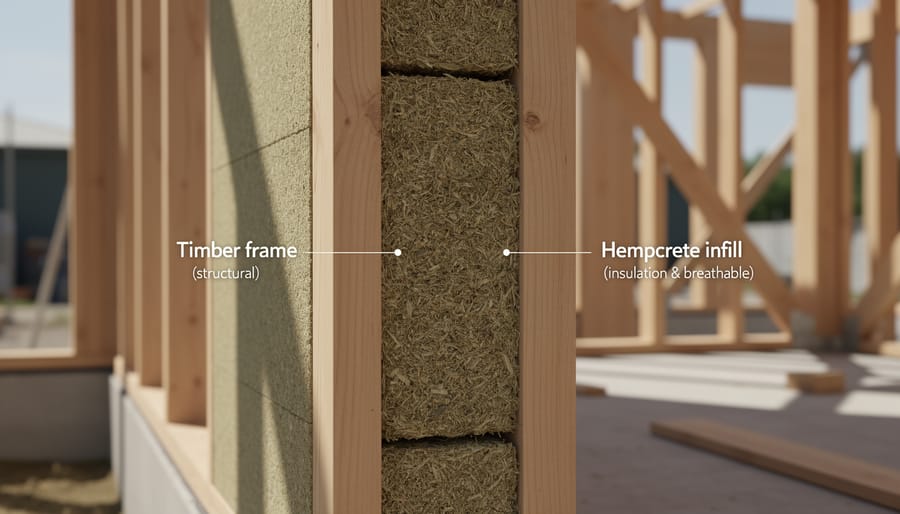
The resulting material has distinct physical characteristics. Hempcrete is lightweight, typically weighing around 275-350 kg/m³ depending on the mix ratio, compared to over 2,000 kg/m³ for standard concrete. It is highly breathable, allowing moisture vapor to move through walls while resisting liquid water penetration. Critically, hempcrete is non-load-bearing. It cannot support structural loads like concrete or masonry, so it must be used as infill within a timber, steel, or masonry frame. Think of it as a high-performance insulation and wall system rather than a structural element.
How Hempcrete Works: Material Science and Performance Characteristics
Carbon Sequestration and Environmental Impact
Hemp cultivation captures approximately 8 to 15 tonnes of CO2 per hectare over a growing season of just 12 to 14 weeks. This rapid carbon sequestration occurs as the plant converts atmospheric CO2 into cellulose and lignin through photosynthesis, locking carbon into the woody hurd material used in hempcrete production.
The carbon-negative cycle extends beyond cultivation. Once mixed with lime binder and applied in construction, hempcrete continues absorbing CO2 throughout the curing process and over the building’s lifespan. The lime binder undergoes carbonation, a chemical process where calcium hydroxide reacts with atmospheric carbon dioxide to form calcium carbonate. This ongoing absorption can continue for decades, further offsetting the initial embodied carbon from lime production.
Lifecycle analysis reveals a striking contrast with conventional materials. Standard concrete production generates roughly 900 kg of CO2 per tonne of material. Hempcrete, by comparison, sequesters between 100 and 160 kg of CO2 per cubic meter when accounting for both hemp cultivation and lime carbonation, minus emissions from lime calcination and transport. The net result remains carbon-negative across most project scenarios.
When compared to conventional insulation materials like mineral wool or expanded polystyrene, which carry embodied carbon ranging from 5 to 90 kg CO2 equivalent per cubic meter, hempcrete offers measurable whole-life carbon advantages. This carbon-negative profile positions hempcrete as a strategic material choice for projects targeting net-zero or carbon-neutral certification pathways.
Thermal and Moisture Performance
Hempcrete’s thermal performance stems from its cellular structure and hygroscopic properties. The material achieves R-values of approximately R-2 to R-2.5 per inch of thickness, which means a standard 300mm (12-inch) wall delivers an R-value around R-24 to R-30. While these figures sit below high-performance spray foam or rigid insulation, hempcrete offers dynamic thermal regulation that static R-values explained in conventional terms don’t fully capture.
The material’s thermal mass stores and releases heat gradually, damping temperature swings throughout the day. In practice, this phase-change behavior reduces peak heating and cooling loads, often allowing mechanical system downsizing during design. Energy modelers need to account for hempcrete’s time-lag effect rather than treating it as simple steady-state insulation.
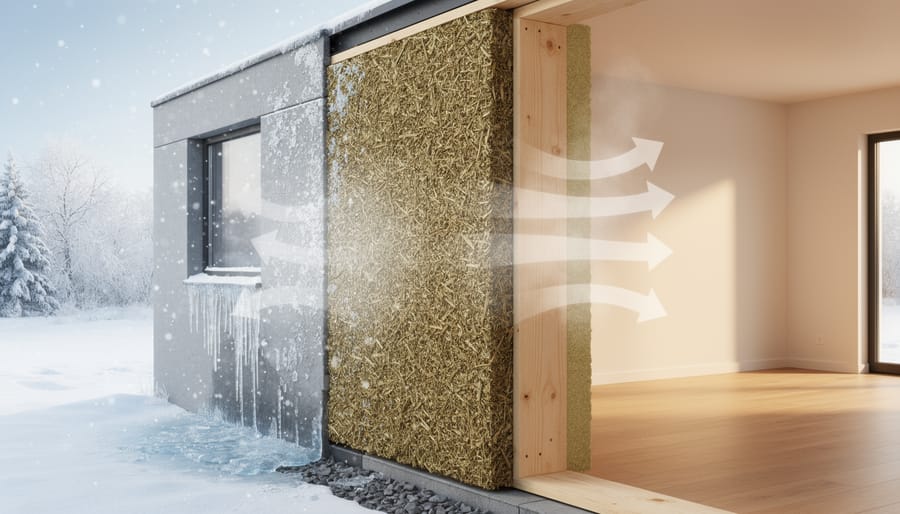
Moisture management sets hempcrete apart from vapor-barrier assemblies. The material absorbs and releases water vapor continuously, buffering indoor humidity between 40-60% relative humidity without trapping condensation within the wall assembly. This hygroscopic action prevents the conditions that foster mold growth and material degradation common in sealed wall systems. Vapor permeability ratings typically exceed 10 perms, classifying hempcrete as a vapor-open material that requires breathable finishes on both interior and exterior faces.
For HVAC load calculations, account for reduced latent cooling demand due to passive humidity regulation, and model thermal mass benefits using dynamic simulation tools rather than simplified peak-load methods.
Types and Formulations of Hempcrete
Hempcrete arrives on site in three primary formats, each suited to different project scales and contractor capabilities. Site-mixed hempcrete offers maximum flexibility: contractors combine loose hemp hurds with a lime binder and water in a forced-action mixer on location. This approach works well for bespoke projects where formulation can be adjusted during installation, though it demands careful quality control and consistent mixing protocols. Pre-mixed bagged products eliminate batching variables by delivering factory-blended hurd-binder combinations that require only water addition. These products reduce on-site errors and suit smaller projects or contractors new to hempcrete, albeit at a premium cost. Prefabricated panels and blocks shift production entirely off-site, delivering dimensionally stable units that install faster than wet-mix methods and compress construction timelines.
The binder determines hempcrete’s curing characteristics and ultimate performance. Natural hydraulic lime (NHL) sets through both carbonation and hydraulic reaction, offering moderate early strength and compatibility with traditional lime building methods. Formulations using NHL 3.5 or NHL 5 grades suit structural frames requiring earlier formwork removal. Pozzolanic additives like metakaolin or ground granulated blast-furnace slag accelerate set times and can boost compressive strength, though they alter the material’s vapor permeability profile. Some proprietary binders blend hydraulic lime with supplementary cementitious materials to balance workability, cure speed and breathability, competing with alternatives like low-carbon concrete in sustainable building portfolios.
Hurd-to-binder ratios fundamentally shift material behavior. A 1:1 ratio (by weight) yields denser hempcrete at roughly 400-450 kg/m³, providing higher compressive strength for floor screeds but reduced thermal performance. Leaner 2:1 or 2.5:1 ratios drop density to 250-300 kg/m³, improving insulation values to R-2.5 per inch while sacrificing mechanical strength. Wall infill typically employs mid-range ratios balancing structural stability and thermal resistance. Roof insulation mixes favor maximum hurd content for lower density and better R-values, while floor applications reverse this priority.
Specialty formulations address specific building elements. Wall mixes maintain workability for vertical casting or spraying. Floor screeds incorporate higher binder content to withstand foot traffic and accept finish flooring. Roof insulation variants maximize porosity for moisture release while maintaining adequate cohesion under compression loads.
Hempcrete Applications in Construction
New Build vs. Retrofit Projects
Incorporating hempcrete into new construction offers distinct advantages over retrofit applications, though both scenarios present viable pathways for this material. In new builds, designers can plan the entire building envelope around hempcrete’s hygroscopic properties from the outset, selecting complementary materials that maintain vapor permeability throughout the wall assembly. This integrated approach allows architects to optimize wall thickness, specify compatible lime-based finishes, and design structural frames that accommodate hempcrete infill without thermal bridging concerns.
Retrofit projects require more careful assessment of existing building conditions. The primary consideration is breathability compatibility. Adding hempcrete to walls that incorporate vapor barriers or impermeable exterior cladding can trap moisture and compromise the material’s performance. Before specifying hempcrete retrofits, building surveyors must evaluate the existing envelope’s ability to manage moisture movement. Older buildings with traditional lime plaster or permeable brick often prove ideal candidates, whereas structures with modern vapor-tight systems may require envelope modifications.
Structural assessment becomes critical in retrofit applications. Load-bearing walls must be evaluated to ensure adequate capacity after adding hempcrete’s weight, typically 275-350 kg per cubic meter depending on formulation. Thermal bridge mitigation presents additional complexity in retrofits. Existing structural elements that penetrate the building envelope require careful detailing to prevent cold spots where hempcrete meets concrete slabs, steel beams, or conventional insulation. New construction allows these junctions to be designed with thermal breaks integrated from the start, reducing on-site coordination challenges and performance compromises.
Installation Methods and Construction Techniques
Construction teams deploying hempcrete have three primary installation methods, each with distinct labor requirements, timelines, and suitability for different project types.
The cast-in-place technique remains the most common approach for custom builds and retrofit projects. Crews erect temporary formwork, typically plywood or rigid insulation panels, against both sides of the structural frame, creating a void that receives the wet hempcrete mix. The material is hand-tamped or compacted in lifts of 300-500mm to ensure proper density and eliminate voids. Formwork rises incrementally as each lift sets, typically over several days, allowing the lime binder to begin its initial cure before additional weight loads the wall. This method offers maximum design flexibility and works well for complex geometries, but it’s labor-intensive and weather-dependent. Expect 0.5-0.8 cubic meters of hempcrete placement per person per day for experienced crews.
Spray application significantly accelerates installation. Specialized pneumatic equipment projects the hempcrete mix onto the structural frame through a nozzle, building up wall thickness in successive passes. Only one side requires formwork, the exterior face, while the sprayed material adheres to the frame and builds outward. This method cuts installation time by 40-60% compared to cast-in-place and reduces formwork costs, but requires investment in spray equipment and trained operators. It’s particularly effective for large commercial projects where speed justifies equipment mobilization.
Precast hempcrete blocks or panels arrive on site ready for dry-stacking or panel erection, eliminating wet curing delays and weather exposure during installation. Blocks typically measure 600x300x300mm and install like oversized masonry units with lime mortar joints. Panels, often 2400x600mm or larger, bolt to structural frames and require crane placement. Precast systems deliver the fastest enclosure times and predictable quality, though they sacrifice design flexibility and currently carry premium pricing due to limited manufacturing capacity.
Wall thickness varies by climate zone and thermal performance targets. Temperate regions typically specify 300-350mm walls (R-20 to R-25 equivalent), while colder climates demand 400mm or greater for adequate insulation. Floor screeds run 100-150mm; roof applications range from 200-300mm depending on structural capacity.
Curing protocols critically impact performance. Hempcrete requires 6-8 weeks for full carbonation cure, though it reaches handling strength within 7-10 days. During this period, maintain airflow through the assembly to facilitate moisture evaporation, but protect from direct water exposure and freezing temperatures. Don’t apply vapor-impermeable finishes, conventional paint, vinyl siding, cementitious renders, until moisture content drops below 20%, verified with a moisture meter. Breathable lime plasters, clay renders, and wood cladding with ventilated cavities can be applied sooner as they permit continued drying.
Sequencing with other trades demands coordination. Complete roofing and install windows before hempcrete placement to minimize water exposure. Schedule electrical and plumbing rough-ins before infill, routing conduit and boxes through the structural frame since cutting hempcrete post-cure creates dust and compromises thermal continuity. MEP trades appreciate hempcrete’s workability, chases and penetrations cut easily with hand saws during the first two weeks of cure.
Quality control focuses on mix consistency and compaction. Batching by weight rather than volume ensures repeatable hurd-to-binder ratios. Test samples from each batch for density (target 275-350 kg/m³ for wall applications) and verify proper compaction by visual inspection for voids or slumping within formwork.
Expert Perspective: Hempcrete in Practice
I spoke with James Mitchell, a chartered architect with fifteen years’ experience and principal at Mitchell & Partners in Bristol, who has specified hempcrete on twelve residential and mixed-use projects since 2019. His largest hempcrete build to date was a 280-square-metre community centre completed in 2024.
“The biggest surprise was how forgiving the material is during installation,” Mitchell explains. “We had concerns about achieving consistent density and avoiding cold bridges, but the crew adapted quickly. By the second project, they were working at pace comparable to conventional timber-frame infill.”
On performance, Mitchell reports that clients consistently praise indoor air quality and temperature stability. “One homeowner recorded a 40% reduction in heating costs compared to their previous property of similar size. The hygroscopic properties genuinely work, we’ve seen zero condensation or mold issues in buildings now three to five years old.”
Cost remains the primary barrier. Mitchell estimates hempcrete adds 15-20% to build costs compared to standard insulation systems when accounting for materials, specialized labor, and extended drying schedules. “The eight-week cure time before applying finishes pushes out timelines, which affects financing and cash flow. You need clients who understand they’re investing in lifecycle performance, not just upfront economy.”
The steepest learning curve, he notes, involves coordination with building control officers unfamiliar with the material. “We’ve had to commission independent testing and provide extensive technical documentation to satisfy code compliance in jurisdictions without established hempcrete provisions. Budget time for that education process.”
His advice for first-time specifiers: start with a small, low-risk project to build team confidence, engage a specialist hempcrete consultant early in design, and manage client expectations on timelines and costs transparently. “Hempcrete delivers on its promises, but it requires commitment beyond conventional construction approaches.”
Regulatory, Code Compliance, and Standards Landscape
Hempcrete occupies an evolving position in building regulatory frameworks worldwide. Unlike conventional materials with decades of codified standards, hempcrete faces a patchwork landscape of acceptance that varies significantly by jurisdiction, creating both opportunities and challenges for construction professionals.
No universal building code currently governs hempcrete use across major markets. In the United States, hempcrete isn’t explicitly addressed in the International Building Code (IBC), meaning projects typically require approval through alternative methods and materials pathways under IBC Section 104.11. This process demands engineering reports, material testing documentation, and collaboration with local building officials who may have limited familiarity with bio-based composites.
France leads regulatory development with Professional Rules published by Construire en Chanvre, offering technical guidance on design, installation, and performance expectations. The UK benefits from Building Research Establishment (BRE) publications and case study data that inform building control assessments, though hempcrete remains outside mainstream approved documents. Ireland published the first national hempcrete construction standard (S.R. 65) in 2016, establishing technical requirements for practitioners.
Fire testing presents a critical compliance hurdle. Hempcrete typically achieves Class E fire ratings in European classification systems, requiring protective layers or engineering strategies to meet more stringent requirements in commercial applications. Structural approval hinges on demonstrating that hempcrete serves only as infill within an independent frame, with load calculations verified by chartered engineers.
Insurance considerations mirror code uncertainty. Underwriters in jurisdictions without established hempcrete precedent may impose higher premiums or require additional documentation of material performance and installer qualifications.
For projects in regions lacking specific hempcrete provisions, engaging consultants experienced in alternative materials approval becomes essential. This expertise navigates testing protocols, documentation requirements, and building official negotiations that can otherwise derail timelines and budgets. As hempcrete market adoption expands through 2026, standardization efforts continue, but specifiers must currently approach each project with jurisdiction-specific regulatory strategies rather than relying on universal code pathways.
Cost Analysis and Project Economics
Hempcrete typically costs between £220-280 per cubic meter for materials in the UK market, with installation adding £150-200 per cubic meter depending on application method. For a typical wall assembly, this translates to approximately £180-250 per square meter installed, roughly 20-40% higher than conventional insulated masonry or timber frame construction with mineral wool.
Material procurement represents a significant cost factor. Hemp hurd availability varies by region, with transport costs for imported materials affecting project budgets. Lime binders add expense compared to portland cement, though prices have stabilized as suppliers scale production. Projects near hemp cultivation areas or established supply chains see better material economics.
Labor costs reflect the specialized knowledge required. Few contractors have hempcrete experience, creating a learning curve that extends installation timelines. Cast-in-place applications require 6-8 weeks of curing before subsequent trades can proceed, potentially adding weeks to project schedules. Spray application reduces installation time but demands equipment investment and trained operators.
The economic case strengthens when lifecycle costs enter calculations. Hempcrete buildings demonstrate 15-20% reductions in heating and cooling loads, allowing for smaller HVAC systems, a capital cost offset of £5,000-15,000 on typical residential projects. Operational energy savings compound over decades, with documented cases showing 30-40% lower energy bills compared to code-minimum construction.
Break-even typically occurs within 12-18 years when factoring in energy savings, though this varies with climate, energy prices, and system design. Early adopters face premium costs, but market maturation and integration with other sustainable innovations are driving economies of scale. Projects prioritizing carbon accounting increasingly value hempcrete’s sequestration benefits, which don’t appear in traditional cost analyses but carry growing regulatory and market weight in 2026.
Case Study: Hempcrete in a Completed Project
The Flat House in Cambridgeshire, UK, completed in 2019, demonstrates hempcrete’s viability in contemporary residential construction. This 150-square-meter single-story dwelling was designed by Practice Architecture for clients seeking a net-zero energy home with minimal environmental impact.
The project team specified hempcrete for all external wall infill within a prefabricated timber frame structure. Walls measure 300mm thick, combining structural oak posts with hempcrete cast in place using temporary formwork. The design prioritized passive house principles, leveraging hempcrete’s thermal mass and breathability to reduce mechanical heating and cooling loads.
Construction began in spring to maximize natural drying during warm months. The team mixed hempcrete on-site using locally sourced hemp shiv and Tradical Hemcrete binder, applied in 500mm lifts with 48-hour intervals between pours to prevent slumping. Total wall installation required six weeks, followed by an eight-week curing period before internal finishes could proceed. This extended timeline represented the primary scheduling challenge, requiring careful coordination with subcontractors and client expectations management.
The construction team encountered moisture-related learning curves. Initial batches proved too wet, causing formwork bulging and uneven curing. Adjusting the water-to-binder ratio and implementing more robust bracing resolved these issues by the second wall section. The project architect noted that contractor familiarity with hempcrete significantly improved efficiency after the first wall bay.
Post-occupancy monitoring over two heating seasons revealed stable internal humidity between 40-60% without mechanical ventilation, validating hempcrete’s hygroscopic performance. Space heating demand measured 35% lower than modeled predictions for conventional insulated construction, attributed to thermal mass effects not fully captured in standard heat loss calculations.
Client feedback emphasized comfort quality, consistent temperatures, absence of drafts, and notably quiet interiors, as standout benefits. Material cost premiums (approximately 15% over conventional build-up) were offset by reduced HVAC equipment sizing and ongoing energy savings.
Key takeaways for specifiers: allow extended construction schedules, budget for contractor training on first hempcrete projects, plan formwork systems carefully to manage wet material behavior, and communicate curing requirements clearly across all trades. The Flat House validates hempcrete’s technical performance while illustrating the process discipline required for successful implementation.
Common Questions About Hempcrete
Is hempcrete structural or load-bearing?
No, hempcrete is a non-structural material that requires a separate frame, timber, steel, or masonry, to carry building loads. It functions as insulating infill, not as a structural element.
How does hempcrete perform in freeze-thaw cycles and humid climates?
Hempcrete’s breathable, hygroscopic nature allows it to manage moisture without trapping water, which prevents freeze-thaw damage. In humid regions, it regulates interior humidity effectively, though proper detailing and adequate drying time during construction are essential.
What is the expected lifespan of a hempcrete building?
Evidence from European projects suggests hempcrete buildings can last several centuries when properly constructed and maintained. The lime binder continues to harden and absorb CO2 over time, actually increasing durability as the structure ages.
Can hempcrete be used in commercial projects or only residential?
Hempcrete is suitable for both residential and commercial applications, including schools, offices, and community buildings. The primary constraint is project scale and local code acceptance rather than building type.
How does hempcrete interface with conventional finishes?
Hempcrete accepts lime plasters, clay plasters, and breathable renders directly. Conventional gypsum board can be applied over a lime-based basecoat, though vapor-impermeable finishes should be avoided to maintain the wall assembly’s breathability.
Are there supply chain challenges for hempcrete materials?
Hemp hurd availability varies by region, with more established supply networks in Europe than North America. Lead times for materials can be longer than conventional products, and sourcing locally-grown hemp remains limited in some markets, though the situation is improving as hemp cultivation expands.
These questions reflect the most frequent concerns raised during project feasibility assessments. Professionals integrating hempcrete into broader decarbonization strategies should work with experienced consultants who understand both the material’s capabilities and its limitations within specific regulatory contexts. Early engagement with building officials and material suppliers reduces uncertainty and keeps project timelines realistic.
Hempcrete stands out as a genuinely sustainable building material for construction professionals pursuing low-carbon projects in 2026. Its carbon-negative profile, achieved through both cultivation-phase CO2 absorption and ongoing mineralization during the lime curing process, positions it as one of the few materials that actively removes carbon from the atmosphere over its lifetime. The thermal regulation and moisture management capabilities deliver measurable performance benefits, reducing HVAC loads while creating healthier indoor environments through natural breathability.
That said, hempcrete isn’t a universal solution. Code acceptance remains patchy across jurisdictions, requiring case-by-case approval in many markets. Material and labor costs typically exceed conventional alternatives, particularly where specialized expertise is scarce. The non-structural nature of hempcrete means it must work within a supporting frame system, limiting certain applications. Construction timelines extend due to curing requirements, which can complicate project scheduling.
For firms committed to net-zero construction, hempcrete warrants serious consideration as part of a broader material strategy. Start with pilot projects where longer timelines and higher upfront costs align with client sustainability goals. Work closely with experienced consultants to navigate code approval processes. Monitor regulatory developments as standardization efforts progress and supply chains mature.
Hempcrete won’t replace concrete or steel, but it offers proven performance for specific applications where low embodied carbon and superior hygrothermal properties matter. As the construction industry moves toward mandatory carbon accounting and tighter energy standards, bio-based materials like hempcrete will occupy an increasingly important role in the professional toolkit.
