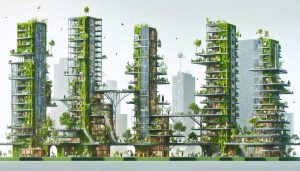
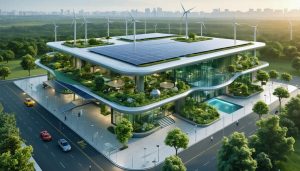
Artistic representation of a net-zero energy commercial building with solar panels, green spaces, and sustainable features.

These Net-Zero Energy Buildings Are Revolutionizing Commercial Construction

Net-zero architecture has moved from aspirational concept to proven reality, with zero energy buildings now demonstrating unprecedented operational efficiency across diverse climate zones and building types. The Bullitt Center in Seattle, the Unisphere in Silver Spring, and the Bosco Verticale in Milan exemplify how commercial structures can generate as much energy as they consume while maintaining premium workplace functionality. These pioneering projects have validated critical …

A contemporary urban landscape showcasing the integration of green roofs, bioswales, and urban forests among skyscrapers, symbolizing the evolution of sustainable urban construction.

Green Infrastructure: The Next Evolution in Urban Construction

Green infrastructure transforms urban landscapes from concrete jungles into resilient, sustainable cities through strategic integration of natural systems. As metropolitan areas face intensifying climate challenges and growing population pressures, the implementation of green infrastructure has evolved from an environmental aspiration to a critical engineering imperative.
Industry data demonstrates that cities incorporating comprehensive green infrastructure solutions …

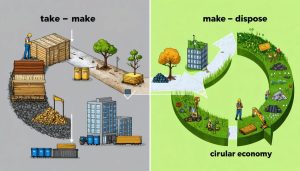
Conceptual illustration showing the contrast between linear construction waste piles and circular construction practices with material reuse and modular structures.

Why Urban Circular Economy Could Save Construction Companies Millions

The construction industry stands at a pivotal crossroads between sustaining traditional linear production models and embracing circular economy principles that could revolutionize how we build. While linear economies follow the “take-make-dispose” pathway that has dominated construction for centuries, circular economies reimagine waste as a resource, transforming our $11.5 trillion global construction sector through systematic material reuse and regenerative design.
Recent data reveals that construction generates 35% of global waste, with only 20% currently being recycled or repurposed. The circular economy model …

"A diverse team of construction professionals, including architects, contractors, and project managers, collaborating around a digital table with architectural plans and BIM models, highlighting teamwork and integrated project delivery."

Why Stakeholder Collaboration Is Critical for Construction Project Success

In today’s complex construction landscape, effective stakeholder engagement strategies determine the success or failure of major projects. Stakeholder collaboration transforms traditional project delivery by breaking down silos between owners, contractors, architects, and other key players, creating a unified approach to project execution. This integrated methodology has revolutionized how construction projects are conceived, planned, and delivered, reducing conflicts by up to …

An imaginative cityscape featuring skyscrapers and buildings made from sustainable materials like mycelium bricks and engineered timber, integrated with greenery and solar panels, representing the future of eco-friendly urban development.

These Revolutionary Building Materials Are Reshaping Sustainable Construction

Revolutionizing the construction industry demands urgent attention as innovative, eco-friendly building materials emerge to address climate change and resource scarcity. Today’s sustainable construction practices are being transformed by breakthrough materials that combine performance with environmental responsibility.
From carbon-negative concrete alternatives to bio-based composites derived from agricultural waste, these next-generation materials are redefining …

Aerial view of a modern city integrating green infrastructure with urban parks, vertical gardens, bioswales, and permeable pavements.

10 Groundbreaking Green Infrastructure Projects Reshaping Modern Cities

In the race to combat climate change and enhance urban resilience, green infrastructure development has emerged as a cornerstone of modern city planning. From Copenhagen’s innovative bioswales managing 30% of stormwater runoff to Singapore’s vertical gardens covering over 120 hectares of building façades, cities worldwide are transforming grey urban landscapes into high-performance environmental assets. These solutions deliver measurable returns on investment: reduced flooding risks, decreased urban …

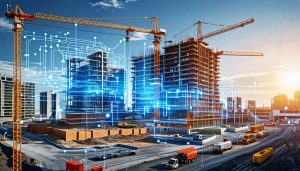
A digital twin representation of a construction site, featuring a 3D model and data overlays connecting the physical and digital worlds.

Digital Twins: Revolutionizing Construction Project Management

Discover how digital twins are revolutionizing the construction industry, enabling smarter planning, efficient execution, and optimized asset management. In this article, we delve into the concept of digital twins, exploring their key components, real-world applications, and the immense potential they hold for construction projects of all scales. Through expert insights and in-depth case studies, you’ll gain a comprehensive understanding of how digital twins are transforming the way we design, build, and maintain the built environment. Prepare to embark on a journey that will change your perspective on the future of construction and …

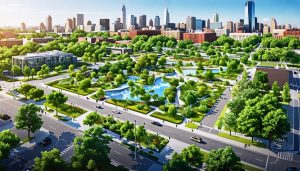
An aerial illustration depicting a cityscape with green roofs, lush parks, permeable pavements, and abundant tree canopies, showcasing the integration of urban green infrastructure into the urban environment.

Revitalize Your City: The Game-Changing Power of Urban Green Infrastructure

Integrate permeable pavements to enhance stormwater management by allowing rainfall to infiltrate through surfaces, reducing runoff and improving water quality. Implement green roofs to absorb rainwater, provide insulation, and extend the lifespan of building materials while boosting urban biodiversity. Design rain gardens strategically to manage stormwater close to its source, filtering pollutants and facilitating ground absorption. Use urban tree canopies effectively for cooling urban areas, improving air quality, and creating aesthetically pleasing environments, which can translate into increased property values. Leverage bioswales to …

Conceptual illustration of a digital dashboard displaying various construction project metrics including cost variance, ROI, schedule performance, and safety compliance in a data-driven format.

7 Key Construction Metrics That Drive Project Success in 2024

In today’s competitive construction landscape, measuring the right metrics stands as the fundamental difference between project success and costly setbacks. Construction leaders leveraging data-driven decision making consistently outperform their peers by 20-30% in project delivery times and cost efficiency. The industry’s rapid digital transformation has made it crucial for organizations to track, analyze, and optimize key performance indicators across safety, productivity, financial …

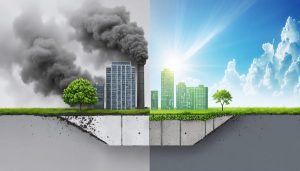
Conceptual depiction of a building transitioning from smoke-laden traditional concrete production to eco-friendly low-carbon concrete, highlighting industrial byproducts like slag and fly ash.

Low Carbon Concrete: The Game-Changing Building Material That’s Dividing the Industry

As the construction industry pivots toward sustainable construction practices, low-carbon concrete emerges as a transformative solution in the battle against climate change. With traditional concrete production accounting for 8% of global CO2 emissions, this innovative alternative promises to revolutionize how we build our future infrastructure.
Recent advances in materials science have enabled the development of concrete mixtures that reduce carbon emissions by up to 70% while maintaining structural …