
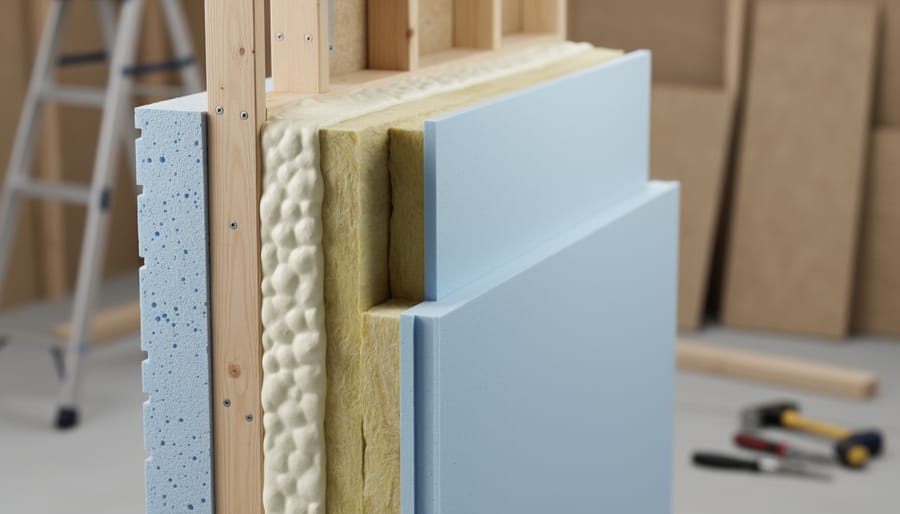
R-value is the measure of a material’s resistance to heat flow, with higher numbers indicating better insulating performance. For every inch of thickness, materials like closed-cell spray foam can achieve R-6 to R-7, while fiberglass batts typically deliver R-3 to R-4, and rigid foam boards fall somewhere in between.
Understanding R-values isn’t just about meeting code requirements. It’s about making informed decisions that affect energy performance, long-term operating costs, and occupant comfort across the building’s lifespan. In 2026, as energy codes tighten and owners demand greater efficiency from their buildings, selecting materials with appropriate R-values has become a critical competency for construction professionals.
The challenge goes beyond memorizing numbers from a table. Different applications require different approaches. Wall assemblies, roof systems, and foundation details each demand specific thermal performance thresholds, and the real-world R-value can differ significantly from laboratory ratings depending on installation quality, moisture exposure, and thermal bridging through framing members.
This article breaks down the mechanics of how R-values work at the material level, provides category-by-category comparisons of common construction materials with their tested thermal resistance values, and demonstrates practical applications through real project examples. You’ll find expert perspectives from building scientists and thermal performance specialists, plus case studies showing how material selection decisions played out in actual construction scenarios. We’ll also examine emerging smart insulation technologies that adapt their thermal properties to changing conditions, representing where the industry is headed as buildings become more responsive and efficient.
What Are R-Values in Construction Materials?
R-values measure a material’s resistance to heat flow, quantifying how effectively it prevents thermal energy from moving through a building assembly. Specifically, R-value represents thermal resistance per unit area, expressed as the temperature difference needed to transfer one unit of heat through one square foot of material over a specified time period. In the United States, R-values are measured in ft²·°F·hr/BTU, while international applications use the metric equivalent (m²·K/W). A higher R-value indicates greater insulating capacity and better thermal performance.
The science behind R-values centers on controlling conductive, convective, and radiative heat transfer. When temperature differences exist between a building’s interior and exterior, heat naturally flows from warmer to cooler areas. Insulation materials with high R-values slow this movement by trapping air pockets, reducing molecular conduction paths, or blocking radiative heat transfer. The R-value essentially measures how many hours it takes for one BTU of heat to pass through one square foot of material for each degree Fahrenheit of temperature difference.
Understanding related thermal terminology helps construction professionals make informed material decisions:
- R-value
- The measure of thermal resistance per unit area, indicating how well a material resists heat flow. Higher values mean better insulation performance.
- Thermal Resistance
- The temperature difference across a material divided by the heat flux through it, representing the material’s opposition to heat transfer.
- U-value
- The inverse of R-value (U = 1/R), measuring thermal transmittance or how readily heat passes through an assembly. Lower U-values indicate better insulation.
- Thermal Conductivity
- A material property measuring how quickly heat moves through a substance, typically expressed as k-value or lambda. Materials with lower thermal conductivity achieve higher R-values per inch.
R-values became the industry standard because they provide a consistent, additive metric for comparing materials and designing building envelopes. Unlike thermal conductivity, which varies inversely with performance, R-values scale intuitively, doubling the R-value halves the heat loss. This makes specification straightforward: construction professionals can add R-values of successive layers to calculate total assembly performance, enabling accurate energy modeling and code compliance verification across different material combinations and thicknesses.
How R-Values Work in Building Envelopes
Calculating Total R-Value in Wall Assemblies
# Calculating Total R-Value in Wall Assemblies
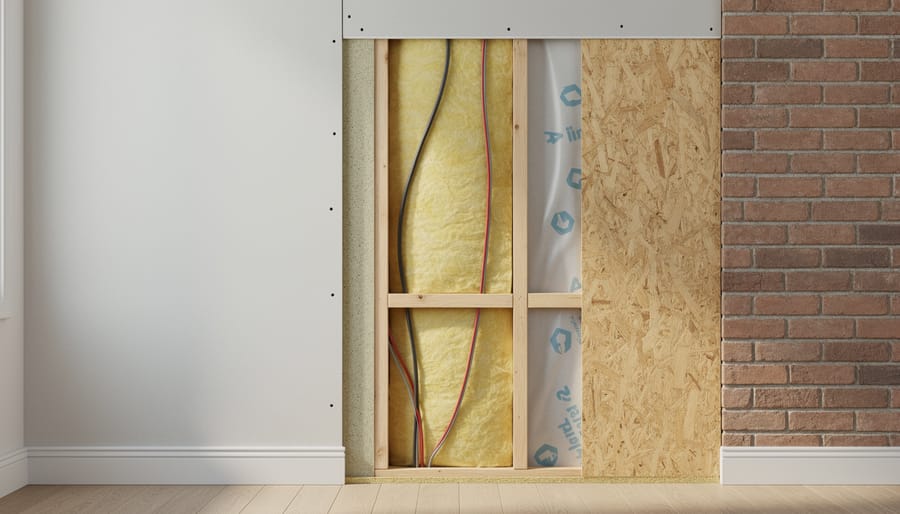
Calculating the total R-value of a wall assembly requires adding the individual R-values of each layer, from exterior sheathing through insulation to interior finish. Start with the rated R-value per inch for each material, multiply by actual thickness to get the layer’s contribution. A typical wood-frame wall might include: exterior sheathing (R-0.5), cavity insulation (R-13 for 3.5 inches of fiberglass), interior drywall (R-0.45), and air films (R-0.85 combined). The nominal sum gives R-14.8.
However, this calculation ignores thermal bridging, the heat loss through framing members that bypass cavity insulation. Wood studs conduct heat roughly five times faster than fiberglass. In standard 16-inch-on-center framing, studs occupy about 25% of the wall area, creating a parallel heat flow path that degrades overall performance by 20-25%. The effective whole-wall R-value for that R-14.8 assembly drops to approximately R-11 to R-12.
Professional energy modelers use the parallel-path method: calculate R-values separately for the clear-field (insulated) and framing sections, weight each by its percentage of wall area, then combine using the reciprocal formula. This accounts for temperature-dependent R-values and real-world thermal bridging. Steel framing creates even more severe bridging, up to 50% reduction, requiring continuous exterior insulation to maintain code-compliant thermal performance.
Environmental Factors Affecting R-Value Performance
Rated R-values represent laboratory conditions that rarely match real-world performance. Several environmental factors significantly reduce the thermal resistance of construction materials once installed.
Moisture poses the most serious threat to R-value performance. When insulation absorbs water, thermal resistance drops dramatically, fiberglass can lose up to 50% of its insulating capacity when wet. Water conducts heat roughly 25 times faster than air, effectively creating thermal shortcuts through the material. This makes moisture barriers and proper detailing critical. Advanced hydrophobic coatings now help protect insulation materials from moisture infiltration, preserving their rated performance.
Temperature extremes also affect R-value stability. Most materials are tested at 75°F, but performance varies as temperatures shift. Foam boards can lose 10-15% of their R-value in cold climates as the blowing agent migrates out over time. Conversely, extreme heat degrades certain materials, reducing long-term thermal resistance.
Compression destroys the air pockets that provide thermal resistance. Fiberglass batts compressed from 6 inches to 4 inches don’t retain two-thirds of their R-value, they may lose 40% or more because density increases unevenly. This commonly occurs around electrical boxes, pipes, and structural members.
Installation quality determines whether materials achieve their potential. Gaps, voids, and poorly fitted batts create convective loops that bypass insulation entirely. A wall with R-19 batts installed with just 5% gaps performs closer to R-15 in practice. Proper cutting, fitting, and air sealing transforms rated R-values into measured thermal performance.
Types of Construction Materials and Their R-Values
Traditional Insulation Materials
Fiberglass batts remain the most widely installed insulation in residential construction, delivering R-3.2 to R-3.8 per inch depending on density. These flexible blankets fit between standard stud spacing and offer contractors a familiar, cost-effective solution, though performance drops when compressed or installed with gaps.
Mineral wool batts provide R-3.0 to R-4.2 per inch with superior fire resistance and sound dampening compared to fiberglass. The stone-fiber composition maintains dimensional stability under heat and doesn’t absorb moisture, making it ideal for commercial projects requiring fire-rated assemblies.
Cellulose insulation a category of sustainable biomaterials made from recycled paper, achieves R-3.6 to R-3.8 per inch when dense-packed into wall cavities. Loose-fill applications in attics settle over time but excel at filling irregular spaces that batts cannot reach.
Rigid foam boards deliver higher R-values in thinner profiles. Expanded polystyrene (EPS) provides R-3.6 to R-4.2 per inch, extruded polystyrene (XPS) offers R-5.0, and polyisocyanurate hits R-6.0 to R-6.5 per inch when foil-faced. These continuous insulation layers reduce thermal bridging through framing members.
Smart and Advanced Insulation Materials
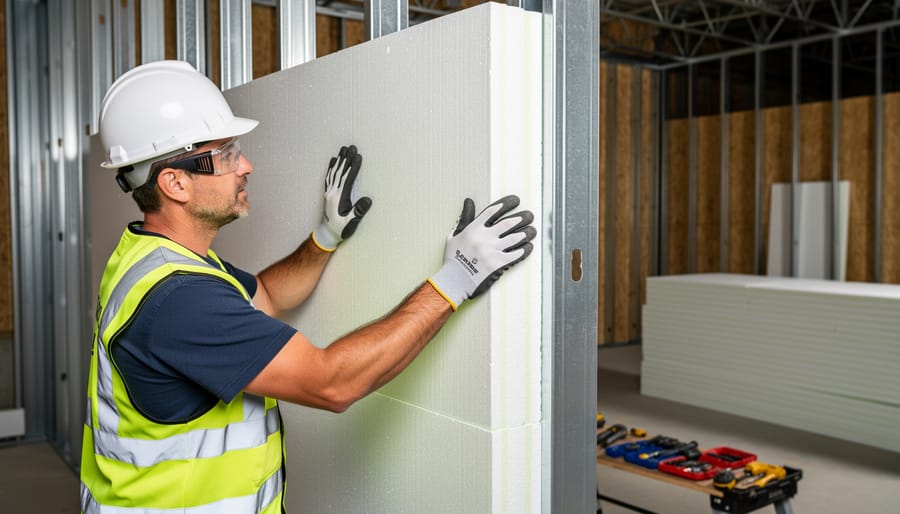
Smart insulation materials represent the cutting edge of thermal performance, delivering R-values that surpass conventional options while introducing adaptive capabilities. Aerogel insulation achieves R-values between R-8 and R-10 per inch, roughly three times that of fiberglass, making it ideal for space-constrained applications where maximum thermal resistance is essential. Despite higher material costs, aerogel’s exceptional performance allows thinner wall assemblies without compromising insulation value.
Vacuum insulated panels (VIPs) push performance even further, reaching R-25 to R-50 per inch under ideal conditions. These panels use evacuated cores wrapped in gas-barrier envelopes to eliminate conductive and convective heat transfer. The trade-off: any puncture compromises the vacuum seal and drastically reduces performance, requiring careful handling during installation and protection within assemblies.
Phase-change materials (PCMs) introduce a different paradigm by storing and releasing thermal energy as they transition between solid and liquid states. While PCMs don’t provide high static R-values, they reduce peak heating and cooling loads by moderating temperature swings, particularly valuable in buildings with significant diurnal temperature variations.
Emerging technologies like quantum-enhanced insulation are beginning to appear in specialized applications, using nanostructured materials to manipulate heat transfer at the molecular level. These materials promise R-values exceeding R-12 per inch while maintaining structural integrity and long-term stability. In 2026, construction professionals increasingly specify these advanced materials for high-performance envelopes, net-zero projects, and renovations where conventional insulation thickness isn’t feasible.
Structural Building Materials
Structural building materials provide the skeleton of a building envelope, yet most contribute minimal thermal resistance compared to dedicated insulation products. Understanding their R-values reveals why insulation layers remain essential rather than relying on structure alone for thermal performance.
Concrete delivers roughly R-0.08 per inch, a 12-inch concrete wall achieves only R-0.96, negligible by modern standards. Wood performs significantly better at R-1.0 to R-1.25 per inch depending on species and density; a 2×6 wood stud offers R-6.9, though thermal bridging through framing reduces effective wall assembly performance by 20-40%. Brick and concrete block sit around R-0.2 and R-0.11 per inch respectively, making solid masonry walls poor thermal barriers without added insulation.
Steel and aluminum offer virtually no thermal resistance (R-0.0003 per inch for steel), creating severe thermal bridges when used as framing members. This explains why steel-framed buildings require continuous exterior insulation to offset conductivity losses that can reduce assembly R-values by 50% compared to rated cavity insulation alone.
These structural R-values, while low, must be calculated into total assembly performance. A typical wood-framed wall with R-19 cavity insulation delivers an effective R-value closer to R-13 once framing is factored in, a reality that drives specification decisions toward advanced framing techniques and continuous insulation strategies that minimize thermal bridging while meeting code requirements.
Practical Applications of R-Values in Construction Projects
Construction professionals rely on R-values throughout every phase of a project, from initial design through final inspection. The metric serves as both a regulatory checkpoint and a design optimization tool that directly affects building performance, project costs, and occupant comfort.
The most immediate application involves code compliance verification. Building officials require documentation showing that specified assemblies meet minimum R-value thresholds for each climate zone. Architects submit wall, roof, and floor calculations that account for all layers, from exterior cladding through structural framing to interior finishes. These calculations must demonstrate compliance even when accounting for thermal bridging through studs and other penetrations that reduce overall assembly performance.
Energy modeling software transforms R-values into predicted annual energy consumption and peak heating/cooling loads. Engineers input material specifications to simulate building performance under local climate conditions, enabling comparisons between design alternatives before construction begins. A model might reveal that upgrading from R-13 to R-21 wall insulation reduces HVAC equipment size requirements enough to offset the material cost difference, or that roof insulation improvements deliver better returns than foundation upgrades for a specific building type.
Material selection decisions weigh R-values against multiple competing factors:
- Building code compliance for walls, roofs, foundations, and fenestration in specific climate zones
- Energy efficiency targets for LEED certification, net-zero performance, or utility incentive programs
- Cost-benefit analysis comparing installed cost per R-value across material options
- Climate-specific design considerations including moisture management and seasonal temperature swings
Project specifications translate R-value requirements into precise material callouts and installation standards. Rather than specifying “fiberglass batt insulation,” specs state “R-21 unfaced fiberglass batt insulation, 5.5-inch nominal thickness, installed in full contact with cavity surfaces without compression or gaps.” This precision ensures contractors deliver the intended thermal performance.
During construction administration, R-values guide substitution approvals when specified materials become unavailable. An architect might approve switching from R-6 rigid foam to two layers of R-3 foam if installation details maintain continuity, but reject a proposal that introduces thermal bridges. Field verification confirms that installed assemblies match designed R-values through thickness measurements and infrared thermography before concealment.
R-Value Requirements and Building Codes in 2026
Building codes in 2026 establish minimum R-value requirements that vary significantly across climate zones, directly shaping material selection for every construction project. The International Energy Conservation Code (IECC) and ASHRAE 90.1 standards form the regulatory foundation, with most jurisdictions adopting zone-specific requirements based on heating and cooling degree days.
Climate Zone 1 (hot-humid regions like Miami) requires minimum R-13 wall insulation and R-30 attic insulation, while Climate Zone 7 (cold regions like Duluth) mandates R-21 walls and R-49 attics. These differences reflect the thermal demands of each region. Commercial buildings face stricter requirements, with Climate Zone 5 typically requiring R-20 continuous insulation for mass walls and R-30 for steel-framed walls.
The 2024 IECC update, now widely adopted in 2026, introduced more stringent requirements for high-performance building envelopes. Basement wall R-values increased by R-5 to R-10 in northern zones, and continuous insulation requirements expanded to reduce thermal bridging through framing members. Window and door U-factors also tightened, pushing builders toward triple-pane assemblies in colder climates.
These regulations drive material selection by establishing performance baselines that designers must meet or exceed. A project in Climate Zone 6 requiring R-20 wall assemblies might use 4 inches of closed-cell spray foam, 6 inches of mineral wool, or 3 inches of advanced thermal materials like aerogel composite panels. The code requirements don’t dictate specific products but set performance thresholds that eliminate inadequate options from consideration.
Many jurisdictions now enforce compliance through energy modeling software that calculates whole-building thermal performance rather than prescriptive component requirements. This approach gives designers flexibility to balance R-values across different assemblies while meeting overall energy targets, encouraging innovation in material combinations and building envelope strategies.
Expert Insights: Selecting Materials Based on R-Values
# Expert Insights: Balancing R-Value Requirements with Project Realities
“The biggest mistake I see is engineers treating R-values as the only number that matters,” explains Dr. Sarah Chen, a building science consultant with 18 years of experience designing high-performance envelopes. “A material with R-30 looks impressive on paper, but if your crew can’t install it properly or moisture compromises it within three years, you’ve achieved nothing.”
Chen emphasizes that effective material selection for construction requires weighing multiple factors against code minimums. “I always start with the climate zone requirement, that’s your baseline. But then you need to ask: What’s the realistic installed performance? A poorly installed R-30 system often underperforms a well-executed R-20 assembly.”
Cost-effectiveness extends beyond initial material pricing. “I’ve specified aerogel insulation at $8 per square foot where traditional materials cost $2, and the client thanked me,” Chen notes. “The aerogel’s R-10 per inch meant we achieved code compliance in a thin retrofit cavity where conventional materials couldn’t fit. The alternative was structural modifications costing five times more.”
Installation complexity directly impacts field performance. “On a recent commercial project, we chose spray foam over mineral wool batts despite similar R-values per inch. The irregular framing and penetrations meant batts would have gaps and compression points, thermal bridging that negates half your R-value. The spray foam sealed everything uniformly.”
Chen’s decision framework prioritizes three questions: Does it meet code? Will it perform as rated after installation? What’s the lifecycle cost including labor, air sealing, and durability? “R-values for construction materials are your starting point, not your finish line,” she concludes.
Case Study: High-Performance Building Envelope Design
The Portland Innovation Center, a 45,000-square-foot commercial office building completed in early 2026, demonstrates how strategic R-value optimization can achieve net-zero energy performance in a challenging Pacific Northwest climate. The project team faced a critical decision: meet aggressive thermal performance targets within a constrained budget while accommodating an accelerated construction timeline.
The design team selected a hybrid wall assembly combining 3 inches of closed-cell spray foam (R-21) with 2 inches of continuous exterior mineral wool insulation (R-8), achieving a total assembly R-value of R-29 while minimizing thermal bridging through the steel stud framing. This approach cost 18% less than the initially specified vacuum insulated panel system while delivering 94% of its thermal performance. The continuous exterior insulation layer proved essential, thermal imaging conducted six months post-occupancy revealed virtually no heat loss at structural penetrations, validating the assembly’s effectiveness.
Moisture management emerged as the primary technical challenge during construction. The team integrated advanced moisture protection systems with the insulation assembly, including a self-adhered weather barrier and careful detailing at all penetrations. Blower door testing measured 0.18 air changes per hour at 50 pascals, exceeding the Passive House standard and demonstrating exceptional installation quality.
Energy monitoring through the building’s first year of operation confirmed projected performance. Heating and cooling loads ran 62% below comparable code-minimum buildings in the same climate zone, with the high-R-value envelope reducing peak demand by 47%. The measured data validated the modeling assumptions and proved that thoughtful material selection based on R-value optimization delivers measurable returns in operational performance and occupant comfort.

Common Questions About R-Values in Construction
What’s the difference between R-value and U-value?
R-value measures thermal resistance (resistance to heat flow), while U-value measures thermal transmittance (how easily heat passes through). They’re mathematical inverses: U-value = 1/R-value. Higher R-values indicate better insulation, whereas lower U-values represent better performance.
Is a higher R-value always better for construction materials?
Not necessarily. While higher R-values provide greater thermal resistance, you must balance performance against cost, space constraints, structural requirements, and code minimums. Over-insulating beyond code requirements in mild climates often doesn’t justify the expense, and excessive insulation thickness can create detailing challenges at wall penetrations and openings.
How does climate affect R-value requirements?
Climate zones determine minimum R-value requirements through building codes. Cold climates demand higher R-values to prevent heat loss, while hot climates prioritize preventing heat gain. Mixed climates require balanced approaches that address both heating and cooling loads throughout the year.
Do R-values degrade over time in construction materials?
Some materials experience R-value degradation while others remain stable. Closed-cell spray foam and certain rigid boards can lose performance as blowing agents diffuse out over 5-10 years. Fiberglass, mineral wool, and cellulose maintain stable R-values if kept dry and properly installed, though moisture intrusion, compression, or settling can reduce effectiveness.
Construction professionals regularly encounter confusion about how R-values translate to real-world performance. The rated R-value represents laboratory conditions with ideal installation, but field performance often differs due to thermal bridging through framing members, air leakage at penetrations, and moisture accumulation. Understanding these practical limitations helps you set realistic expectations for building envelope performance and avoid overreliance on rated values alone.
Another common question involves comparing materials with identical R-values per inch. Two products with R-4 per inch aren’t interchangeable, installation complexity, moisture sensitivity, air sealing properties, and long-term durability vary significantly. Spray foam provides both insulation and air sealing, while fiberglass batts require separate air barriers. These factors influence total system performance beyond the simple R-value number.
Types or components
# Types of Construction Materials Categorized by R-Value Performance
Construction materials fall into three primary categories based on their thermal resistance characteristics, each serving distinct roles in building envelope design.
Insulation Materials represent the highest R-value category, purpose-built for thermal resistance. Fiberglass batts deliver R-3.2 to R-3.8 per inch, mineral wool provides R-3.0 to R-3.3, spray foam ranges from R-3.5 to R-6.5 depending on density, and rigid foam boards achieve R-4.0 to R-6.5. Advanced options like aerogel insulation can exceed R-10 per inch.
Structural Materials contribute secondary thermal resistance while providing mechanical support. Wood framing offers R-1.0 to R-1.25 per inch, concrete delivers R-0.08 to R-0.20, brick provides R-0.20 per inch, and steel contributes minimal resistance at R-0.003 per inch. These values affect overall assembly performance, particularly at thermal bridges.
Finish and Cladding Materials add marginal R-value while serving aesthetic and weather protection functions. Drywall contributes R-0.45 per half-inch, exterior sheathing adds R-0.5 to R-1.3, and siding materials range from R-0.6 to R-2.0 depending on thickness and composition.
Understanding these categories helps construction professionals select appropriate materials for each building envelope layer to achieve target thermal performance.
Understanding R-values for construction materials has shifted from a simple compliance checkbox to a strategic decision point that shapes building performance, operational costs, and environmental impact. The professionals who master thermal resistance fundamentals, how materials resist heat flow, how assemblies combine, and where theoretical ratings diverge from field performance, gain a competitive edge in delivering efficient, durable structures.
The construction industry in 2026 stands at an inflection point. Traditional insulation materials still dominate most projects, but smart insulation technologies are closing the performance gap while solving installation challenges that have plagued the field for decades. Aerogels and vacuum insulated panels deliver R-values previously unattainable in space-constrained retrofits. Phase-change materials stabilize temperature swings in ways static insulation cannot. These advances don’t replace the need to understand R-values, they make that knowledge more valuable.
Building codes will continue tightening thermal performance requirements as energy targets become more aggressive. The professionals who thrive won’t just meet minimum R-value thresholds; they’ll design assemblies that account for thermal bridging, moisture dynamics, and real-world installation variables that code tables ignore. They’ll recognize when paying more per R-value point delivers lower lifecycle costs, and when code-minimum solutions make financial sense.
The future belongs to builders who treat R-values not as isolated specifications but as one data point in a broader material selection framework that balances thermal performance, embodied carbon, durability, and constructability. That integrated perspective separates competent execution from genuine expertise.
