
A conceptual image showing a digital interface with construction risk analytics juxtaposed with a traditional paper-based assessment, highlighting the shift towards advanced risk management tools in the construction industry.

Smart Construction Risk Management: How Quantitative Software Is Revolutionizing Project Safety

In today’s high-stakes construction environment, quantitative risk management software transforms complex project uncertainties into measurable, manageable metrics. By leveraging advanced algorithms and real-time data analytics, these sophisticated platforms enable project managers to predict potential cost overruns, schedule delays, and safety incidents with unprecedented accuracy.
Modern QRM solutions integrate seamlessly with existing project management systems, providing decision-makers with data-driven insights that were previously impossible to obtain through traditional risk assessment methods. From Monte Carlo …

Conceptual illustration of a smart building with integrated energy management systems, featuring solar panels, sensor networks, and a central digital control hub.

These Smart Buildings Are Revolutionizing Home Energy Management

Smart buildings have revolutionized modern architecture by seamlessly integrating intelligent energy systems with advanced automation technologies. The Edge in Amsterdam stands as a prime example, achieving unprecedented sustainability with its 28,000 sensors managing everything from occupancy to lighting levels. Singapore’s Capita Green demonstrates how biometric access control and predictive maintenance systems can reduce operational costs by 30% while enhancing security protocols. New …

Conceptual illustration of a smart city with a digitally-integrated building, featuring visible IoT connections and AI interfaces, illustrating the transformation in property management through advanced technology.

How AI and IoT Are Reshaping Modern Property Management

The rapid acceleration of the PropTech revolution has fundamentally transformed how construction professionals approach building design, development, and management. As artificial intelligence, digital twins, and advanced automation reshape industry standards, construction leaders must adapt to maintain competitive advantage. These five technological breakthroughs represent more than incremental improvements—they mark a paradigm shift in how we conceptualize, execute, and optimize …

Futuristic smart building with digital interface overlay illustrating interconnected building automation systems in a modern urban environment.

Open Source BAS: The Future of Smart Building Control Is Already Here

Open source building automation systems are revolutionizing how modern facilities operate, offering unprecedented control and cost efficiency without proprietary constraints. As AI-powered building systems continue to evolve, open-source platforms have emerged as robust alternatives to traditional vendor-locked solutions, enabling facility managers to integrate diverse systems seamlessly while maintaining complete control over their infrastructure.
These systems …

Split-screen image juxtaposing a construction blueprint and cranes on one side with a Gantt chart and project management tools on the other, illustrating the essential balance between building projects and managing them effectively.

Project vs. Project Management: Critical Distinctions That Impact Construction Success

In today’s complex construction landscape, distinguishing between projects and project management represents a fundamental challenge that directly impacts operational success and profitability. While a project encompasses specific deliverables, timelines, and objectives—such as constructing a commercial building or developing an infrastructure system—project management orchestrates the intricate processes, methodologies, and leadership required to bring these visions to reality. This distinction becomes particularly crucial in construction, where multiple stakeholders, substantial resources, and strict regulatory requirements …

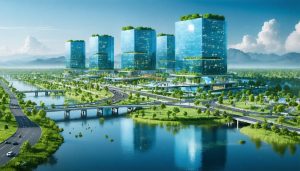
Conceptual illustration of a futuristic smart city demonstrating interconnected green spaces, modular buildings, and smart grids, highlighting circular economy principles.

How Smart Cities Are Revolutionizing Urban Design Through Circular Economy

Urban planners worldwide are revolutionizing city development through circular economy in urban construction, delivering measurable environmental and economic benefits. Advanced modeling software now enables precise carbon footprint calculations for entire districts, while integrated green infrastructure systems reduce energy consumption by up to 40% compared to traditional urban designs. Leading municipalities have demonstrated that implementing bio-based materials …

A conceptual illustration depicting the fusion of structural architecture with interior design, featuring digital blueprints and eco-friendly materials to symbolize innovative and sustainable design practices.

Interior Design and Architecture Degrees: What Top Firms Really Want From Graduates

Transform your career trajectory by mastering the intricate interior design and architecture boundaries through a comprehensive dual degree program that combines creative vision with technical expertise. Professional certification in both disciplines has become increasingly vital as modern building projects demand integrated solutions that seamlessly merge spatial planning with structural innovation.
Leading architecture firms now specifically seek professionals with dual …

Illustration of a modern construction site featuring diverse individuals collaborating on inclusive design elements like ramps, multilingual signage, and flexible workspaces, showcasing physical, cognitive, cultural, and socioeconomic diversity.

How Smart Design Bridges These 4 Critical Diversity Gaps in Modern Construction

Diversity in construction extends far beyond traditional demographics, fundamentally shaping how we design, build, and operate modern spaces. Four distinct dimensions – physical, cognitive, cultural, and socioeconomic diversity – create the framework for truly inclusive built environments. Physical diversity addresses mobility, sensory capabilities, and age-related needs, demanding thoughtful consideration in everything from entrance designs to workspace layouts. Cognitive diversity encompasses varying learning styles, information processing patterns, and neurological differences, directly influencing wayfinding systems and …

Conceptual illustration of a construction site protected by a large shield, representing comprehensive risk management strategies with elements such as cranes, safety gear, financial charts, and a calendar.

Risk-Proof Your Construction Project: Battle-Tested Strategies That Actually Work

Construction risk management demands a methodical, comprehensive approach that directly impacts project success and bottom-line profitability. Developing a bulletproof risk management plan requires systematic identification, quantification, and mitigation of potential threats across all project phases.
Recent industry data reveals that 70% of construction projects exceed budgets and timelines due to inadequate risk assessment, while properly managed projects demonstrate 25% higher completion …

Conceptual illustration of a modern smart home with advanced thermal energy management systems, highlighting thermal energy flows and IoT connectivity between systems.

Smart Homes Get Smarter: How Thermal Energy Systems Are Revolutionizing Residential Efficiency

Thermal energy applications represent a transformative force in modern construction, driving unprecedented advances in smart building energy management and sustainable architecture. By harnessing the fundamental principles of heat transfer and thermal storage, today’s construction professionals are revolutionizing how buildings interact with their environment and manage energy resources. From advanced heat pump systems that achieve coefficients of performance exceeding 4.0 to innovative …