
Conceptual illustration of a smart grid network with interconnected digital lines, renewable energy sources like solar panels and wind turbines, and AI analytics, representing the innovative integration in AI-powered energy trading systems.

AI-Powered Energy Trading: How Automated Systems Are Revolutionizing Smart Grids

Automated energy systems are revolutionizing how modern buildings interact with smart grid technology, delivering unprecedented control over energy consumption and operational efficiency. These intelligent systems integrate advanced sensors, machine learning algorithms, and real-time data analytics to optimize energy usage across commercial and industrial facilities. By automatically adjusting HVAC operations, lighting systems, and power distribution based on occupancy patterns and environmental conditions, these systems …

Conceptual illustration depicting a modern energy-efficient skyscraper integrating solar panels, geothermal loops, and smart HVAC systems, symbolizing the transformation of building efficiency through renewable technologies.

Renewable HVAC Systems Are Transforming Modern Building Efficiency

Revolutionizing modern building efficiency, smart HVAC energy management systems integrated with renewable energy sources are transforming how we approach commercial and industrial climate control. By combining solar thermal collectors, geothermal heat pumps, and energy recovery ventilation systems, buildings can reduce operational costs by up to 60% while maintaining optimal comfort levels. The convergence of renewable technologies with traditional HVAC infrastructure presents …

A large-scale 3D printer extrudes concrete to build the walls of a modern house on a construction site, showcasing innovative building technology with workers supervising the process for precision.

3D Printed Houses: Real Construction Costs Revealed in 2024

3D-printed house construction slashes building costs by 20-50% compared to traditional methods, revolutionizing affordable housing solutions worldwide. As the 3D printed building revolution gains momentum, construction firms report average costs between $280-340 per square foot, with material expenses representing just 30% of total project budgets.
Industry analysis reveals compelling economics: a 1,500-square-foot 3D-printed home typically costs $140,000-180,000 to complete, …

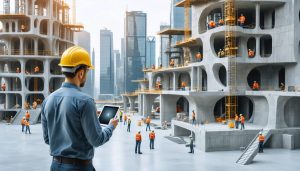
A futuristic cityscape with large-scale 3D printers constructing buildings with complex geometries. Workers are remotely monitoring the construction process, showcasing the innovative impact of 3D printing in modern construction.

3D Printing Transforms Construction: Game-Changing Benefits Reshaping Project Delivery

3D printing technology is revolutionizing the future of construction technology, fundamentally transforming how we design, build, and deliver construction projects. This advanced manufacturing method enables construction companies to reduce project timelines by up to 70% while cutting labor costs by 50-80% compared to traditional building methods. By depositing materials layer by layer with precision automation, 3D printing eliminates many of the inefficiencies and limitations inherent in …

Conceptual visualization of a construction site with quantum and nanotechnology innovations, showing how quantum dots and nanoscale particles enhance building materials.

Quantum-Enhanced Building Materials Are Revolutionizing Modern Construction

Quantum mechanics and nanotechnology are revolutionizing construction materials at the molecular level, enabling unprecedented advances in structural strength, energy efficiency, and material performance. By manipulating matter at the nanoscale (1-100 nanometers), engineers can now develop self-healing concrete, ultra-lightweight composites, and smart sensors that monitor structural integrity in real-time. These breakthrough applications leverage quantum effects – including electron tunneling, superposition, and quantum coherence – to create materials with properties previously thought impossible.
For construction …

Conceptual depiction of a modern home protected by a transparent shield, symbolizing climate resilience and sustainable building design. Elements such as enhanced insulation, solar panels, and structural connections are visible in the design.

2018 Building Codes Transform Homes for Climate Resilience

The 2018 International Residential Code (IRC) marks a pivotal shift in how the construction industry addresses climate resilience and energy efficiency in residential buildings. These comprehensive updates, affecting over 90% of U.S. residential construction projects, introduce stringent requirements for building envelope performance, structural integrity, and sustainable design practices. For construction professionals navigating these changes, understanding the code’s enhanced provisions for hurricane-resistant construction, energy-efficient building systems, and wildfire mitigation becomes critically important.
The revised …

Conceptual illustration depicting the transformation of construction project management utilizing blockchain technology; showing digital overlays of data blocks, nodes, and smart contracts interacting with a construction site.

Decentralized Blockchain Platforms Are Transforming Construction Project Management

Revolutionizing construction project delivery, decentralized blockchain platforms are transforming how industry stakeholders collaborate, verify, and execute complex building initiatives. These distributed ledger systems eliminate traditional intermediaries, creating an immutable record of transactions, contracts, and project milestones that enhances transparency and reduces disputes. Blockchain applications in construction have demonstrated up to 25% reduction in administrative costs …

A vibrant urban environment featuring people of diverse ages and abilities interacting with accessible architectural elements such as ramps, tactile paths, and wayfinding signs, illustrating the essence of inclusive design.

Building Beyond Barriers: Real-World Inclusive Design Solutions That Work

Designing for diverse populations demands a fundamental shift in how we approach modern construction and architectural solutions. Today’s built environment must seamlessly accommodate a rich tapestry of users, from varying age groups and physical abilities to distinct cultural backgrounds and socioeconomic circumstances. Through innovative inclusive design patterns, construction professionals are reimagining spaces that serve multiple demographics simultaneously.
Recent …

Conceptual illustration of a modern skyscraper showcasing smart glass technology, with windows shifting from clear to tinted states, highlighting energy efficiency and advanced architectural integration.

Smart Glass Technology Revolutionizes Modern Construction Safety and Efficiency

Revolutionary smart glass technology is transforming modern construction, offering unprecedented control over light transmission, energy efficiency, and occupant comfort. J smart glass, an advanced electrochromic glazing solution, stands at the forefront of this architectural innovation, enabling buildings to dynamically respond to environmental conditions while reducing HVAC costs by up to 20%.
Integrating semiconducting metal oxides and nano-layered materials, J smart glass transitions between transparent and tinted states within minutes, triggered by low-voltage electrical currents. This sophisticated system eliminates the need …

A diverse group of construction professionals, including engineers and architects, collaborating over architectural plans at an active job site.

Building Better Teams: How Collaborative Norms Transform Construction Innovation

In today’s high-stakes construction environment, the 7 Norms of Collaboration represent a transformative framework that consistently delivers 25-35% higher project efficiency rates. Leading construction firms worldwide have integrated these proven protocols to revolutionize their team dynamics and project outcomes. From Manhattan’s latest skyscrapers to complex infrastructure developments across Europe and Asia, these norms have become the cornerstone of successful collaborative construction management.
These structured communication principles – Pausing, Paraphrasing, Posing Questions, Putting Ideas on the Table, …