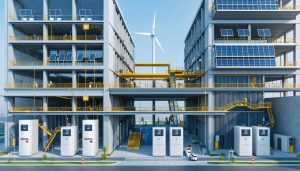

Conceptual illustration of a modern construction site featuring advanced power storage solutions, including battery units, solar panels, and wind turbines, highlighting energy integration and sustainability.

Power Storage Solutions Revolutionizing Modern Construction Projects

Power storage solutions have become the cornerstone of modern construction, fundamentally transforming how buildings manage and distribute energy. As construction costs soar and environmental regulations tighten, innovative smart energy systems are revolutionizing project economics and operational efficiency. Advanced battery technologies, from lithium-ion installations to emerging solid-state solutions, now enable construction professionals to …

Conceptual illustration of a futuristic smart city demonstrating interconnected green spaces, modular buildings, and smart grids, highlighting circular economy principles.

How Smart Cities Are Revolutionizing Urban Design Through Circular Economy

Urban planners worldwide are revolutionizing city development through circular economy in urban construction, delivering measurable environmental and economic benefits. Advanced modeling software now enables precise carbon footprint calculations for entire districts, while integrated green infrastructure systems reduce energy consumption by up to 40% compared to traditional urban designs. Leading municipalities have demonstrated that implementing bio-based materials …

Conceptual illustration of a futuristic smart building with AI-driven energy management systems and IoT integration, emphasizing advanced data-driven energy optimization and sustainability.

Zenergy Building Tech Revolutionizes Smart Construction Energy Management

In the race toward net-zero construction, smart energy systems have found their ultimate expression in Zenergy Building Technologies. This revolutionary framework integrates advanced AI-driven control systems, predictive energy management, and responsive building automation to create structures that actively optimize their own performance. By combining real-time data analytics with adaptive building mechanics, Zenergy technologies reduce operational …

Illustration depicting concrete degradation processes through chemical, physical, and biological factors, along with sustainable innovations like biodegradable and recyclable concrete solutions.

The Truth About Concrete’s Biodegradability: What Construction Professionals Need to Know

In the evolving landscape of sustainable construction, concrete’s environmental impact remains a critical concern for industry professionals. While concrete doesn’t biodegrade in the conventional sense, its interaction with environmental factors presents complex challenges for long-term infrastructure planning and environmental compliance. The calcium-silicate-hydrate (C-S-H) bonds that give concrete its legendary durability also make it resistant to natural decomposition processes, persisting in the environment for centuries. However, concrete does undergo gradual deterioration through carbonation, chemical attack, and …

A dynamic view of Copenhagen featuring green roofs, solar panels, and bike lanes, illustrating the city’s groundbreaking urban loop and circular economy approach.

Copenhagen’s Groundbreaking Urban Loop Project Redefines Circular City Design

Copenhagen’s transformation into a carbon-neutral metropolis showcases how cities can tackle complex urban sustainability challenges through systematic innovation. The city’s comprehensive circular economy initiative has reduced carbon emissions by 42% since 2005 while maintaining economic growth – setting a new benchmark for sustainable urban development worldwide.
This achievement stems from three interconnected strategies: implementing district-wide heating …

Illustration depicting a modern construction site with electric vehicles connected to smart charging stations, showing energy flow between the vehicles and the power grid, symbolizing vehicle-grid integration.

Vehicle-Grid Integration: The Future of Construction Site Power Management

Vehicle-grid integration (VGI) stands at the forefront of construction site electrification, transforming how the industry manages power distribution and sustainability. By connecting electric vehicles (EVs) to the power grid, construction companies can create bidirectional energy flow systems that optimize power consumption, reduce operational costs, and enhance grid stability during peak demand periods.
This revolutionary approach enables construction sites to utilize EV batteries as mobile power storage units, providing emergency backup power during outages and supplementing grid capacity during high-demand construction …

Diverse group of construction stakeholders, including architects, contractors, and community representatives, collaborating in a conference room with blueprints and digital devices displaying a construction site.

How Smart Stakeholder Engagement Drives Construction Project Success

Transform stakeholder management from a project challenge into a strategic advantage by implementing a systematic, data-driven engagement framework. Modern construction projects demand sophisticated approaches to navigate complex stakeholder relationships, with research showing that projects achieving the highest benefits of effective stakeholder engagement secure 23% higher completion rates and 30% better budget adherence.
Map stakeholder influence through digital …

A futuristic construction site featuring AI-powered analytics dashboards overlayed on smart construction equipment, showcasing optimized energy consumption and resource utilization in a sustainable environment.

AI-Powered Analytics Are Revolutionizing Sustainable Construction

Data science is revolutionizing the path to sustainable construction, transforming how we design, build, and operate our built environment. By harnessing the power of advanced analytics and machine learning, construction professionals can now predict energy consumption patterns, optimize resource utilization, and minimize environmental impact with unprecedented precision.
The convergence of data science and sustainability represents a critical turning point for the construction industry. Real-time sensors, IoT devices, and sophisticated modeling algorithms are enabling projects to achieve up to 30% reduction in energy consumption …

Futuristic construction site displaying sustainable materials, digital twin technology, and solar-powered equipment, highlighting decarbonization strategies in the building industry.

Carbon-Smart Construction: Proven Decarbonization Strategies That Actually Work

Decarbonization stands as the construction industry’s most pressing challenge, with buildings accounting for nearly 40% of global carbon emissions. Leading construction firms are revolutionizing their approaches through three critical pathways: materials innovation, process optimization, and operational efficiency. By implementing science-based targets and embracing circular economy principles, the sector can achieve up to 50% emissions reduction by 2030.
The transformation toward carbon-neutral construction demands immediate action across the entire building lifecycle. From specifying low-carbon concrete alternatives to …

Conceptual image of a city skyline represented in a circular pattern, featuring construction materials and arrows to illustrate the continuous flow and regenerative nature of the circular economy in urban development.

How Circular Economy Models Are Revolutionizing Urban Construction

In an era where resource scarcity meets environmental urgency, the circular economy business model emerges as a transformative force reshaping the construction industry’s future. This regenerative approach challenges traditional linear “take-make-dispose” practices, offering construction professionals a framework to create sustainable value while minimizing waste and maximizing resource efficiency.
Leading construction firms worldwide are revolutionizing their operations by implementing closed-loop systems, where materials, components, and resources maintain their highest utility throughout the project lifecycle. …