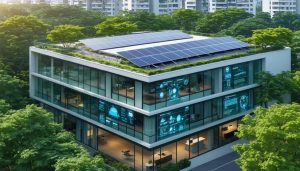

Modern office building showcasing solar panels, energy management displays, and green landscaping, representing sustainability principles in property management.

These 6 Sustainability Principles Transform Property Management (With Real Results)

In today’s high-stakes property management landscape, implementing robust sustainability principles isn’t just environmental stewardship—it’s a strategic imperative where sustainability drives profit and performance across the entire asset lifecycle. The six foundational principles of sustainability represent a comprehensive framework that transforms conventional building operations into resource-efficient, future-ready assets.
These principles—resource optimization…

Conceptual illustration depicting the GICS framework transforming construction events with interconnected gears and construction icons representing industry groups and technology integration.

How GICS Industry Groups Transform Construction Event Planning

Transform your construction industry events with GICS (Global Industry Classification Standard) classifications to create targeted, high-impact networking opportunities. This standardized framework, trusted by leading industry associations, segments the market into 11 sectors, 24 industry groups, and numerous sub-industries, enabling precise attendee categorization and strategic event planning.
For construction professionals, GICS classifications provide essential structure for organizing …

Digital illustration showing the transition from traditional power grids to advanced smart grid systems in a construction setting, featuring solar panels, wind turbines, and data analytics.

Smart Grid Technology Revolutionizes Construction Energy Management

Smart grid technology is revolutionizing the construction industry’s approach to energy management, offering unprecedented control over power distribution, consumption, and efficiency. This intelligent network infrastructure combines advanced sensors, automated controls, and data analytics to create a responsive, self-healing power delivery system that adapts in real-time to changing energy demands and conditions.
For construction professionals and project stakeholders, smart grid implementation represents a critical advancement in building infrastructure development. By integrating renewable energy sources, optimizing load …

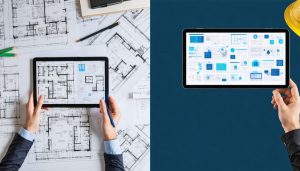
A split-screen image showing the contrast between traditional paper blueprints and modern digital construction plans displayed on a tablet, highlighting the evolution in construction communication.

Digital Construction Platforms Are Transforming Project Communication (Here’s How)

Digital communication platforms have revolutionized how construction teams collaborate, driving unprecedented efficiency and transparency across projects. As digital transformation in construction accelerates, these platforms have become indispensable tools for managing complex workflows and diverse stakeholder interactions.
Modern construction projects generate thousands of daily communications—from RFIs and submittals to change orders and progress updates. Traditional methods of …

A conceptual image showing a split-screen comparison; on the left, traditional building energy controls, and on the right, a modern AI interface representing efficient energy management.

AI-Powered Building Energy Systems Cut Costs by 30% While Boosting Efficiency

In today’s high-stakes energy landscape, AI-based energy management systems (EMS) are revolutionizing how buildings consume and optimize power resources. These intelligent systems leverage machine learning algorithms and real-time data analytics to reduce energy costs by 15-30% while maintaining optimal occupant comfort. By integrating thousands of IoT sensors, weather forecasts, and historical usage patterns, modern AI-powered EMS platforms automatically adjust HVAC systems, lighting controls, and power distribution networks with unprecedented precision. For construction professionals and facility managers, implementing AI-based …

Conceptual depiction of wind energy construction showcasing blueprints and digital schematics over a landscape with wind turbines being constructed, emphasizing project management.

Wind Energy Construction: How Smart Project Management Slashes Costs and Timelines

Wind energy construction represents one of the fastest-growing sectors in renewable energy construction, with global capacity expanding by 93 GW in 2023 alone. This surge demands precise engineering, substantial capital investment, and sophisticated project management expertise to execute successfully.
Modern wind farm construction encompasses far more than turbine installation – it requires comprehensive site analysis, advanced foundation engineering, and intricate logistics …

Futuristic cityscape with a modern high-rise building showcasing digital twin technology. Transparent layers reveal digital data streams and IoT sensors over the building, set against an urban backdrop with smart infrastructure elements.

Digital Twins Transform Smart Buildings: Real-World Impact and ROI

Digital twin technology is revolutionizing urban development, creating virtual replicas of cities that transform how we plan, build, and manage urban infrastructure. As digital twins in construction become increasingly sophisticated, smart cities are leveraging this technology to optimize operations, enhance sustainability, and improve citizen services in real-time.
By combining IoT sensors, AI-driven analytics, and advanced 3D modeling, digital twin smart cities create living, …

A high-tech construction site with smart waste bins, IoT sensors, and automated sorting machines showcasing advanced waste management technology in an urban setting.

Smart Waste Innovation Revolutionizes Construction Site Management

Revolutionary waste management technologies are transforming how cities handle their municipal waste streams, with construction and demolition materials representing over 40% of global urban waste volume. Leading municipalities have achieved remarkable success through zero waste initiatives that integrate artificial intelligence, blockchain tracking, and advanced materials recovery facilities (MRFs).
Smart waste bins equipped with IoT sensors now optimize collection routes in …

Split image showing a commercial construction site installing a ground source heat pump on one side and a residential home with an air-source heat pump on the other, symbolizing the application of renewable heating technologies in both domestic and non-domestic settings.

Renewable Heat Incentives: How UK Construction Firms Can Maximize Returns

Renewable Heat Incentives (RHI) represent a transformative shift in how the construction industry approaches sustainable building design and energy efficiency. As renewable energy policies continue to reshape industry standards, these financial mechanisms offer construction professionals unprecedented opportunities to integrate clean heating technologies while maintaining robust return on investment. For building developers and project managers, RHI programs provide substantial financial support—often …

Digital illustration of a modern construction site showcasing connected elements symbolizing data flow and cybersecurity, with icons highlighting security measures.

Construction Site Data Breaches Cost Millions: Your Security Blueprint for 2024

Digital threats to construction operations have evolved from minor inconveniences to potentially devastating attacks that can halt multimillion-dollar projects instantly. As construction sites increasingly rely on connected devices, Building Information Modeling (BIM), and integrated project management systems, cybersecurity has become as crucial as physical security measures. Recent attacks targeting construction firms have resulted in compromised project data, stolen intellectual property, and ransomware incidents costing the industry over $5.2 billion in 2022 alone.
Modern construction projects depend on a complex digital …