
Conceptual depiction of a futuristic cityscape featuring buildings with integrated quantum energy storage systems, showcasing glowing quantum dots capturing and distributing energy.

Quantum Energy Storage: The Future of Construction Power Management Is Already Here

Quantum energy storage stands poised to revolutionize modern construction through breakthrough power storage solutions that operate at the atomic level. By harnessing quantum mechanical principles, this emergent technology enables construction projects to store and distribute energy with unprecedented efficiency, reducing operational costs by up to 40% compared to conventional systems. The integration of quantum storage systems into building infrastructure …

Illustration of a modern smart building with integrated building automation systems, showcasing connections between HVAC, lighting, and security controls, symbolizing energy efficiency and digital innovation.

Smart Building Controls That Actually Save You Money (With Real ROI Data)

Building automation control systems are revolutionizing modern facility management, delivering energy cost savings of up to 40% while enhancing occupant comfort and operational efficiency. These intelligent systems integrate HVAC, lighting, security, and environmental controls into a unified network, enabling real-time monitoring and automated response protocols across entire building portfolios.
As the cornerstone of smart building technology, modern…

Visualization of a modern skyscraper with innovative resilient technologies, including adaptive facades and integrated green spaces, against a vibrant cityscape.

Construction Resilience: How Modern Buildings Are Engineered to Survive Anything

In an era of intensifying climate challenges and evolving project demands, resilient technology in construction has become fundamental to building success. The construction industry faces unprecedented pressures – from extreme weather events and resource scarcity to rapid technological advancement and shifting regulatory landscapes. Modern construction resilience transcends traditional building practices, encompassing adaptive design strategies, innovative materials, and intelligent …

Conceptual illustration of a smart building using Z-Wave technology, showing interconnected devices and signal paths that form a robust mesh network for automation and control.

Z-Wave Technology: The Backbone of Modern Smart Building Control

Z-Wave technology stands at the forefront of smart building automation, transforming how commercial facilities operate and communicate. This wireless communication protocol enables seamless integration of devices, from lighting and HVAC systems to access controls and security equipment, creating a robust mesh network that strengthens with each added component.
Unlike traditional building automation systems, Z-Wave operates on a low-power, sub-gigahertz frequency band (908.42 MHz in North …

Conceptual illustration of a modern construction site using digital tools like BIM models, mobile devices, and IoT sensors to enhance efficiency and collaboration.

Digital Construction Tools That Actually Save Time and Money

Digital construction tools are revolutionizing project delivery across the architecture, engineering, and construction (AEC) industry, driving unprecedented improvements in efficiency, accuracy, and collaboration. From Building Information Modeling (BIM) platforms that enable real-time 3D visualization to cloud-based project management solutions that streamline workflows, these technologies are transforming traditional construction processes into data-driven operations. Industry leaders leveraging these digital tools report up to 40% reduction in project delays and a 35% decrease in documentation errors.
The integration of mobile …

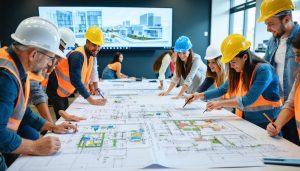
"Diverse group of community members and professionals collaborating over construction designs through blueprints and 3D models in an engaging environment."

Participatory Design: How Construction Projects Thrive Through Community Collaboration

Participatory design revolutionizes construction projects by directly engaging end-users, stakeholders, and community members in the planning and decision-making process. This collaborative approach, emerging from Scandinavian workplace democracy movements in the 1970s, transforms traditional top-down design methodologies into inclusive, user-centered solutions that deliver measurable results. In today’s complex building environment, where stakeholder expectations and project requirements continuously evolve, participatory design offers construction professionals a structured framework to capture diverse perspectives, minimize costly…

A futuristic cityscape showcasing modern infrastructure with integrated HVAC systems, renewable energy sources, and smart technology interfaces, emphasizing sustainable and climate-resilient construction practices.

How New HVAC Building Codes Are Reshaping Climate-Resilient Construction

HVAC building codes represent the critical intersection of engineering precision, public safety, and environmental responsibility in modern construction. As climate change intensifies and energy efficiency becomes paramount, these regulations have evolved from simple ventilation requirements into comprehensive frameworks that shape the future of sustainable building design.
Recent updates to international building codes mandate up to 30% higher energy efficiency standards for HVAC systems, while introducing stringent requirements for smart building controls and renewable energy integration. These changes directly impact how …

Futuristic industrial scene illustrating the concept of predictive maintenance with digital data streams processing equipment performance metrics.

How Predictive Maintenance is Revolutionizing Modern Energy Management

Predictive maintenance revolutionizes how industries prevent equipment failures and optimize operational efficiency through advanced analytics and real-time monitoring. By leveraging sophisticated energy management systems and sensor networks, this proactive approach detects potential issues before they escalate into costly breakdowns. Unlike traditional maintenance schedules, predictive maintenance employs machine learning algorithms and IoT sensors to analyze equipment performance patterns, …

A conceptual image depicting a quality control robot on a construction site, utilizing advanced sensors and AI to inspect building structures, symbolizing the technological revolution in construction accuracy.

Quality Control Robots Are Revolutionizing Construction Accuracy

Quality control robots are revolutionizing construction site inspection processes, emerging as one of the most transformative construction innovations of the past decade. These autonomous systems, equipped with advanced sensors and machine learning capabilities, are reducing inspection times by up to 90% while achieving unprecedented accuracy rates of 99.9% in defect detection.
Unlike traditional manual inspection methods, which typically sample only 10-15% of materials and components, robotic …

Construction site workers using advanced technology for real-time carbon tracking, showcasing digital data overlay on building sustainability efforts.

Carbon Tracking in Construction: Smart Solutions That Actually Drive Results

Carbon tracking has become the cornerstone of modern construction sustainability, driving measurable reductions in environmental impact while delivering significant cost savings across building lifecycles. Implementation of proven decarbonization strategies now enables construction firms to quantify, monitor, and optimize their emissions with unprecedented precision. As regulatory requirements tighten and stakeholder expectations evolve, sophisticated carbon tracking systems …